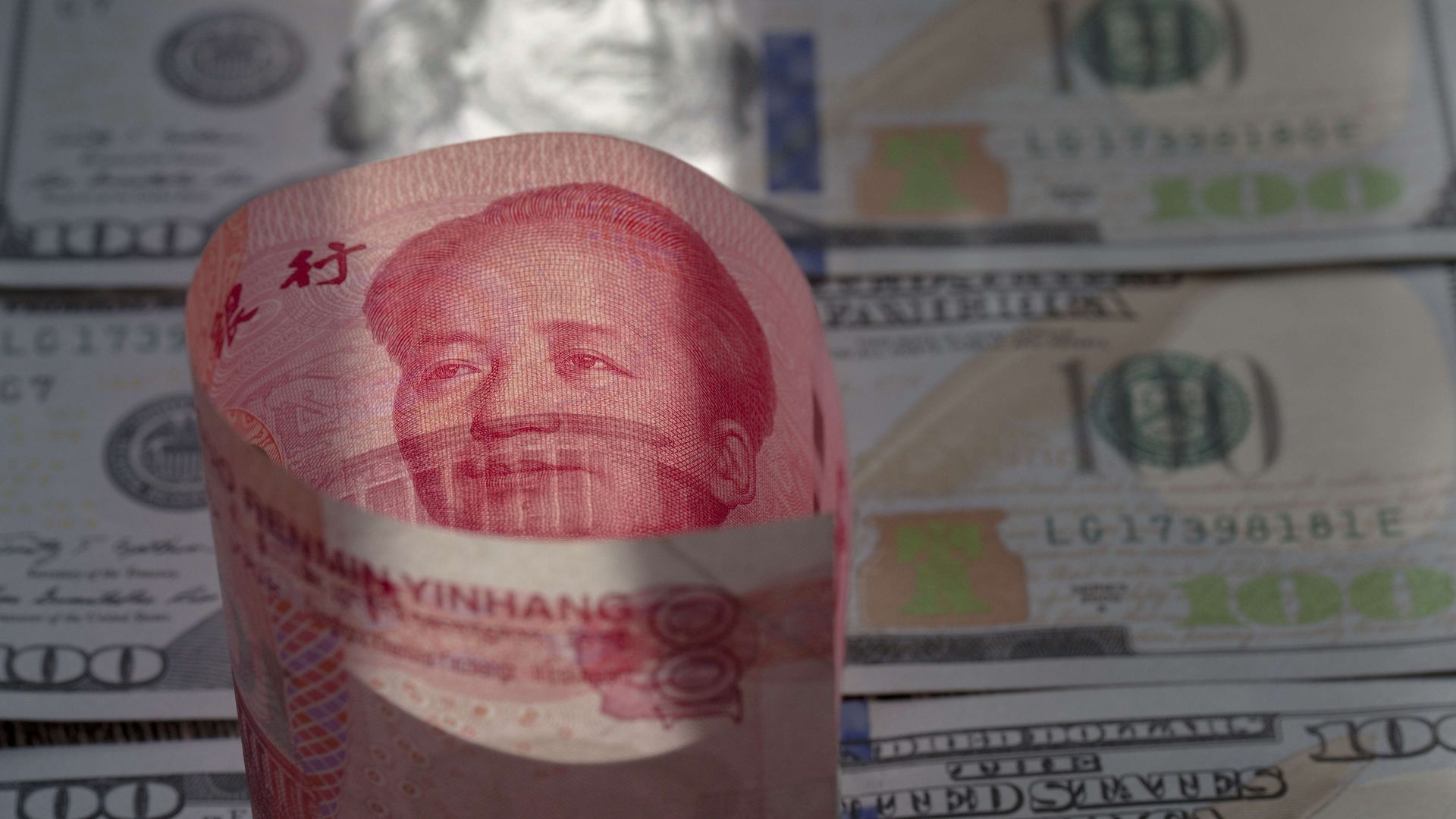
U.S. Treasury Secretary Steven Mnuchin on Monday night declared China to be a currency manipulator, just hours after the Chinese government allowed the yuan to slip below a 7-to-1 dollar ratio for the first time in over a decade.
Why it matters: This is a further ratcheting up of trade tensions between the two countries, and also marks the first time any U.S. president has used the currency manipulator label since 1994.
Cesar Sayoc, 57, was sentenced Monday to 20 years in prison for sending explosives to prominent Democrats and critics of President Trump, according to the Washington Post.
Catch up quick: Sayoc, who pled guilty to the crime, sent 16 pipe bombs to people that included Hillary Clinton, Barack Obama, George Soros and others, just days before the 2018 midterm elections. He had been working as a pizza delivery man and strip club staffer a the time, telling U.S. District Judge Jed Rakoff: "Now that I am a sober man, I know that I was a sick man."
Wall Street had its worst day of the year on Monday, with the Dow Jones Industrial Average sinking 766 points, the S&P 500 down 2.98%, and the Nasdaq Composite down 3.47%.
Data: FactSet; Chart: Axios Visuals
What's happening: Equity declines in the U.S., as well as the plunge in Treasury yields, reflect fears that President Trump's trade war with China is escalating.
GateHouse Media and Gannett, the 2 largest newspaper chains in the U.S., officially announced a merger on Monday.
Why it matters: The combination of the two publishing powerhouses means that a single company would own 1 in every 6 newspapers in the United States, as Axios reported last month.
The Chinese yuan was allowed to weaken past 7-to-1 against the dollar for the first time ever in offshore markets and the first time in more than 10 years in its onshore market.
What it means: The move is seen as a response to President Trump's threat on Thursday to add 10% tariffs to $300 billion of Chinese imports. Wall Street extended its multi-day sell-off after the news: the Dow is down more than 500 points, while the S&P 500 and the Nasdaq are off as much as 2% early on Monday. Meantime, the yield on the U.S. 10-year note fell to multi-year lows.
SmartNews, the Japanese news discovery app that has amassed 20 million global monthly active users, has raised $28 million in its latest funding round, bringing the company's valuation to $1.1 billion, executives tell Axios.
Why it matters: It's notable that in today's bleak news market where U.S. tech giants like Google and Facebook dominate most news referral traffic online, a Japanese-based firm has been able to gain traction. SmartNews is one of the few news-related startups to achieve "unicorn" status, or a valuation of over $1 billion, in years.
American incomes have barely changed over the past 20 years on an inflation-adjusted basis, and that's due in large part to the exploding costs of health coverage.
The big picture: More people are plunging deeper into debt as the costs of housing, college and consumer goods greatly outgrow their paychecks. And those paychecks have been stagnant because employers are shoveling more money toward workers' health insurance.






/2019/08/05/1565007424469.gif?w=3840)