Top U.S. general says it will take time to achieve Iran war goals

Add Axios as your preferred source to
see more of our stories on Google.
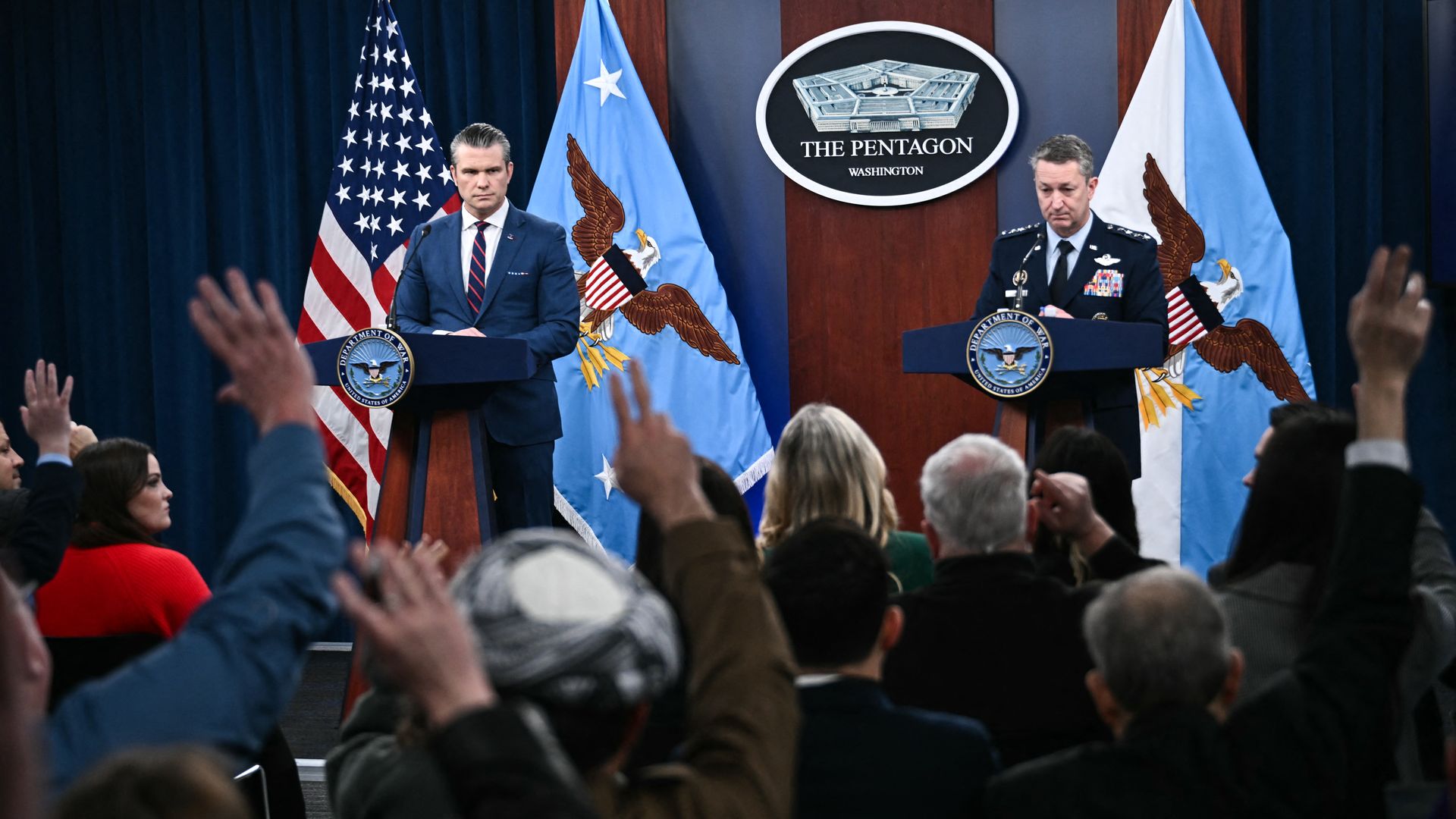
Defense Secretary Pete Hegseth and Joint Chiefs of Staff Chairman Gen. Dan Caine take questions from reporters at the Pentagon. Photo: Brendan Smialowski/AFP via Getty Images
The U.S. military operation against Iran, dubbed "Epic Fury," will not end "overnight," Secretary of Defense Pete Hegseth and Joint Chiefs of Staff Chairman Gen. Dan Caine said at a Pentagon press conference Monday.
- The top officials declined to offer a specific timetable for the historic joint bombing campaign with Israel.
Why it matters: The briefing marked the first time senior Trump administration officials publicly described the ongoing combat operations and took questions from reporters since the fighting began Saturday.
What they are saying: "To be clear ... this is not a single overnight operation," Caine said. "The military objectives CENTCOM and the Joint Force have been tasked with will take some time to achieve, and in some cases will be difficult and gritty work."
- "We expect to take additional losses, and as always, we will work to minimize U.S. losses," the top U.S. general added, following the deaths of four U.S. service members.
What to watch: President Trump said in interviews Sunday that the war could last about four weeks. Hegseth declined to elaborate, saying he would "never hang a time frame" on the operation.
- "President Trump has all the latitude in the world to talk about how long it may or may not take — four weeks, two weeks, six weeks. It could move up. It could move back," Hegseth said.
- But in his opening remarks, Hegseth sought to draw a contrast with past Middle East interventions in Iraq and Afghanistan, stressing that the operation will not be an "an endless war."
The big picture: Hegseth claimed that the goal of the operation is not "regime change" in Iran — but expressed satisfaction that the Iranian regime "has changed" as a result of the assassination of Supreme Leader Ali Khamenei by Israel.
- He said the main objective is to "prevent Iran from the ability to project power outside of its borders" by eliminating its ballistic missile capability, degrading its navy and destroying "other security infrastructure."
- Hegseth also stressed that preventing Iran from ever obtaining a nuclear weapon remains a core goal. "These are not utopian goals ... We will finish this on 'America First' conditions," he said.
Behind the scenes: Caine provided reporters with the first detailed account of how the war began, revealing Trump gave the final go-ahead Friday afternoon at 3:38 p.m. ET.
- "The President directed, and I quote, 'Operation Epic Fury is approved. No aborts. Good luck. Close, close.' End quote," Caine said.
- He said Trump's order gave U.S. forces in the region the green light to make final preparations for both defensive and offensive operations.
Caine said maintaining the element of surprise was critical and that the operation was highly classified.
- Ahead of the kinetic strikes, U.S. Cyber Command and the Space Force conducted cyber operations to disrupt and "blind Iran's ability to see, communicate and respond" when major combat operations began, Caine said.
- At 1:15 a.m. ET (9:45 a.m. in Tehran), the fighting started. Caine said the "trigger event" was an Israeli Defense Forces strike "enabled by the U.S. intelligence community."
Between the lines: He was referring to the Israeli strikes that eliminated dozens of senior Iranian political and military officials, including Khamenei.
- Shortly afterward, the U.S. launched its own strikes focused on targets in southern Iran. More than 100 U.S. military aircraft participated in the first wave, along with Tomahawk missiles launched from Navy ships.
- U.S. forces also fired missiles from ground-based platforms in the region.
- "This was a massive, overwhelming attack across all domains of warfare, striking more than 1,000 targets in the first 24 hours," Caine said.
State of play: Caine said that 57 hours into the operation, the focus of the U.S. military is on targeting Iranian command-and-control infrastructure, naval forces, ballistic missile sites and intelligence assets.
- "The combined impact of these strikes has resulted in the establishment of local air superiority. This air superiority will not only enhance the protection of our forces, but also allow them to continue operations over Iran," he said.
- Caine said additional forces, including fighter jets, are arriving in the region Monday.
He added that an investigation is underway into the three U.S. Air Force F-15s that were downed in Kuwait, saying they were not hit by enemy fire.
- Caine said four U.S. soldiers killed in the fighting were stationed at a fortified tactical operations center that sustained significant damage from an Iranian missile.
- Hegseth said there are currently no U.S. troops on the ground in Iran, but declined to "go into the exercise of what we will or will not do" in the future.
This story is breaking news. Please check back for updates.
