How Oct. 7 changed everything

Add Axios as your preferred source to
see more of our stories on Google.
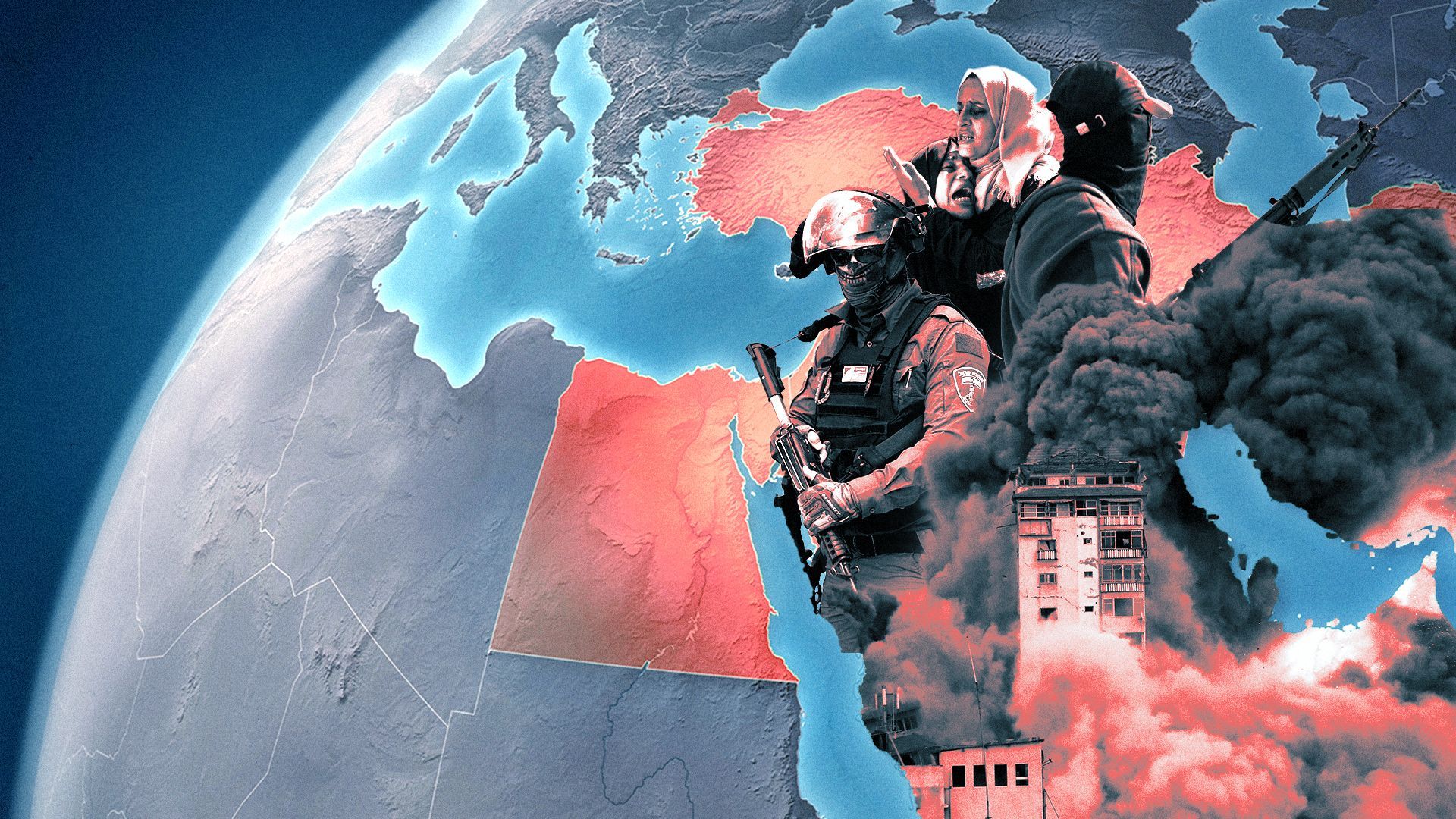
Photo illustration: Lindsey Bailey/Axios. Photos: Anadolu, Ahmad Gharabli via Getty Images
The Oct. 7 Hamas terrorist attacks unleashed a year of unthinkable violence in Israel, Gaza and across the Middle East.
- The arrival of a full-blown regional war now threatens the lives of millions more people.
The big picture: One year after the largest massacre of Jews since the Holocaust, the bloodshed continues with no end in sight. Israel could soon be fighting the longest war in its 76-year history.
- The Hamas surprise attack on Oct. 7, which killed 1,200 Israelis and led to the kidnapping of 250 more, was the worst security failure in Israel's history.
- Israel's retaliation led to the bloodiest war in Gaza's history — and the deadliest year for Palestinians since the Nakba in 1948, with more than 41,000 people killed.
Today, the fighting has spilled over from Gaza to Lebanon and at least six different fronts — upending the lives of tens of millions of people and triggering the region's biggest crisis since the Arab Spring in 2010.
What to watch: In the U.S., which continues to be Israel's most important ally and biggest supplier of arms, both Vice President Harris and former President Trump want the regional conflict to be over by Jan. 20.
- But whoever wins the Nov. 5 election is likely to inherit an expanding war in the Middle East.
- Whether it's Trump or Harris, the next president will have to make decisions on this issue on day one — and potentially even during the transition.
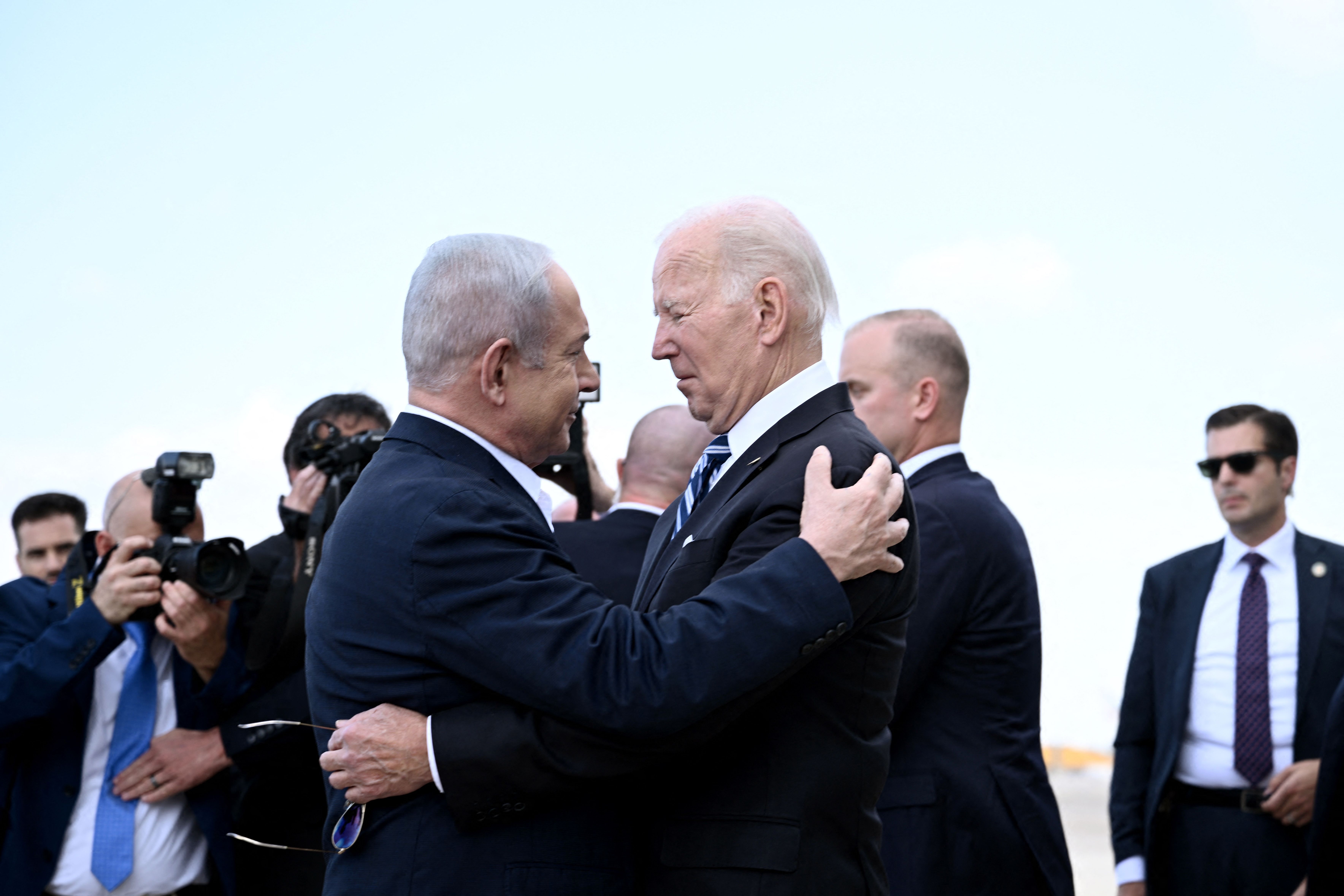
Behind the scenes: President Biden, who was personally involved in many of the war's turning points over the last year, had a clear goal after Oct. 7: prevent the crisis in Gaza from escalating to the entire region.
- In the first week of the war, Biden sent an unprecedented number of U.S. forces to the region to help defend Israel and deter Iran and Hezbollah from opening other fronts.
- Biden's message to Iran and its proxies — one that Harris also echoed — was simple: "Don't."
- In some ways, the message was also directed to the Israeli war cabinet — a warning not to repeat the mistakes the U.S. made in Afghanistan and Iraq after 9/11.
But as the war continued, Biden's deterrence of Iran and its proxies — and his influence over Israel's decisions — waned.
- While the White House consistently called for de-escalation, Israel's operations in Gaza escalated, the attacks on Israel increased and the war in the region gradually expanded.
How we got here: On Oct. 8, 2023, as Israel was still reeling from Hamas' terrorist rampage, Hezbollah opened up a second front by firing rockets from Lebanon.
- The cross-border conflict dramatically escalated last month, when Israel detonated hundreds of booby-trapped pagers and walkie-talkies carried by members of the Iranian-backed militia.
- Israel then began attacking top Hezbollah officials in targeted airstrikes, killing the group's leader, Hassan Nasrallah, on the same day Prime Minister Benjamin Netanyahu addressed the UN in New York.
- At least 2,000 people have been killed in Lebanon over the past year, including 127 children — most of which came in the last two weeks. On Sept. 30, Israel launched its first ground invasion of its northern neighbor since 2006.
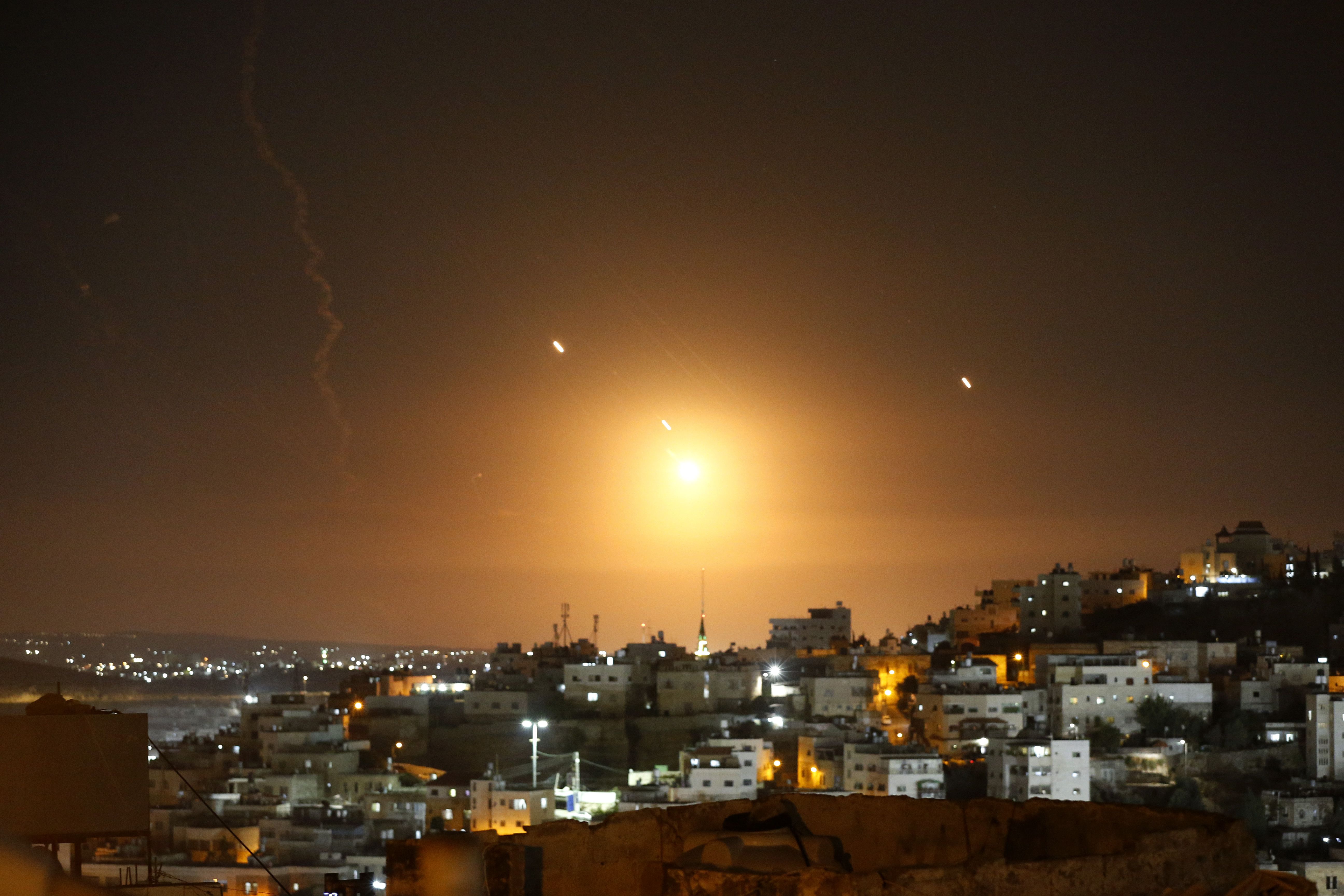
Elsewhere across the region, Iran and its proxies — including the Houthis in Yemen and militias in Iraq and Syria — have stepped up their attacks on Israel and U.S. assets over the past year.
- In April, Iran shattered a long-standing taboo by launching a direct attack on Israel — a barrage of drones, cruise missiles and ballistic missiles mostly targeting military infrastructure.
- Last week, in response to the assassinations of Nasrallah and Hamas leader Ismail Haniyeh in Tehran, Iran launched another massive ballistic missile attack on Israel.
- Both attacks were largely defeated by a coalition led by the U.S., but Israel is now preparing a massive response to Iran that could send the region into a deeper spiral of escalation.
In the Israeli-occupied West Bank, meanwhile, the security situation has significantly deteriorated in the year since Oct. 7.
- Attacks by Palestinian militants have surged, and the Israel Defense Forces have ramped up their raids — using drones and even fighter jets to conduct air strikes in the West Bank for the first time in two decades.
- The situation has been further exacerbated by growing violent attacks by Israeli settlers against Palestinian civilians, prompting unprecedented sanctions by the Biden administration.
State of play: While 100 hostages were released in a deal last November — and several have been rescued in Israeli military operations — at least a dozen have been murdered in Hamas captivity. Several were killed by IDF fire.
- 101 hostages are still held in Gaza, among them seven Americans and numerous other foreign nationals.
- Over the last six months, Biden has spent hundreds of hours pushing for a deal that would lead to a release of the hostages and a ceasefire that might end the war — the only solution, in his eyes, to calming the Middle East.
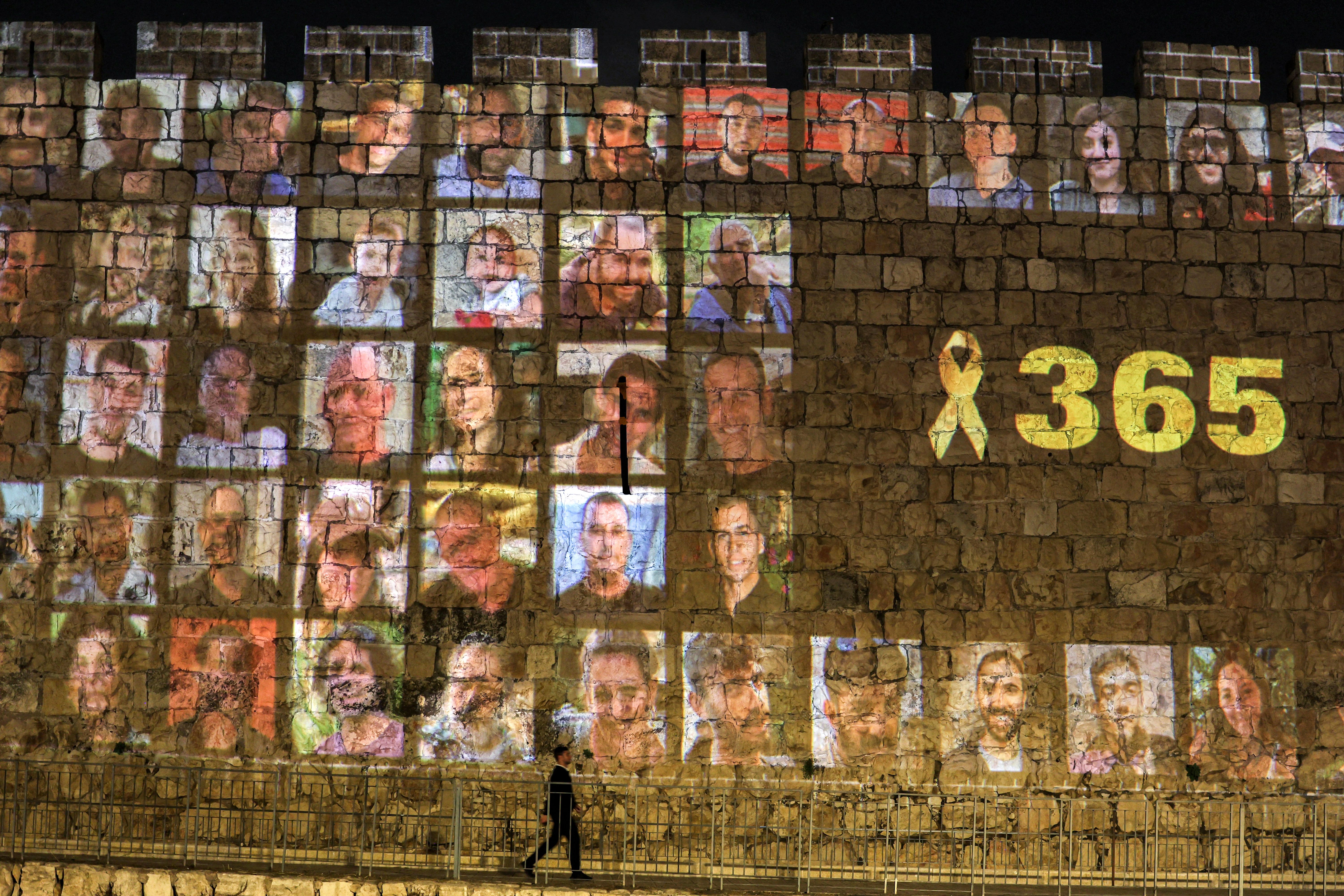
But negotiations are almost completely frozen, with Netanyahu and Hamas leader Yahya Sinwar refusing to allow concessions that would make such a deal possible.
- Biden built his entire strategy on the hostage and ceasefire deal — failing to develop any Plan B that could potentially halt the region's downward spiral.
- The hostage crisis is not likely to be solved before a new president enters the Oval Office.
Zoom out: From a security perspective, the Oct. 7 attack shook Israeli confidence in their military and intelligence community. But over the last year, Israel has bolstered its policy of deterrence by delivering unprecedented blows to Hamas, Hezbollah, the Houthis and other Iran-backed groups.
- The pro-Iranian "axis of resistance" has suffered massive damage and casualties, costing Iran proxy militant forces that it had spent years training to fight, weaken and deter Israel from attacking the Iranian nuclear program.
But while Israel has managed to recuperate militarily, its strategic situation is dire:
- The IDF is fighting on seven different fronts, with no end in sight.
- Israel is stuck fighting in Gaza with no exit strategy — a presence that looks more and more like perpetual occupation.
- The Israeli economy has taken huge damage that will take years to rebuild.
- Very few foreign airlines fly to Israel, and the port of Eilat has been shut down almost completely.
- Israel's diplomatic isolation is growing, and Israeli society is exhausted. A recent poll showed 23% of Israelis have thought about leaving the country over the last year.
Israel's integration in the region has also taken a significant hit, after years of strengthening ties with Arab countries through the Abraham Accords.
- Three of those countries — the United Arab Emirates, Bahrain and Morocco — haven't severed relations with Israel, but their "warm peace" with Israel cooled down.
- Biden's dream of a "mega-deal" that would broker peace between Israel and Saudi Arabia was on the verge of a breakthrough before Oct. 7. Today, the Saudis have effectively taken it off the table for the foreseeable future.
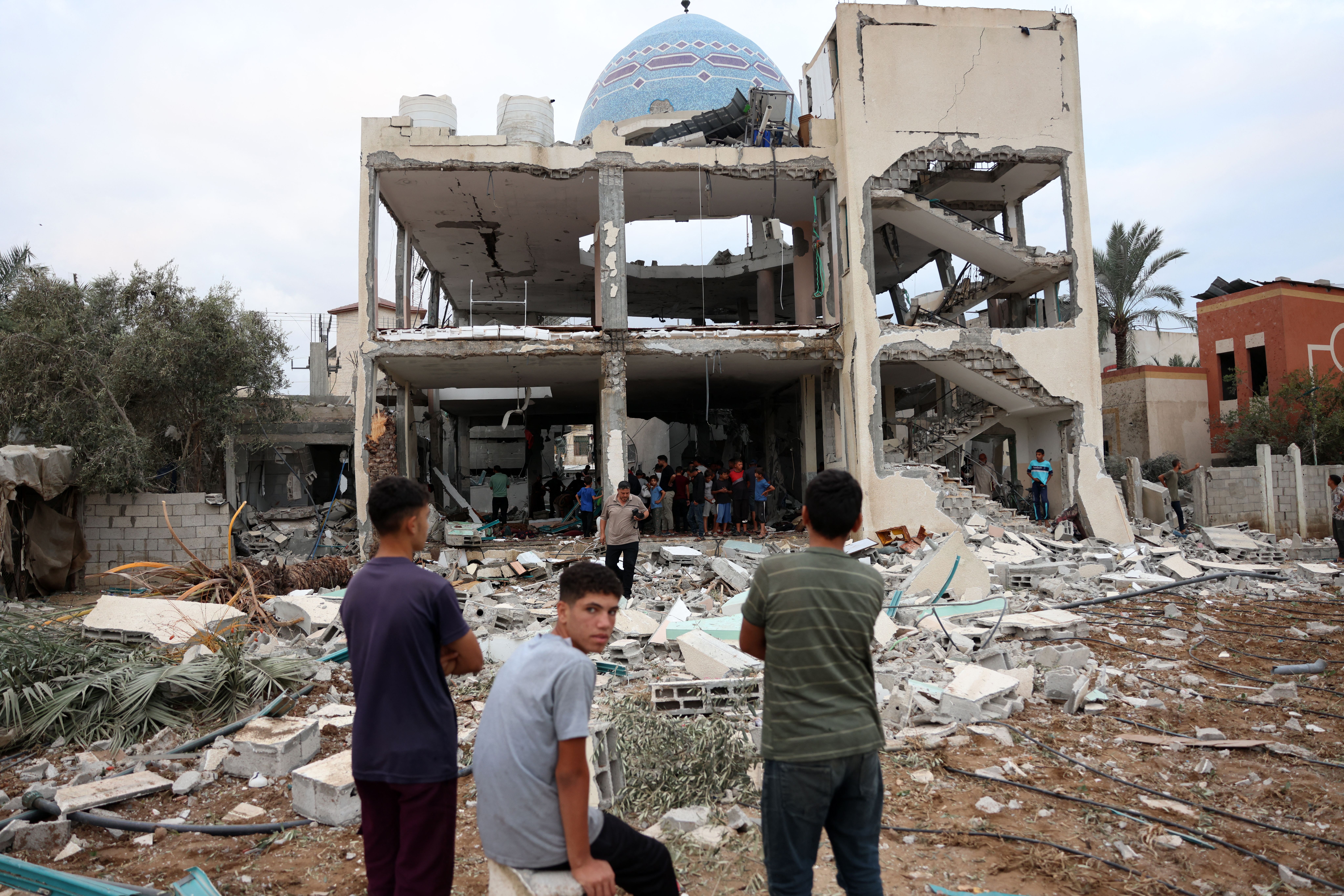
The bottom line: The Hamas attack brought the Israeli-Palestinian conflict to the center of global attention, after years of being cast aside.
- But it also resulted in the biggest catastrophe for the Palestinian people since 1948, as Israel's response in Gaza has led to death and destruction of biblical dimensions.
- With no realistic "day-after" plan for Gaza, including reconstruction, the condition of two million Palestinians in Gaza — most of them displaced — is likely to deteriorate even further.
- Today, Netanyahu is entrenched, the violence is spreading and the goal of an independent Palestinian state appears more elusive than ever.
