Israel killed top Hezbollah military commander in Beirut strike

Add Axios as your preferred source to
see more of our stories on Google.
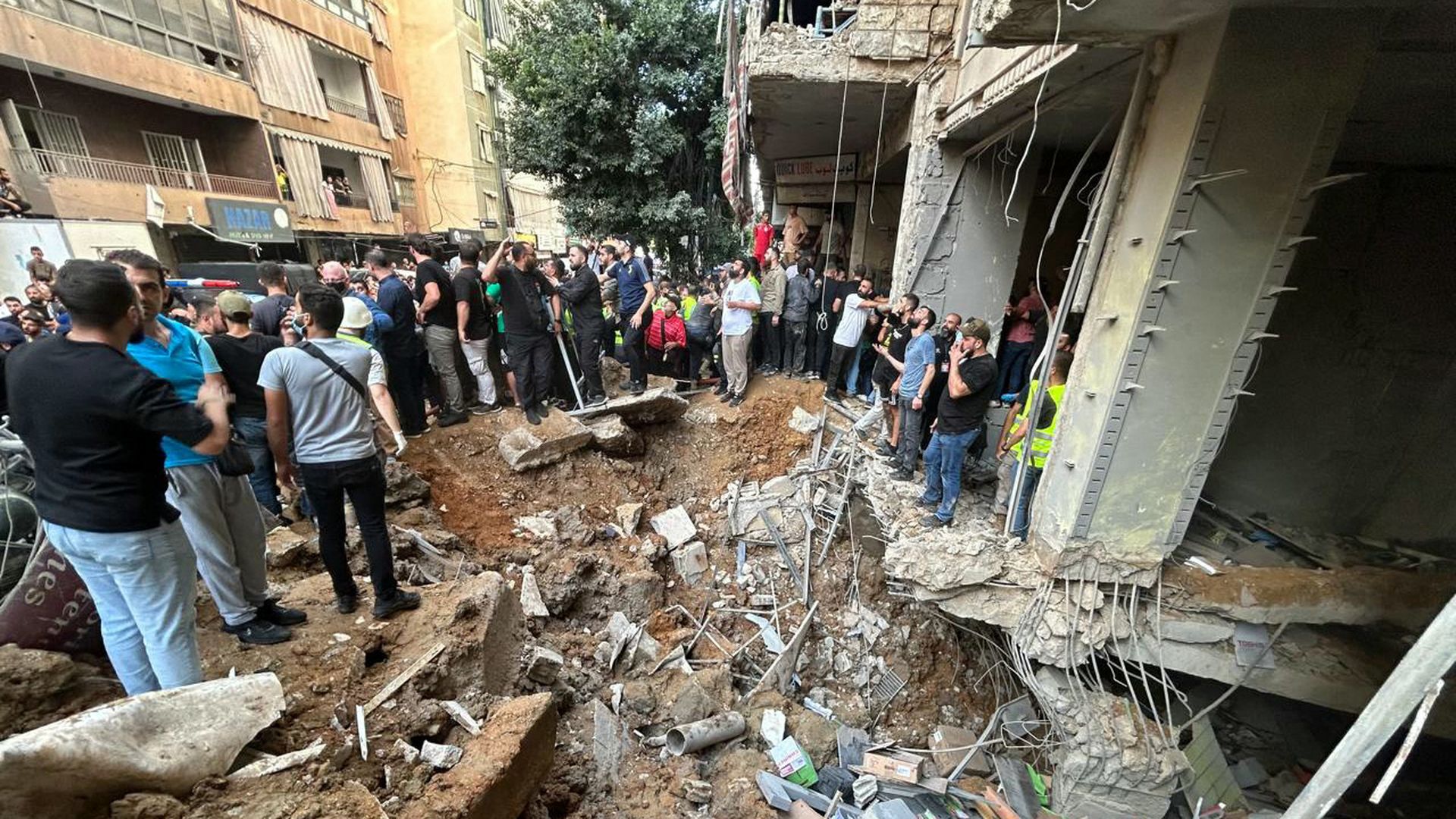
People check the damage at the scene of an Israeli strike in Beirut's southern suburbs on Sept. 20, 2024. Photo: Anwar Amro/AFP via Getty Images
Hezbollah confirmed its head of military operations, Ibrahim Aqil, was killed on Friday in an Israeli airstrike on a southern Beirut neighborhood. Lebanon's health ministry said at least 12 people were killed and dozens more were wounded.
The big picture: The strike in Beirut is further escalating the fighting between Israel and Hezbollah, risking an all-out war.
- The IDF said Aqil was the head of Hezbollah's military operations and the commander of the elite Radwan Forces, and claimed he was in charge of a plan to invade northern Israel. He was killed along with other commanders in his unit, the IDF said.
- An Israeli official claimed the senior command of the Radwan forces — about 20 commanders — were killed in the strike.
- IDF spokesperson Rear Admiral Daniel Hagari said in a press conference that Aqil and the Radwan unit commanders were killed as they held a meeting under a building.
Driving the news: The attack comes several days after the remote detonations of pagers and Walkie-Talkies that killed close to 40 people and wounded more than 3,000 others. Hezbollah said many members of its military units and institutions died or were injured in the attacks.
- A senior Israeli official said Israel did not inform the U.S. in advance of the attack in Beirut on Friday, but briefed senior U.S. officials on the matter immediately after it was carried out.
- White House spokesperson John Kirby said he was not aware of any prior notice Israel gave the U.S. about the Beirut strike.
- Kirby said the U.S. still believes a diplomatic solution for the fighting on the Israel-Lebanon border is possible. He stressed that a war between Israel and Lebanon isn't inevitable "and we are trying to prevent it."
The latest: President Biden said at the top of the cabinet meeting on Friday that the administration is working on a solution that would allow civilians in northern Israel and southern Lebanon to go back to their homes.
- "We have to get this done, but we still have a way to go," Biden said.
- Secretary of Defense Austin told his Israeli counterpart Yoav Gallant in a phone call on Friday that the U.S. is concerned about the current escalation and strongly reemphasized the importance of reaching a diplomatic resolution that enables residents to return safely to their homes on both sides of the border, the Pentagon said.
Zoom in: Aqil is one of the founders of Hezbollah's military wing.
- He is wanted by the U.S. for his involvement in the bombings of the U.S. Embassy in Beirut in April 1983, which killed 63 people, and the U.S. Marine Corps barracks in October 1983, which killed 241 U.S. personnel.
What they're saying: An Israeli official described the assassination as "a huge blow" for Hezbollah's military command and control structure.
- Another Israeli official said that after Fuad Shukr was killed by Israel Defense Forces in July, Aqil replaced him as Hezbollah's top military commander.
- The Israeli official said Israel reached the conclusion that it wouldn't be able to reach a diplomatic solution to the situation on the northern border without going through a military escalation.
- "This is why we have been gradually taking our gloves off and increasing our attacks against Hezbollah," the official said.
This is a developing story. Please check back for details.
