Destructive wildfires spawn rare fire tornado in Calif., foul air quality in U.S., Canada


Add Axios as your preferred source to
see more of our stories on Google.
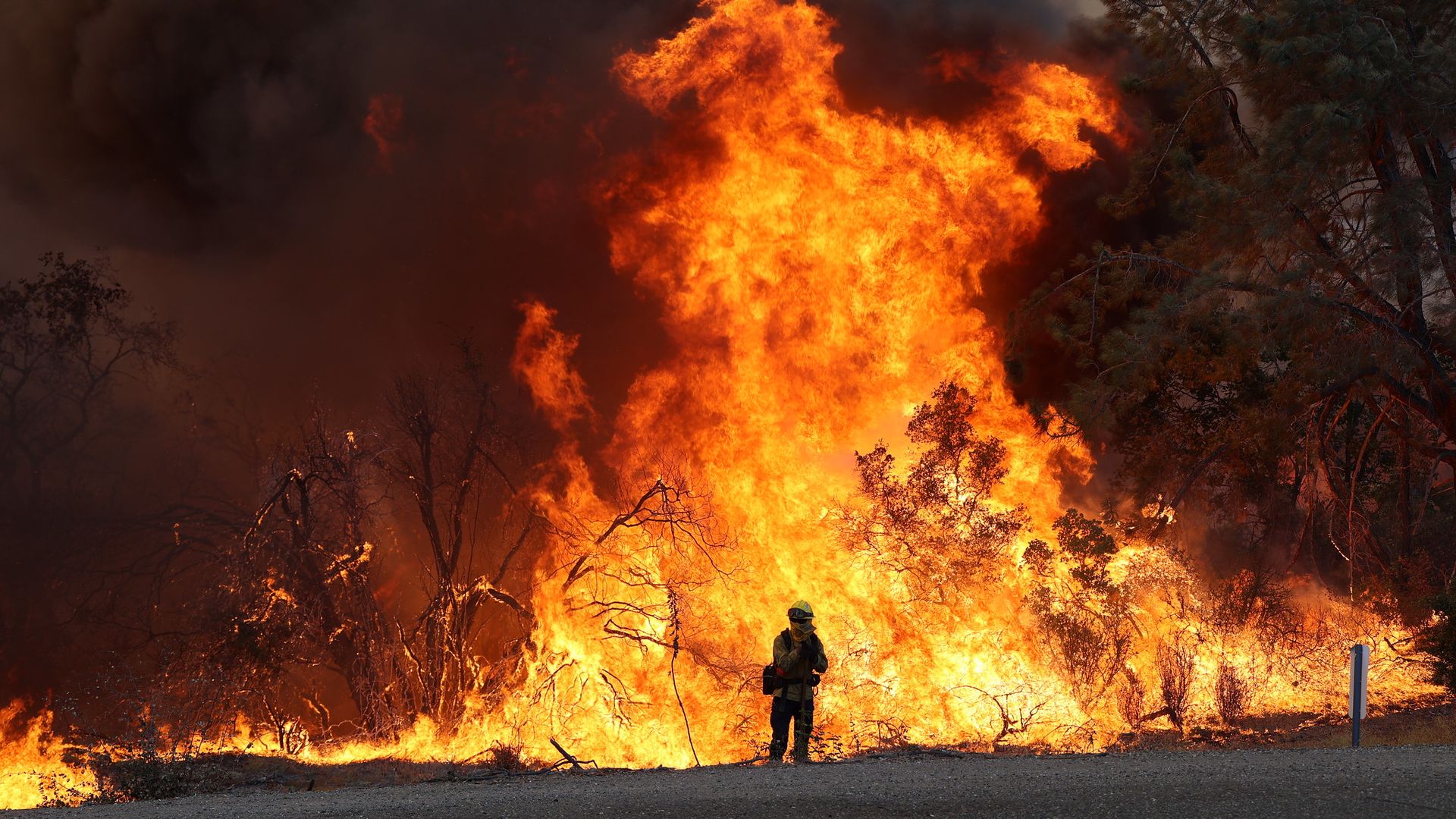
A firefighter stands in front of flames from the Park Fire in Butte County, Cali. on July 25. Photo: Cal Fire.
Raging wildfires and their associated smoke plumes are plaguing parts of the western U.S. and Canada, with hasty evacuations underway in some communities.
The big picture: Extreme heat and dry conditions are yielding extreme fire behavior from northern California into Oregon, while Canada calls up military personnel to battle blazes in British Columbia and Alberta.
Threat level: In Northern California, the massive Park Fire, just northeast of Chico, exploded in size from Thursday after igniting two days earlier and was accompanied by a rotating, towering cloud of heat, ash and smoke, known as a pyrocumulus cloud.
- By the evening, a rare rotating plume that's likely a "fire tornado" was spotted in the blaze.
- Such columns of rotating smoke and strong winds are signs of extreme wildfire behavior and indicate to firefighters that it will be especially difficult to squelch the blaze.
- Meanwhile, Oregon firefighters are tackling dozens of wildfires burning across the state and President Biden called Gov. Tina Kotek Thursday evening to offer support and ensure the state has everything it needs to tackle the blazes, per a pool report.
What we're watching: Smoke from the Park Fire was blowing into Oregon and Idaho, and it will travel further downwind from there.
- Smoke from the Canadian fires has been thickest in that country, but has also been causing deteriorating air quality in parts of the U.S. Upper level smoke, which is not a health concern, was observed this morning in the Northeast U.S.
- Studies show that breathing wildfire smoke is extremely hazardous, particularly for the elderly, those with chronic ailments and children.
- Red flag warnings for high fire weather risk is once again in effect for the region of the Park Fire on Friday.
State of play: Butte County authorities announced Thursday the arrest of a 42-year-old Chico man on suspicion of starting the Park Fire, California's biggest blaze this year, which saw residents in some areas rescued by helicopter near the rural town of Cohasset early Thursday due to cut off escape routes.
- Evacuation orders were in place for Butte and Tehama counties in the Sacramento Valley foothills over the Park Fire, which was burning at 3% containment over nearly 164,000 acres as of Friday morning.
- The Park Fire is now the largest blaze out of 15 large wildfires burning across California. It is consuming abundant, dried-out vegetation from long-duration heat waves, following a wet winter that spurred plant growth
- The town of Paradise, which is being rebuilt after being largely destroyed in 2018 by California's deadliest wildfire, was included in zones affected by evacuation warnings (though not yet evacuation orders).
In Canada, hundreds of wildfires are burning across the country and firefighting crews from Australia and New Zealand have deployed to tackle blazes in British Columbia and Alberta.
- Canada's Prime Minister Justin Trudeau announced on X Thursday evening the deployment of further resources to Alberta to assist in tackling the wind-driven blaze in the popular Jasper National Park and across the province after deploying the Canadian Armed Forces resources.
- Evacuation orders were in effect for some 25,000 people in communities near the park over the blaze, which reached the town of Jasper on Wednesday, where significant structural damage was reported.
Zoom in: The national park, widely considered a crown jewel of the Canadian Rockies, said in a Facebook post Thursday that the priority remained "protecting structures that have not yet been impacted by fire."
- Firefighting efforts had prevented significant damage to much of the infrastructure in the east end of Jasper, but the park's post said the blaze had damaged several bridges around the town and throughout the national park.
- A pyrocumulus cloud was also reported in this fire.
What they're saying: FEMA administrator Deanne Criswell told Axios at a Thursday event that the National Interagency Fire Center in Idaho is now at its highest level of preparedness.
- She said that in a Wednesday briefing, NIFC experts told FEMA that "the next 48 to 72 hours are actually really critical for fire weather because of the conditions that we are seeing across the northwest."
Context: Human-caused climate change has greatly increased the odds of heat waves and made them more intense and longer lasting, multiple studies show.
- Climate change has also increased the occurrence of days with extreme wildfire weather conditions, when blazes can spread quickly and behave erratically.
What's next: While extreme heat is forecast to ease in the Pacific Northwest for a few days, it is expected to move east, with unusually hot and dry conditions settling into the Plains states.
Yes, but: The Climate Prediction Center projects another coast-to-coast heat wave at the end of July and beginning of August, which could increase wildfire risks.
Go deeper: How wildfire smoke impacts your health
Editor's note: This article has been updated with new details throughout.
