Hispanic immigrant wealth grew in U.S. during height of COVID

Add Axios as your preferred source to
see more of our stories on Google.
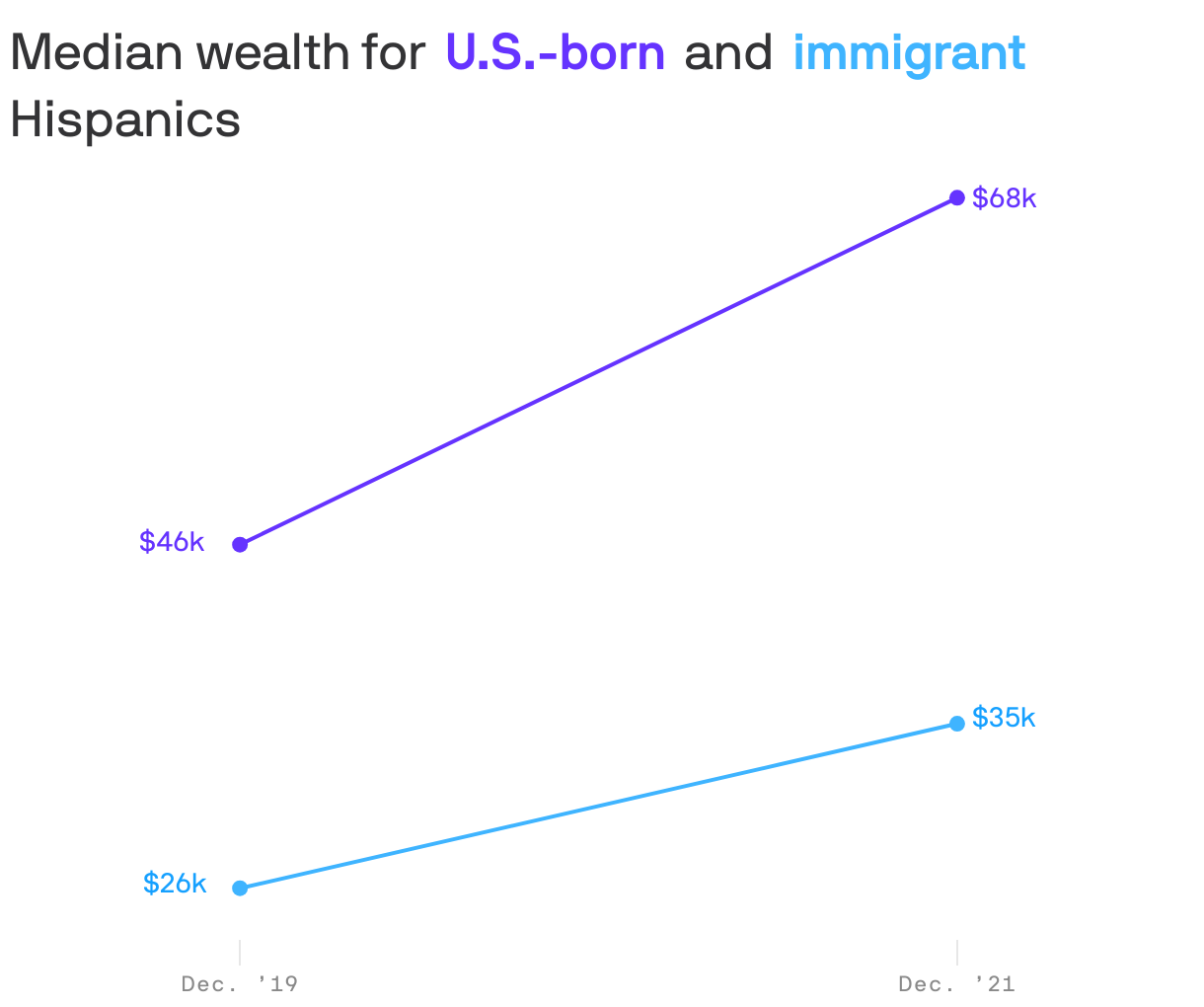
Household wealth increased significantly for both U.S.-born and immigrant Latinos during the height of the COVID-19 pandemic, according to a new report by the Pew Research Center.
Why it matters: This is the first study of this scale assessing the pandemic's impact on immigrants' financial net worth, and it could help inform policy around future crises. Previous research focused on more narrow metrics of financial well-being.
The big picture: Although most Americans saw their wealth increase during the pandemic, in dollar amounts the gap between Hispanic households and white households grew. Latino immigrants' median wealth also rose but they had the lowest household income when compared to other immigrant groups, per Pew.
What's happening: Hispanics had among the highest rates of COVID infection and death related to the disease, as well as wage and job loss during the pandemic, compared to other races and ethnicities.
- Yet because of increases in home equity, stimulus checks and less spending during lockdowns, many were able to grow their net worth, says Rakesh Kochhar, a senior researcher at Pew.
Details: Pew analyzed U.S. Census data on the income of U.S. households, including data on asset ownership and debt.
- Overall, American families made strong financial gains from 2019 to 2021, although what Pew classifies as "poorer" households, along with Hispanic and Black families, had the least gains.
- Median Hispanic immigrant household wealth grew from $25,200 in December 2019 to $35,400 in December 2021 — a 40% spike, according to the report.
- It grew by more than 46% for U.S.-born Hispanics: from $46,500 in 2019 to $68,000 in 2021.
- The median household wealth was $48,700 overall for Hispanics in 2021, and $250,400 for white households.
Between the lines: Researchers don't expect the same level of net worth growth across all demographics to continue because the government is no longer issuing stimulus checks, inflation was much higher in 2021 and 2022, and people are spending more.
What they're saying: Jennifer Haley, a principal research associate for the Health Policy Center at the Urban Institute, says she was surprised that immigrant wealth grew during the pandemic.
- Haley recently co-authored a study that found one in six adults in immigrant families with children in 2022 avoided public benefits such as subsidized health insurance or food assistance over concerns it could hurt their immigration case.
- That "could contribute to family budgets being more strained, fewer dollars allocated to savings, increasing reliance on credit or alternative financial services like payday loans, which might be difficult for them to pay back," Haley says.
- A 2021 study from the institute found that even while experiencing financial hardships because of the pandemic, immigrants were not accessing public benefits over the same concerns.
The intrigue: The Pew analysis found overall U.S.-born people have much higher household wealth than their immigrant parents, which could mean that wealth accumulation can happen within one generation, Kochhar says.
- The median net worth of U.S.-born children of immigrants was nearly $163,000 in 2021, just slightly less than it was for all other U.S.-born people ($179,600).
Subscribe to Axios Latino to get vital news about Latinos and Latin America, delivered to your inbox on Tuesdays and Thursdays.
