Americans got richer during the pandemic

Add Axios as your preferred source to
see more of our stories on Google.
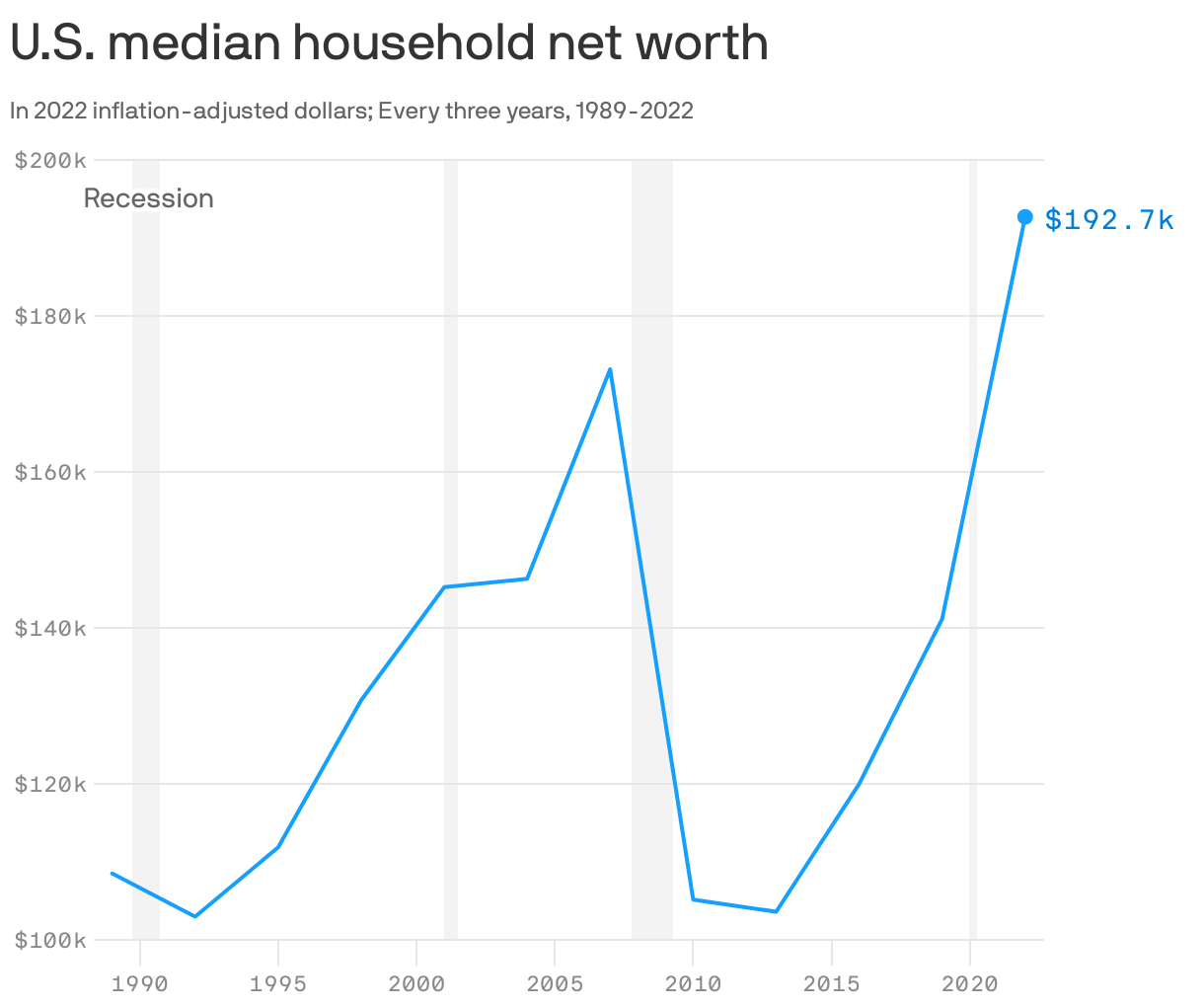
During the pandemic, the U.S. government pulled out all the stops to try to keep Americans' financial lives intact. To a stunning degree, it worked.
Why it matters: The pandemic-era actions of the government prevented a spiral of declining asset values, depleted savings and higher household debt.
- It is a stark contrast with the 2008 crisis, when there was no widespread private sector debt relief, asset prices plunged, and households spent a decade working through their debt overhang.
- The flip side of that is the actions made the federal government's balance sheet worse — with substantially higher public debt — in order to bolster individuals' and companies' balance sheets.
Driving the news: The Fed's Survey of Consumer Finances, out Wednesday, is the gold standard of data about Americans' financial condition. It's only released every three years, but luckily it was conducted in 2019 and 2022, bookending the pandemic.
- It showed improvement in households' finances across nearly every dimension.
By the numbers: The median U.S. household had a net worth of nearly $193,000 in 2022, up from an inflation-adjusted $141,100 in 2019.
- Measures of "financial fragility" were down. The median debt payments as a share of income fell to 13.4%, the lowest seen in the 33-year history of the survey.
How it happened: It reflects a massive, whole-of-government effort to use fiscal and monetary power to keep Americans' household finances afloat.
- Nearly $5 trillion in pandemic spending supported peoples' finances through many channels, including direct payments to Americans and expanded unemployment insurance benefits.
- The Fed goosed values of homes, stocks and nearly every other asset with near-zero interest rates and a cumulative $4.7 trillion in quantitative easing.
Flashback: In the aftermath of the 2008 crisis, there were numerous proposals to offer debt relief to Americans, but the politics were never there to implement any of the more ambitious versions.
- Rather, households weighed down by excessive mortgage and other debt went through an onerous, multiyear process of rebuilding their net worth.
- That, in turn, helps explain why demand was persistently weak in the 2010s, in contrast to the rip-roaring expansion of the last two years.
What they're saying: "It's especially striking given the massive job loss we saw when the pandemic set in," Karen Dynan, a Harvard economist, tells Axios. "I think if you had asked me at the time what household finances would look like two years later, I would have been very pessimistic."
- "I'm delighted to see data that suggests that the aid seems to have made a meaningful difference," she said.
Yes, but: Robust demand fueled the high inflation of the last couple of years. High interest rates reflect the Fed's efforts to fight it.
- And the federal government faces more onerous debt service costs due to both higher debt levels and higher rates, which could squeeze other national priorities.
The bottom line: Americans are paying the piper now for actions that prevented a financial catastrophe in 2020.
