Yellen’s Beijing visit comes as U.S.-China economic ties fray

Add Axios as your preferred source to
see more of our stories on Google.
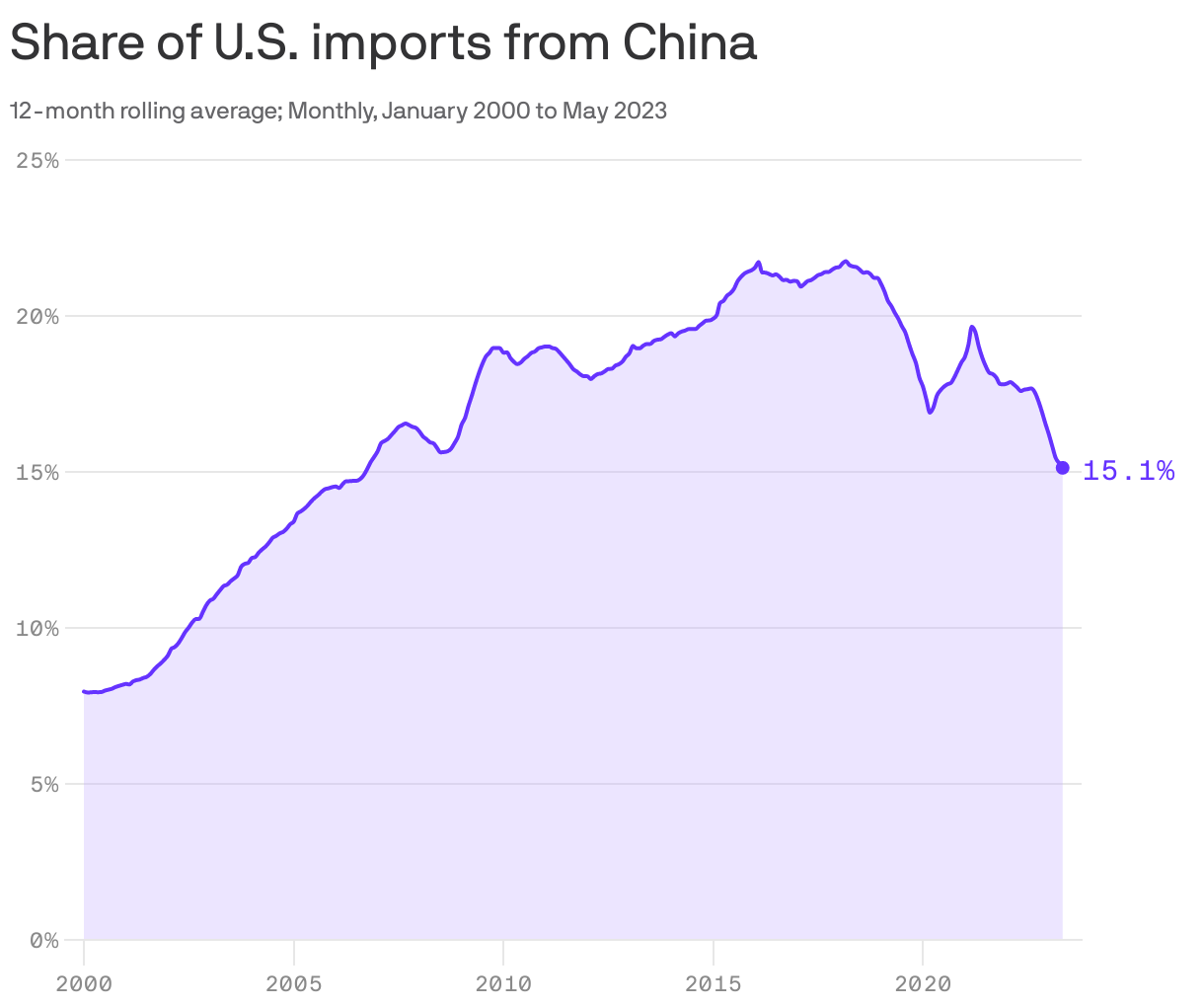
Treasury secretary Janet Yellen's trip to China this week is taking place as trade between the two countries is plunging.
Why it matters: For all that fireworks sales rose again this year — nearly all of them sourced from China — imports from China to the U.S. totaled $130 billion over the four months from February through May. That's down 25% from $175 billion a year ago.
The big picture: Both as a percentage of total imports and as a percentage of GDP, Chinese imports are now at the lowest they've been in 20 years.
- The other side: U.S. exports to China are going up rather than down. Over the same four-month period they totaled $49.3 billion, up slightly from $48.8 billion in 2022.
Be smart: Shrinking imports aren't necessarily a good thing. After all, it's not just fiscal policy and monetary policy that affect inflation; trade policy does too.
- When companies reshore their supply chains and cut Chinese imports, that invariably increases costs — to the companies concerned and, ultimately, to their U.S. customers.
- That's why Yellen tried (and failed) to roll back some of the Trump-era tariffs on China.
- "We should not allow any disagreement to lead to misunderstandings that needlessly worsen our bilateral economic and financial relationship,” Yellen said in Beijing on Friday.
Between the lines: As the NYT detailed this week, relations between the U.S. and China are at their lowest point since 1979. Both countries are trying to hobble the other when it comes to semiconductor technology, with the U.S. specifically looking to ban certain high-tech investment in China, and China restricting the export of gallium and germanium, which are used to make semiconductors.
- That move "will not only cause panic in certain countries, but also exert heavy pain in them," said government mouthpiece China Daily.
- The U.S., meanwhile, is particularly upset about human rights abuses, China's role in international debt workouts, and the weak yuan.
The less that two countries trade with each other, the less reliant they are on each other. Yellen's trip, alongside that of Secretary of State Tony Blinken last month, looks like an attempt to shore up with diplomatic relations what has been lost economically.
The shrinking* trade deficit
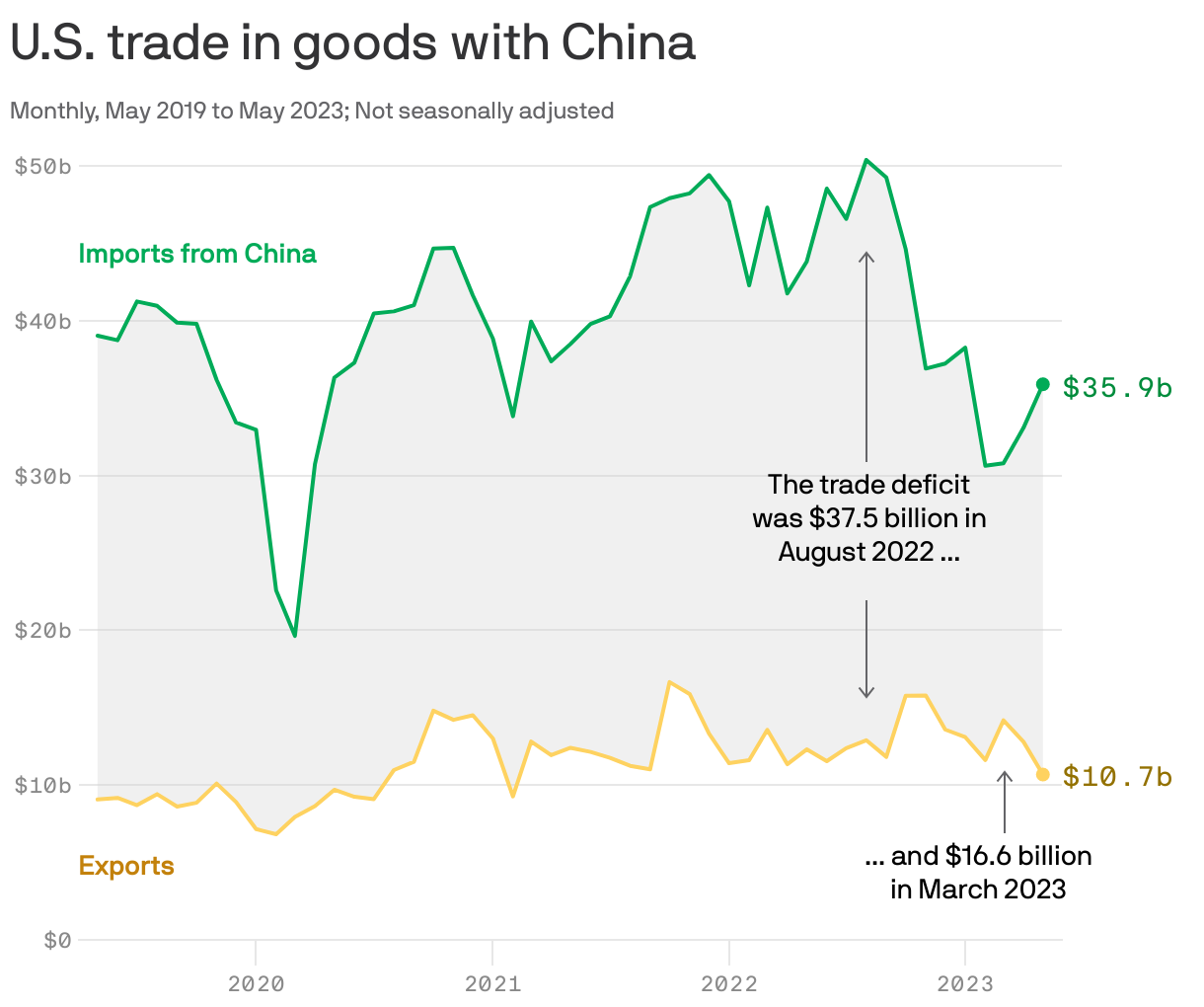
Ignore any headlines you remember from earlier this year about the trade deficit with China being at record highs. Those days are over.
State of play: The shrinking deficit shouldn't be taken entirely at face value. Council on Foreign Relations fellow Brad Setser tells Axios there are a few reasons to add an asterisk to these figures:
- Country of origin rules: Thanks to the Trump tariffs, a lot of companies are doing final assembly of their goods in countries like Vietnam, Malaysia, or Taiwan. Even if the earlier parts of the supply chain are in China, the imports are registered as coming from other countries.
- Base effects: In 2021, there was a huge backlog at U.S. ports. As the backlog cleared up in 2022, it artificially increased imports for that year.
- Reporting: Tariffs get levied on things the Americans consider to be imports, and those things are down. Look at Chinese export data, however, and the numbers look very different. The natural conclusion is that China's exports have, somehow, become things that the U.S. doesn't officially consider to be imports.
The bottom line: Trade between the U.S. and China is shrinking, says Setser, but "the deep diversification of supply chains that is now sought by U.S. policy is only just starting."
Go deeper: Listen to the Axios Today podcast, where host Niala Boodhoo talks about the importance of Janet Yellen's China visit.
Read more ... Shein's tariff arbitrage
