Monday's sports stories

NFL struggles to fill seats in LA
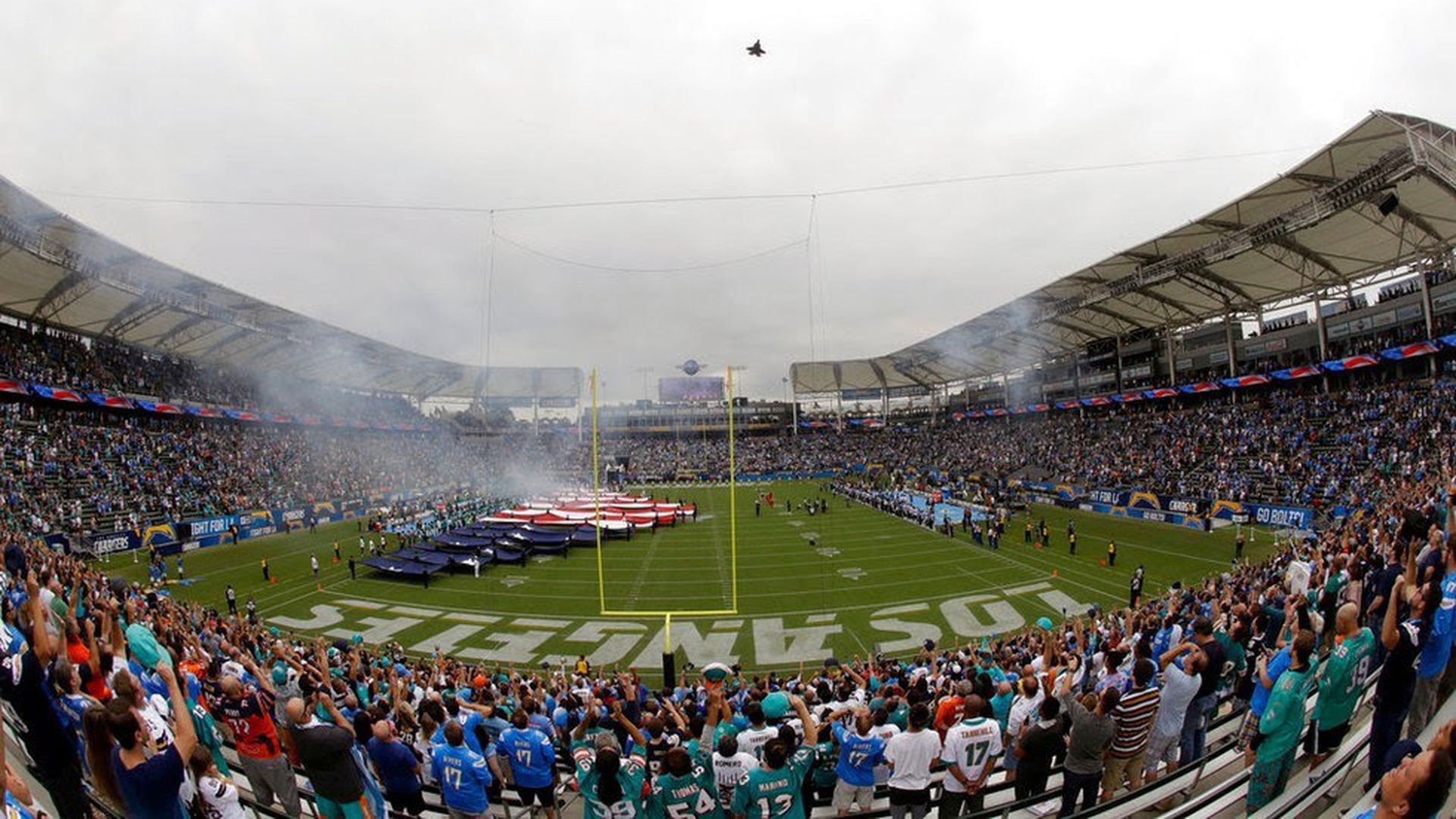
"Lots of empty seats at 2 games in LA," by AP Pro Football Writer Howard Fendrich:
- "[M]aybe — just maybe — the NFL overestimated the appetite for professional football in the Los Angeles area. All of those empty seats in the Coliseum during the TV broadcast of the Rams' 27-20 loss to the visiting Washington Redskins on Sunday? Not a great look."
- "Nor was the Chargers' inability to sell out their first regular-season game in L.A. since moving from San Diego to their temporary stadium, which holds only 27,000, making it by far the smallest facility in the league. They drew only 25,381 for what turned out to be a 19-17 loss to the Miami Dolphins."
- "For fun, let's offer this apples-to-oranges comparison: The Southern California vs. Texas college game on Saturday night attracted nearly 85,000 to the Coliseum."

We asked four experts for a hard look at pro football
Despite the increased attention, the number of concussions in professional football is not shrinking. Some 18,400 of approximately 21,000 ex-NFL players have registered for an expected $1 billion or bigger payout from a lawsuit over chronic traumatic encephalopathy, or CTE, the brain injury they can suffer from repeated concussions.
We asked four experts the following question: Presume that there will always be football players, a professional game, and an audience. Is there an obligation to make the game safe?

Players should get battle pay
From our Expert Voices conversation on pro football.
The difficult part of this question is what is meant by "safe." Does safe mean that no players ever get concussions or that, say, fewer than 15% get concussed? Would soccer or hockey meet such a stringent standard?
We should face the fact that a significant part of football's appeal is the violence that's inherent to the game. Why else would one out of six Americans want to watch a 40-year-old boxer punch a 29-year-old MMA fighter? If violence were not important then the NFL could convert to two-hand touch football and suffer no loss in popularity.
Bottom line: The question is how much concussing is acceptable? It seems that this question is best answered by the NFL Players Association, with the understanding that the more dangerous it is to play football, the greater the compensation and the greater the health benefits must be. That is, there is a marketplace negotiation in which the players receive recompense (or battle pay) for the physical risks that they assume.
Read the other voices in the conversation:
- Doug Patteson, CFO of Turbocam and a former CIA operative: You can't engineer out all risk
- Michael Rosenthal, editor-in-chief, Ring magazine: The athlete is responsible
- Erin C. Tarver, professor of philosophy at Emory University: Fans contribute to the danger

Fans contribute to the danger
From our Expert Voices conversation on pro football.
Many fans deny moral responsibility for the dangers of football by claiming that players freely choose them. But do they? The newest CTE studies show that brain trauma from football is less a risk than a likely outcome. We need to consider what truly informed consent to this outcome requires, and whether it's possible.
Ethicists generally agree that you can't truly consent to something if you are ignorant of its risks and consequences. Players may know that football is risky, but few have known how dangerous until too late — in part because of the NFL's documented efforts to discredit CTE research. It's even worse when we consider that most elite players begin playing football when they are children, incapable of fully understanding the risk.
Meanwhile, "toughing it out" and playing through pain can earn big rewards in the form of fan attention — and, importantly, money. Fans help provide a significant incentive to play football, even in the absence of a full grasp of its consequences.
Bottom line: We can't avoid our own responsibility for the dangers of football. Pretending we can make it safe is not enough; we need a public conversation about how to ensure meaningful consent to it, and to discourage kids from playing until they can plausibly understand what it means.
Read the other voices in the conversation:
- Doug Patteson, CFO of Turbocam and a former CIA operative: You can't engineer out all risk
- Andrew Zimbalist, professor at Smith College and author of Rio 2016: Players should get battle pay
- Michael Rosenthal, editor-in-chief, Ring magazine: The athlete is responsible

You can't engineer out all risk
From our Expert Voices conversation on pro football.
Every profession has its own dangers. We should minimize risks when possible, but there is no way to engineer out all risk.
As a CIA officer, I met with men and women in dangerous environments around the world. Environments fraught with terrorism, poverty, war, corruption and despotism. These assets counted on me to do everything I could to protect them as they put their lives, and sometimes my own, at risk.
So did that risk mean we shouldn't do the work we set out to do? No, it meant I needed to understand the risk and prepare for it. I trained for the job at hand. I gained experience and built skills. I learned to assess risks, analyze and make better decisions. And continually developed new tools and technologies that allowed us to reduce risk. None of those tools are perfect, however, and in the end, the CIA officer has to make an informed risk assessment. Do we meet? Or abort?
Bottom line: You can't remove risk. But with tools and training, you can help those taking the risks be better prepared to make their choice.
Read the other voices in the conversation:
- Andrew Zimbalist, professor at Smith College and author of Rio 2016: Players should get battle pay
- Michael Rosenthal, editor-in-chief, Ring magazine: The athlete is responsible
- Erin C. Tarver, professor of philosophy at Emory University: Fans contribute to the danger