United Technologies said Monday that it plans to split into three different companies: United Technologies, which will consist of the Pratt & Whitney and Rockwell Collins' aerospace business; Otis, comprised of its elevators and escalators businesses; and Carrier, which will include its heating, ventilation, and air conditioning-related businesses.
Background: In announcing the separation, United Technologies also said it completed its Rockwell Collins acquisition, the biggest deal in aerospace history. United Technologies CEO Greg Hayes said last year he would be willing to "explore a full range of strategic options," following the closing of the Rockwell deal. Earlier this year, activist investor Dan Loeb called on the industrial conglomerate to break into separate entities.
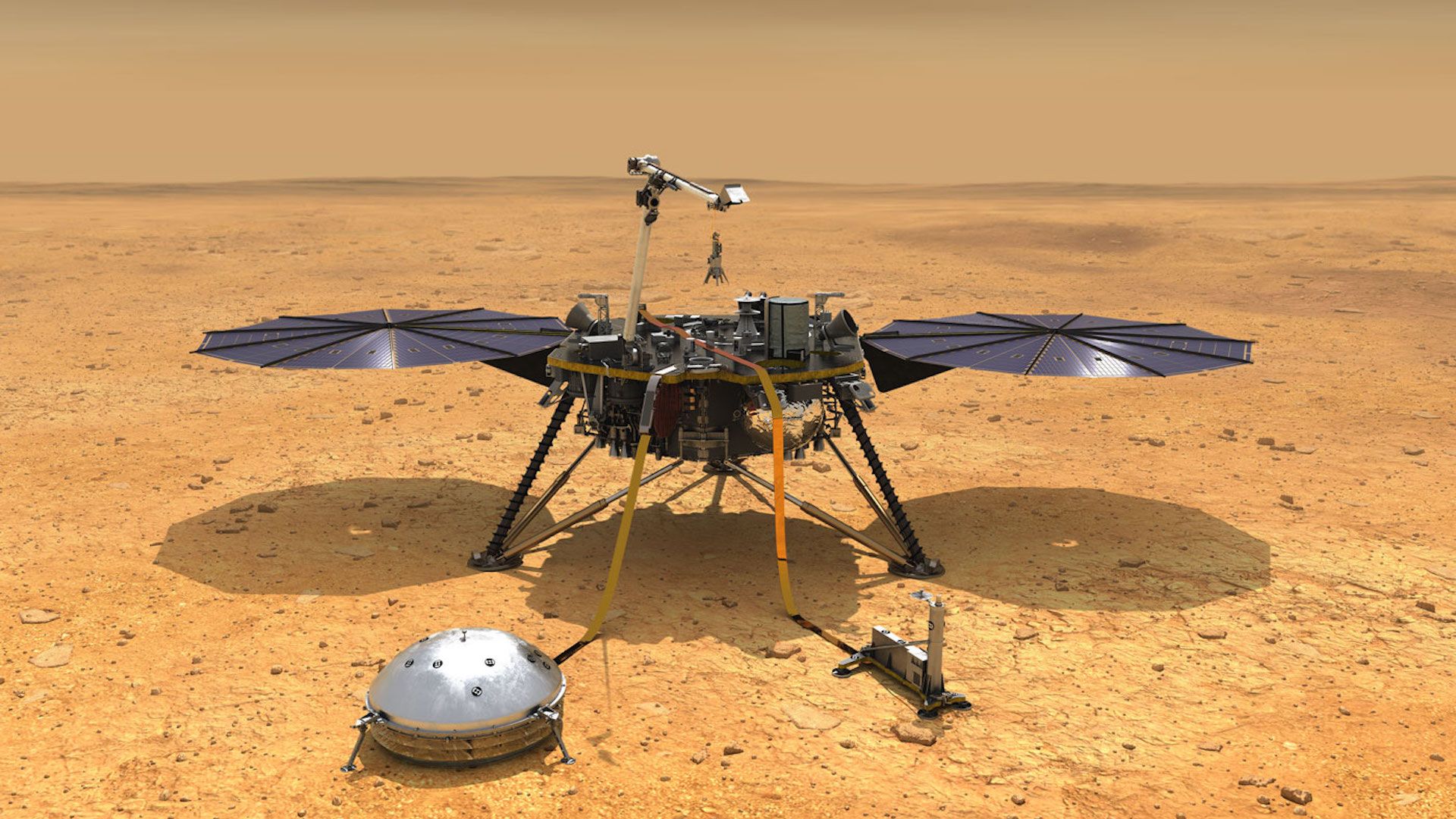
The NASA InSight lander survived a perilous descent through the thin Martian atmosphere and successfully landed on a flat part of the Red Planet on Monday at 2:54 p.m. ET. It has already transmitted its first picture back to Earth.
Why it matters: The landing marks the first robot to successfully land on Mars since NASA's Curiosity rover touched down in 2012. The InSight lander arrived on the planet after completing a nearly 300 million mile trip from Earth. It survived a descent referred to by mission controllers as "seven minutes of terror," during which time the spacecraft followed a series of predetermined maneuvers to slow it down enough for a smooth touchdown.
NASA's InSight spacecraft is aiming for a bull's-eye touchdown on Mars around 3 p.m. today, zooming in like an arrow with no turning back, AP's Marcia Dunn reports from Cape Canaveral, Florida.
Details: After traveling 6 months and 300 million miles, the robotic geologist must go from 12,300 mph to 0 in 6 minutes flat as it pierces the Martian atmosphere, pops out a parachute, fires its descent engines and, hopefully, lands on three legs.
Despite the aggressive timetables provided by SpaceX's Elon Musk and Blue Origin's Jeff Bezos, most Americans are not yet convinced that we'll be living on another planet anytime soon, according to an Axios survey conducted by SurveyMonkey for "Axios on HBO."
However, if given the chance to fly to space for free, about one-third of Americans would take the trip.
Why it matters: During the next decade, we're poised to see multiple deep space exploration missions move forward, from a return to the moon (NASA's plan) to human missions to Mars (SpaceX and, over the longer-term, NASA as well).
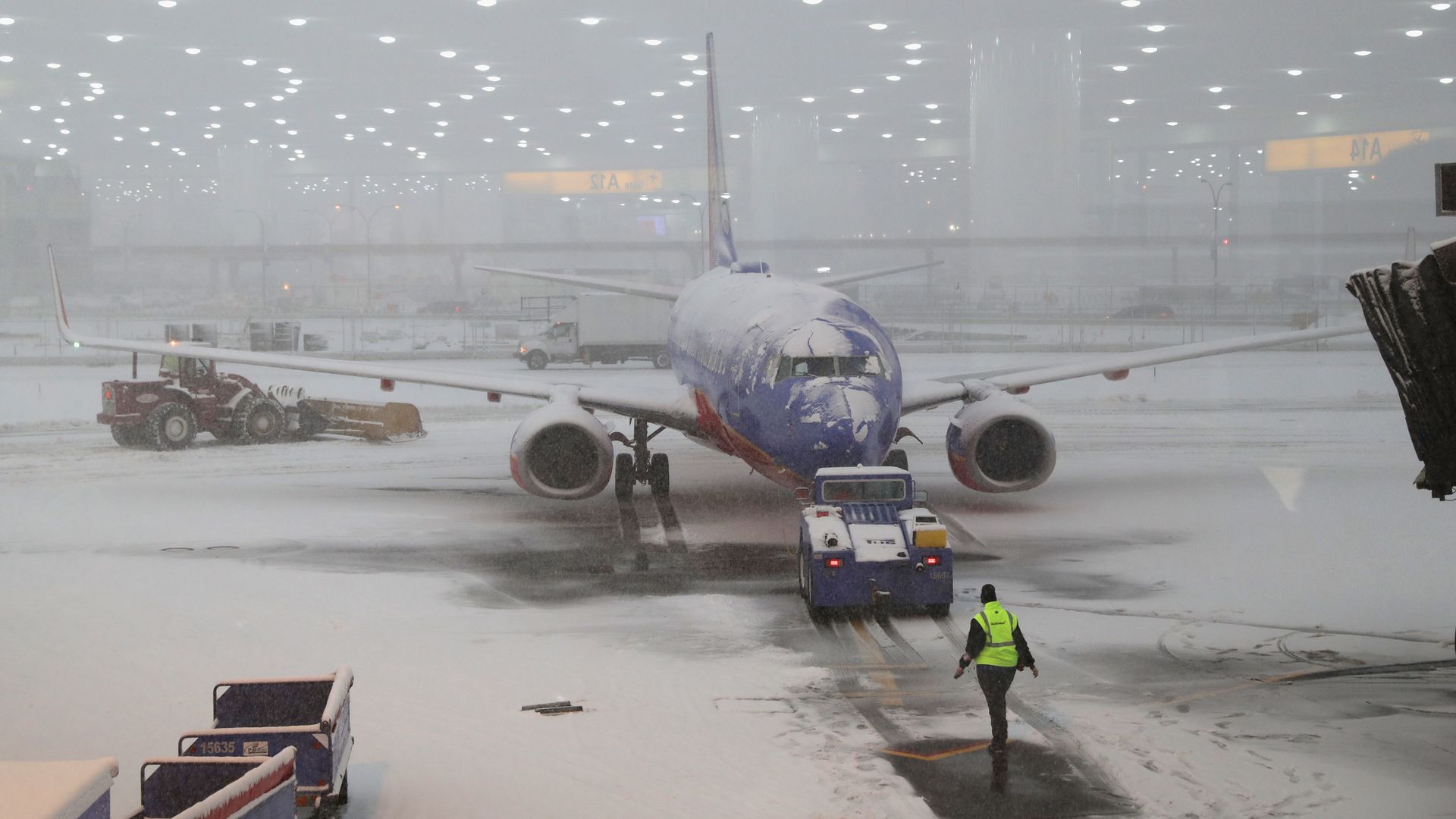
More than 1,600 flights were canceled Sunday and more than 3,600 delayed out of St. Louis and the Chicago area as a major winter storm approaches the midwest, according to data from Flight Aware.
The details: The cancellations are mostly concentrated in the Midwest with Chicago O’Hare airport experiencing more than 700 alone. A blizzard warning was issued by the National Weather Service which explained that a "[s]ignificant winter storm will bring heavy snow and some blizzard conditions from the Middle Mississippi Valley to the Great Lakes through Monday."
Elon Musk,age 47, told "Axios on HBO" that he sees a 70% chance that he'll live to ride one of his SpaceX rockets to Mars. "I know exactly what to do," he said. "I’m talking about moving there."
The big picture: That prediction is dismissed as fantasy by some experts. But Musk said he can envision a flight as soon as seven years from now, with a ticket price of "around a couple hundred thousand dollars."