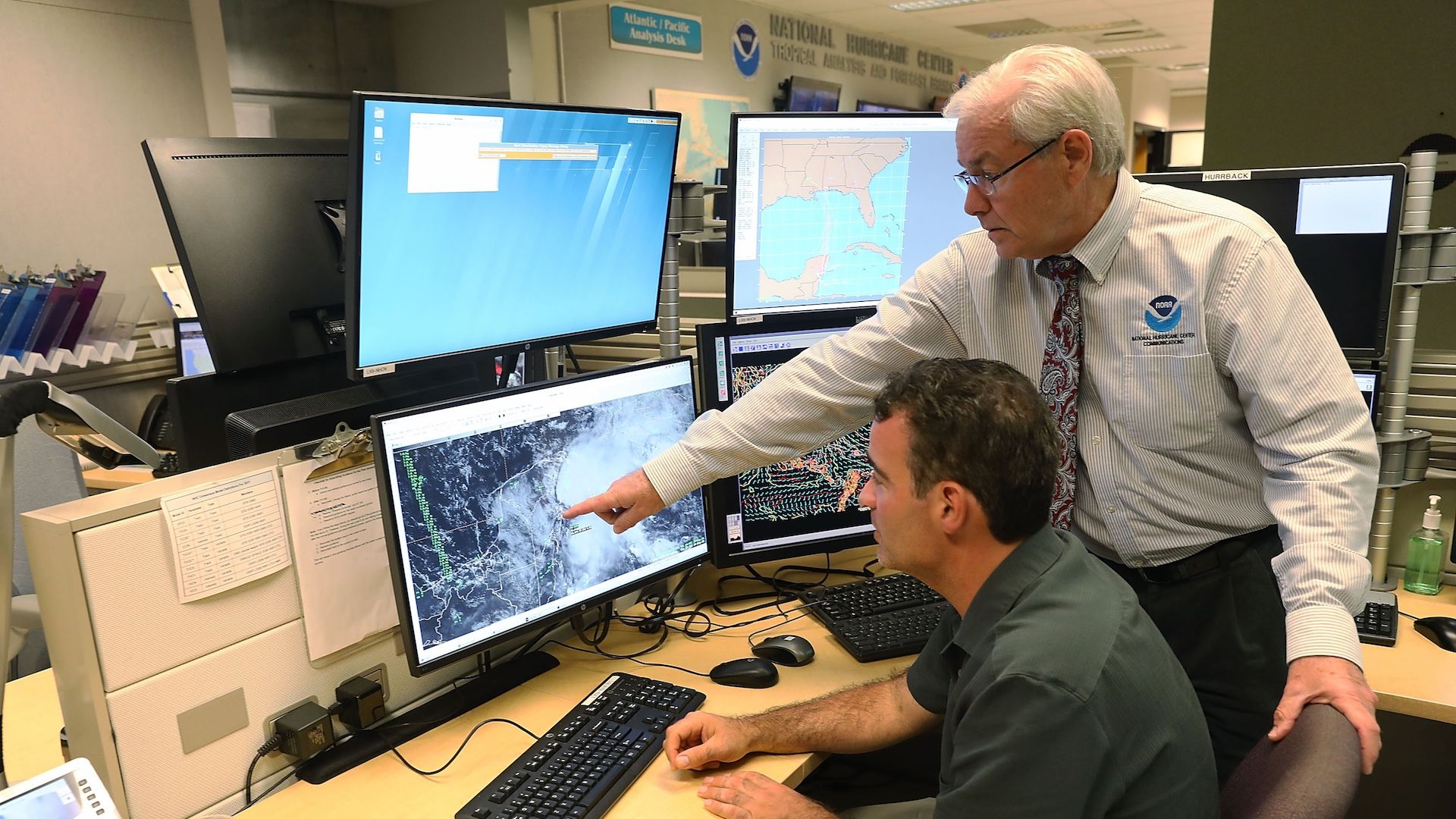
After watching an area of disturbed weather for several days, the National Hurricane Center has determined that Subtropical Storm Alberto has formed in the Gulf of Mexico. The storm, currently near the Yucatan Peninsula, is forecast to crawl northward throughout the holiday weekend.
The impact: The storm is eventually likely to come ashore somewhere between Louisiana and the Florida Panhandle early next week — possibly as soon as Memorial Day. The storm's biggest threat will not be its winds, but rather, its rains.
The full wrath of Tropical Cyclone Mekunu is moving across the coast of southwest Oman and northeastern Yemen on Friday.
The impact: No storm this strong has hit this area since reliable records began in the 1950s, and it's possible the damage from Mekunu will be billions of dollars. Due to a long-running civil war, Yemen does not have robust disaster response capabilities. Plus, the country is in the midst of one of the world's worst cholera outbreaks, which could be exacerbated by this year's rainy season. Oman, however, has more robust response capabilities, but still may be overwhelmed by this event.
Every second on Earth, 100 lightning bolts strike the planet. That's about 8 million strikes per day, and 3 billion a year, on average. But as this map of nearly 9 billion lightning strikes shows, lightning is not evenly distributed around the world.
The bottom line: Each continent, except for the frozen reaches of Antarctica, has lightning hotspots — usually the parts that have clashing air masses or mountains. Spin the map and see where you're at the greatest risk of getting zapped.

/2018/05/25/1527258782981.gif?w=3840)

