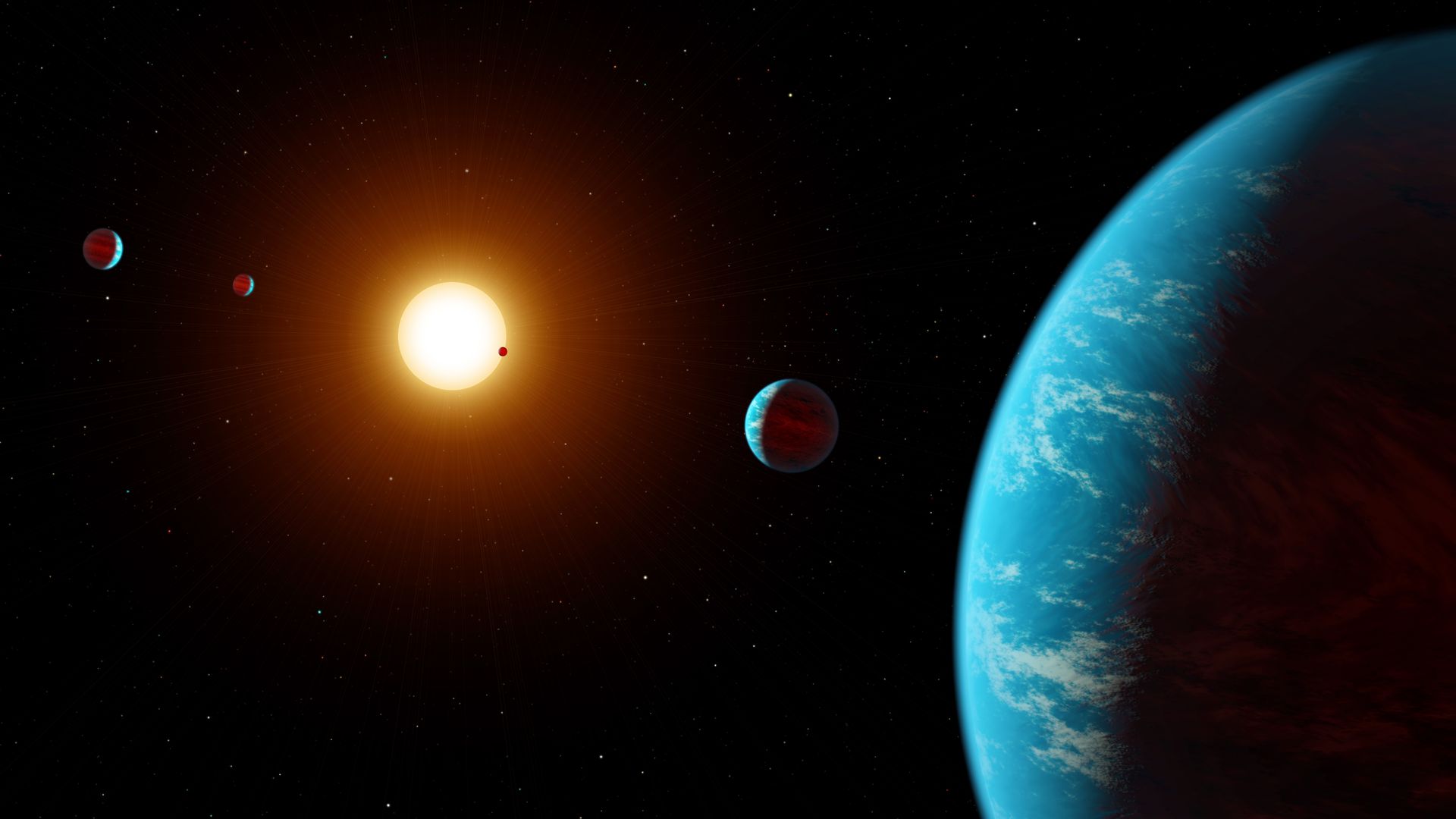
Citizen scientists have discovered a five-planet system orbiting a distant star known as K2-138, astronomers reported Thursday at the annual meeting of the American Astronomical Society and in a preprint posted online.
For the first time, scientists have identified a complex molecule in a distant part of the solar system, according to research published Thursday in the journal Science. The find brings scientists closer to solving a 30 year old astronomical mystery.
Why it matters: The researchers identified benzonitrile, a molecule made of carbon, hydrogen and nitrogen, which is thought to be a building block for two other types of molecules that are possible precursors for life on Earth. By finding it — and developing a technique precise enough to identify specific molecules in distant space — scientists are closer to understanding the types of material that may form planets and the composition of our universe.
The next generation of powerful telescopes will scan millions of stars and generate massive amounts of data that astronomers will be tasked with analyzing. That's way too much data for people to sift through and model themselves — so astronomers are turning to AI to help them do it.
The bottom line: Algorithms have helped astronomers for a while, but recent advances in AI — especially image recognition and faster, more inexpensive computing power —mean the techniques can be used by more researchers. “The mode of operation has to change because there is no way we can handle those data flows,” says astronomer Derek Buzasi from Florida Gulf Coast University.