

August 01, 2024
It's Thursday! Let us know your recess plans — just reply to this email.
- We'll be back in your inbox as soon as Kamala Harris picks a running mate.
- And look out on Monday for our monthly people moves newsletter.
With Congress out, we'll be sending you weekly deep dives on Wednesday afternoons, plus all the breaking tech policy news you need to know.
1 big thing: Tech policy bills to watch
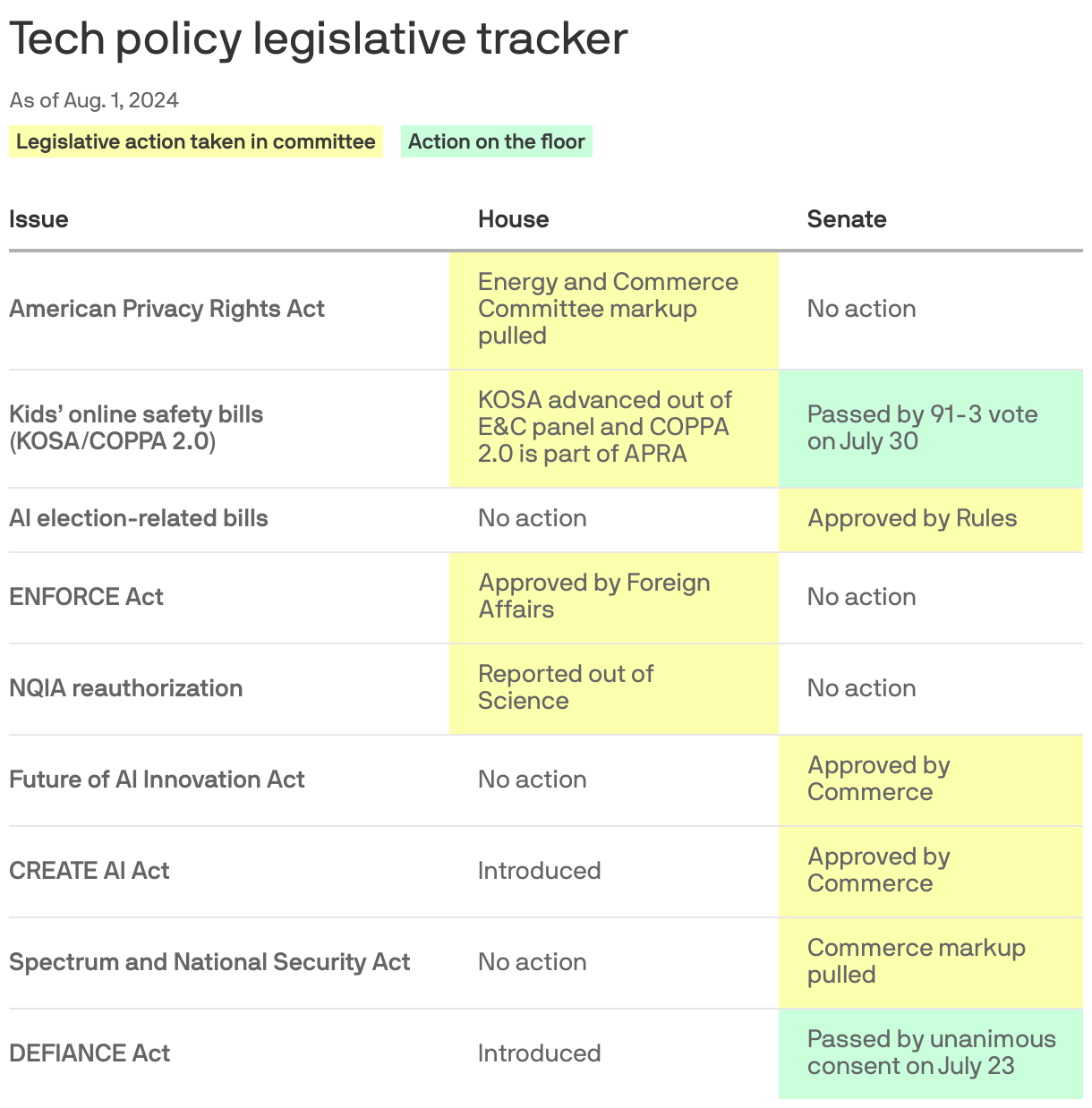
With lawmakers on recess, here's our latest cheat sheet to keep tabs on the most consequential tech bills in play this Congress.
The big picture: Lawmakers made some big moves on legislation before leaving for the summer. Expect end-of-the-year fights over the future of kids online safety, privacy and AI once they're back in town.
Here's a rundown of what we're watching:
American Privacy Rights Act
The issue: Bipartisan legislation, negotiated between House Energy and Commerce Committee Chair Cathy McMorris Rodgers and Senate Commerce Chair Maria Cantwell to enact a comprehensive federal privacy standard.
Status: Advanced out of E&C subcommittee in May, but CMR scrapped the full committee markup scheduled for the end of June following a lack of leadership support.
- Has not yet been introduced in the Senate, but Cantwell told Axios that efforts to pass the bill are not dead.
What's next: Bill sponsors would have to address concerns raised by members, including House leadership, if there's any hope of regaining momentum.
Kids Online Safety
The issue: The Kids Online Safety Act and COPPA 2.0 are moving in tandem, as the safety by design and privacy bills are viewed as complementary.
Status: The Senate on July 30 passed the KOSA/COPPA 2.0 package — dubbed the Kids Online Safety and Privacy Act — in a bipartisan 91-3 vote. In the House, KOSA has advanced out of E&C subcommittee. COPPA 2.0 is part of APRA.
What's next: The KOSA/COPPA 2.0 package now heads to the House, where backers of the legislation need to get key players on board if they want it to become law.
AI in elections
The issue: Efforts to ban AI for deceptive political content, require AI disclaimers and prepare election officials to deal with the technology.
Status: The Senate Rules Committee approved three bills in May. Chair Amy Klobuchar tried to pass the Protect Elections from Deceptive AI Act and the AI Transparency in Elections Act by unanimous consent on July 31, but Sen. Deb Fischer objected. No House action.
What's next: The failed UC attempt signals that this issue is at a standstill ahead of the election.
ENFORCE Act
The issue: Lawmakers are turning up the heat on China, seeking to limit AI software and hardware exports to the top U.S. tech competitor.
Status: Cleared the House Foreign Affairs Committee. No Senate action.
What's next: The bill wasn't included in the House's NDAA, but it could still make it into the Senate version of the annual defense policy bill.
Story continues below.
2. Bill tracker, cont.

Quantum reauthorization
The issue: The National Quantum Initiative Act expired Sept. 30. Some lawmakers are working to revive the effort, which proponents say is key to global competitiveness and national security.
Status: The bill to reauthorize the NQI was reported out of the House Science Committee on July 25. No action in the Senate.
What's next: This clears the way for floor action in the House. Other efforts to boost U.S. quantum activity are advancing through the NDAA.
Future of AI Innovation Act
The issue: Lawmakers are working to authorize government agencies and partnerships with the private sector to promote AI innovation and safety standards.
Status: The Senate Commerce Committee approved the bill on July 31. There is no House companion.
What's next: The legislation now heads to the Senate floor, or it could move in a larger, year-end package.
CREATE AI Act
The issue: The bipartisan, bicameral bill would authorize the National AI Research Resource to boost participation in the technology's development.
Status: The Senate Commerce Committee approved the bill on July 31. In the House, the co-chairs and vice-chairs of the Congressional Artificial Intelligence Caucus have introduced the legislation.
What's next: Like the Future of AI Innovation Act, the bill now heads to the full Senate for a vote. It could also move as part of a bigger package later this year.
Spectrum and National Security Act
The issue: Congress let the FCC's spectrum authority lapse for the first time in decades. This bill, led by Cantwell, would return authority to the agency and funnel auction proceeds to the now-defunct Affordable Connectivity Program.
Status: The Senate Commerce Committee's markup of spectrum legislation has been delayed four times, and the legislation wasn't considered at the committee's most recent markup.
- Ranking Member Ted Cruz and Sen. John Thune have a competing bill that some companies have lauded for directly creating a spectrum auction pipeline.
- Cantwell's bill wasn't part of the tranche of AI and telecoms legislation considered on July 31.
- But key issues it addresses — rip and replace and Affordable Connectivity Program funding — did advance separately.
What's next: We'll be tracking if a different iteration of the Cantwell bill is introduced and whether it gets a markup this fall.
DEFIANCE Act
The issue: The bipartisan DEFIANCE Act would crack down on non-consensual AI pornography and create a federal civil right of action for people who are victims of intimate digital forgeries.
Status: The Senate passed the legislation by unanimous consent on July 23. Rep. Alexandria Ocasio-Cortez has introduced the bipartisan companion legislation in the House.
What's next: All eyes on the House.
3. What we're hearing: Election disinfo

Academics are sounding the alarm on the disproportionate impact of online election disinformation on non-English speakers.
The big picture: Maria sat down yesterday with Brookings' Nicol Turner Lee, The Brennan Center for Justice's Mekela Panditharatne and Free Press Action's Jessica González for a panel on Capitol Hill about concerns over AI and what lawmakers should do before Election Day.
Here's what stood out:
Turner Lee spoke about AI allowing for the microtargeting of specific groups within marginalized communities.
- "Latina, Black, Asian American, indigenous voters who tend to be most vulnerable and who tend to be the biggest voting block also tend to be persuaded by new technologies that are able to come in and microtarget," she said.
Gonzales laid out a number of solutions to combat election disinformation online, including passing a comprehensive data privacy law.
- "I don't know that we'd be in such a dire place right now had Congress passed the American Data Privacy and Protection Act last year."
- "I'm not saying it would have cured everything, but it would have gone a long way in curtailing the collection and use of our private data to target us and to discriminate against us," Gonzales said.
✅ Thank you for reading Axios Pro Policy, and thanks to editors Mackenzie Weinger and David Nather and copy editor Bryan McBournie.
- Do you know someone who needs this newsletter? Have them sign up here.
View archive


