May 04, 2023

Good afternoon. We've got a jam-packed newsletter for you today, so let's dive in.
📍 Situational awareness: The Senate Judiciary Committee advanced the EARN IT Act today (check out the QOTD below).
- The committee has also noticed its intent to mark up four other bills as part of the Stopping the Exploitation of Kids Online package: the STOP CSAM Act, the Cooper Davis Act, the SHIELD Act and the Project Safe Childhood Act.
1 big thing: Skepticism grows over AI in political ads ahead of 2024

Illustration: Shoshana Gordon/Axios
Some U.S. and European politicians are hesitating to use artificial intelligence in political ads even as others have begun tapping into the technology, Maria and Axios' Ryan Heath report.
Why it matters: It's unclear how rapidly evolving AI will affect voter behavior — and guardrails are unlikely to be in place in time for next year's elections, especially in the U.S., which historically lags Europe in tech regulation.
- In 2024, voters will go to the polls in the EU and U.S. (and probably the U.K. and Canada too) for the first time in the same year since 2004.
State of play: Rep. Yvette Clarke this week introduced a bill that would require politicians to disclose when they use AI in political ads.
- The New York Democrat has no co-sponsors but is working to build support in both chambers.
- A draft EU AI Act does not currently include specific language on political ads but places requirements on "high risk" AI use cases affecting human rights, which could lead to election campaigns being subject to transparency requirements.
- The act is likely to come into force only in 2025, after the next European Parliament elections in May 2024. Eva Maydell, who led interparty negotiations on the act, told Axios she hadn't thought about whether to use AI in her own campaign.
- One idea in France is to ban AI-generated or altered videos and photos six months before an election, Politico reported last week.
- In the U.K., science and technology minister Chloe Smith noted in remarks before the House of Commons this week that the country has fully developed electoral laws that already account for false statements by candidates.
Be smart: Politicians talk a big game about the tech they want to regulate. Yet when it comes to elections, they can be more lax (think targeted ads and email campaigns).
What they're saying: Axios asked senators who are in the most competitive races next year whether they would use AI in ads to win.
- Several said they had not thought of it before, and some Republicans claimed not to have seen the RNC's recent video against Biden's re-election bid that used deepfakes.
- Sen. Bob Casey: "I think voters are smarter about campaigns and policy than they ever were before because there is a lot of information and they have to pay attention to a lot of detail. So in the end, if someone is going to try to mislead them with that technology, I think it would probably backfire. I don't see why anyone would use it in a campaign."
- Sen. Joe Manchin: "I'm trying to worry about keeping the country from facing an attack from AI and you're worried about politics and AI?"
- Sen. Jon Tester: "To try to distort my opponent's record? No. It would be totally dishonest with the American voter."
- Sen. Ted Cruz: "If it were an effective ad and it conveyed a message I believed, I'd have the same approach if an artist in the creative department comes up with an idea for an ad. If it's a good ad, sure, I'll air it. But of course no one should engage in dishonesty or deception."
- Sen. Sherrod Brown said he hasn't thought about it for his campaign, but blasted the RNC's use: "It's what the RNC specializes in: character assassination and making stuff up, working with Fox to do that, no surprise there at all."
Meanwhile, in Europe: "We will not use AI for the elections, not in President Metsola's personal campaign in Malta, and also not in the general European Parliament voter awareness campaign," said Jüri Laas, a spokesperson for European Parliament President Roberta Metsola, a center-right conservative.
- Brando Benifei, an Italian social Democrat, told Axios: "I don't underestimate what AI ads can bring: AI can help us creatively. But I will not sacrifice transparency or use AI to manipulate the public in any way."
- German liberal Svenja Hahn MEP said transparency is essential for democracy to keep working through a flood of AI: "In the end the person putting out the content will be responsible for it, no matter if it was created by a person or by AI."
2. Bipartisan Senate duo takes on quantum
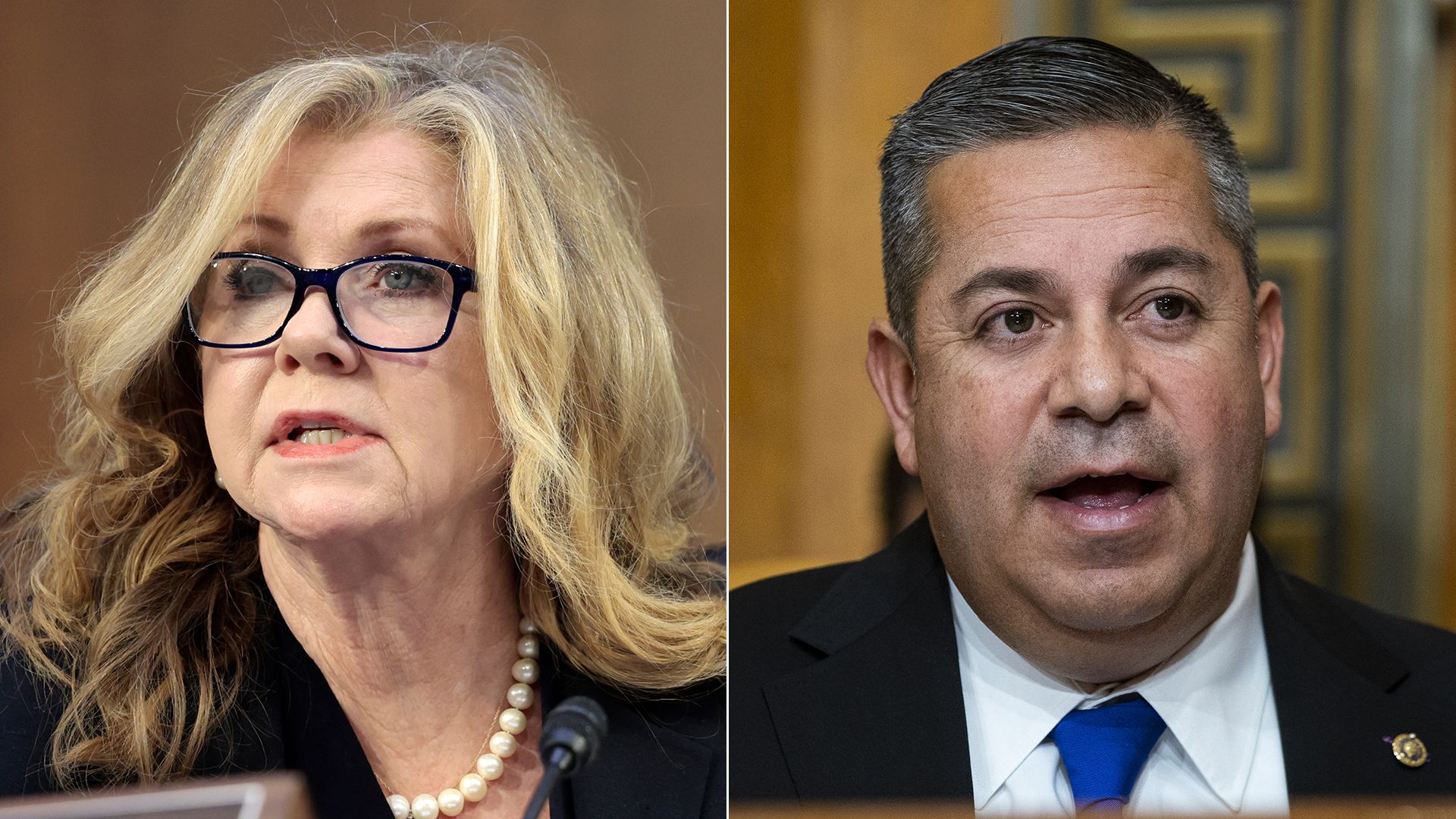
Blackburn and Luján. Photo: Anna Moneymaker and Al Drago/Getty Images
Sens. Marsha Blackburn and Ben Ray Luján today will introduce companion legislation to develop and accelerate near-term quantum applications, Maria exclusively reports.
Driving the news: Congress is continuing to prioritize tech innovation and competition this year, and quantum is one area in which the U.S. lacks a strategy with a short-term focus.
- The Quantum Sandbox for Near-Term Applications Act, introduced in the House last month, would foster public-private partnerships.
Zoom in: Quantum helped significantly reduce waiting times at a Port of Los Angeles pier that processes millions of containers each year.
Zoom out: Experts say quantum computing could be critical to improve and optimize complex supply chain processes.
What they're saying: "While Communist China has publicly acknowledged their goal to lead the world in quantum communications by 2049, it’s critical the United States provide an environment for entrepreneurs and companies to promote competition and continued innovation," Blackburn said in a statement.
- Luján: “I’ve been clear that as these innovative, emerging technologies continue to develop, it’s critical there are pathways into the commercial sector to grow our economy."
What's next: The National Quantum Initiative Act is up for reauthorization this year and is seen as the vehicle for the sandbox bill.
3. QOTD: The EARN IT Act

Illustration: Gabriella Turrisi/Axios
"Section 230 had a reason to exist, to give these platforms a chance to get up and running. They're up and running. They're the largest companies in the world. They're making hundreds of billions of dollars, and part of their business model is destroying people’s lives. And they're gonna beat us. We're going to pass the EARN IT Act today, but it'll go nowhere.… They've got a ton of money and every time you try to do something, there's some group saying, you know, 'You’re destroying speech.' And, you know, the money talks."— Judiciary ranking member Lindsey Graham at today’s business meeting, where the committee favorably reported out the EARN IT Act for the third time in the bill’s history
"We can have these hearings after hearings after hearings. We can hear all the victims and all the surviving parents tell these terrible stories.… And then if we step back and say, 'This is just too big and complicated and we're against too big a situation here and can't change it,' shame on us."— Judiciary Chair Dick Durbin, speaking after Graham at today's business meeting
4. 1 fun thing: Microsoft educates the Beltway

Inside Microsoft’s Digital Transformation Showcase. Photo: Maria Curi
Maria recently crossed the bridge to Arlington to tour Microsoft's Digital Transformation Showcase, an immersive experience launched in March for small groups to learn how tech can aid the government.
Why it matters: Government officials need to have a solid understanding not just of what they're regulating, but also how technology can best be leveraged to achieve their missions, including fighting climate change and responding to natural disasters.
What's happening: The showcase features real-world examples of the cloud, AI, machine learning and 5G in action.
- Although international delegations have visited, the project's main target is the U.S. federal government. Most cabinet-level agencies, such as the Defense and Agriculture departments, have toured.
- The company plans to draw in more D.C. players, including from Capitol Hill, think tanks and industry associations.
What they're saying: "We work with a lot of government leaders who aren’t technical, but they realize they have to understand technology to achieve their missions," said Microsoft director of strategic marketing and partnerships Jennifer Rudy.
- "Over time, the hope is to grow business but grow it in a way where we are partnering with these agencies in a trustworthy fashion."
Editor’s note: Tuesday's Q&A with Sen. Michael Bennet has been corrected to reflect that Bennet sent a letter urging Apple and Google to ban TikTok from their app stores (but he did not introduce legislation for such a ban).
✅ Thank you for reading Axios Pro Policy, and thanks to editors Mackenzie Weinger and David Nather and copy editor Brad Bonhall.
- Do you know someone who needs this newsletter? Have them sign up here.
View archive