Axios Pro tracker: Tech policy bills to watch in the lame duck



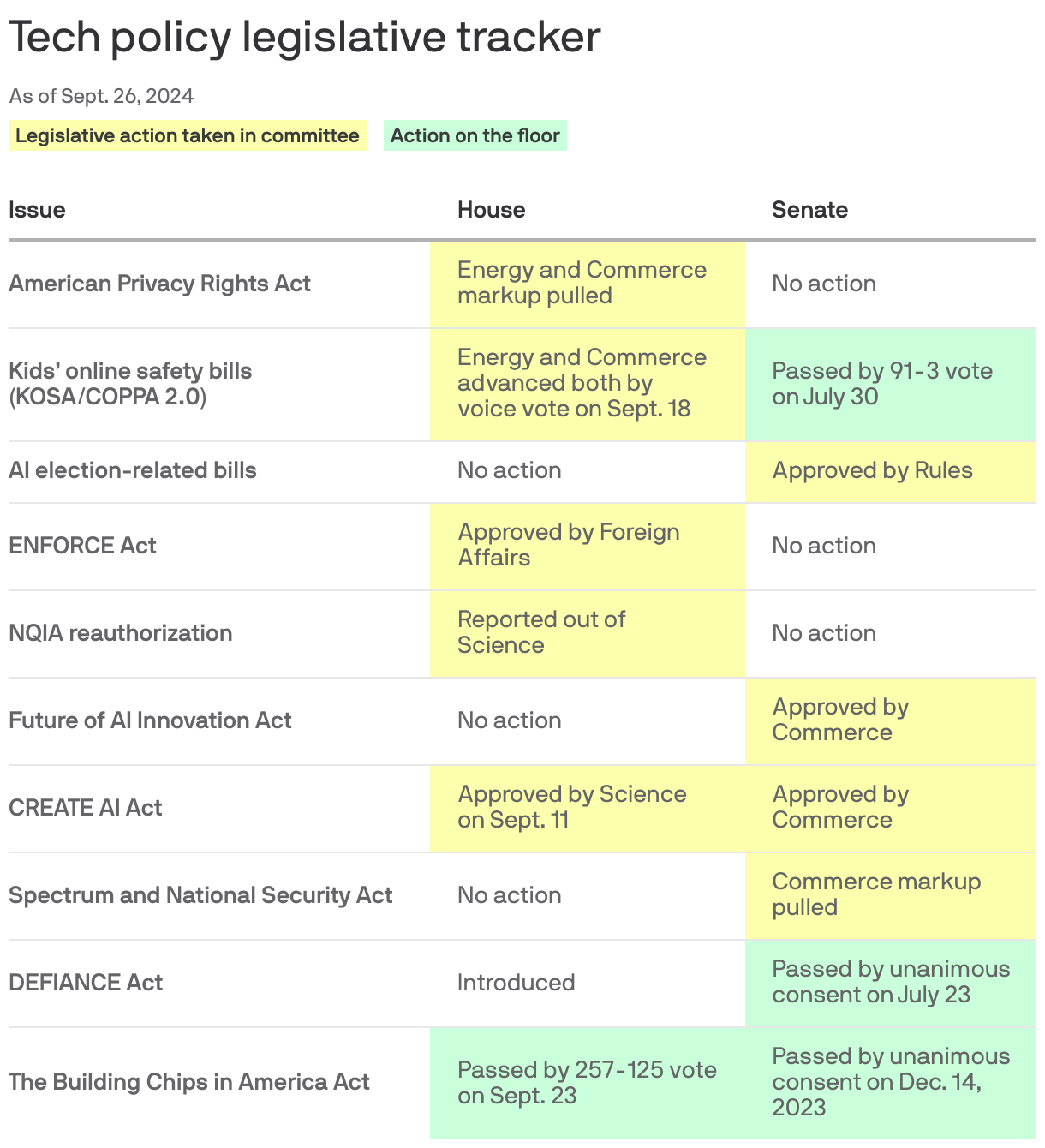
With lawmakers off until after the election and only a short lame duck session left, here's our latest cheat sheet to keep tabs on the most consequential tech bills in play before the end of this year.
The big picture: Lawmakers weren't as active on tech bills prior to the pre-election recess compared to just before the one in August. Still, we expect tussling over the same main topics when election season is over: the future of kids online safety, privacy and AI.
- Those debates may shift or die off depending on who takes or maintains control of the House, Senate and White House.
Here's a rundown of what we're watching:
American Privacy Rights Act
The issue: Bipartisan legislation, negotiated between House Energy and Commerce Committee Chair Cathy McMorris Rodgers and Senate Commerce Chair Maria Cantwell to enact a comprehensive federal privacy standard.
Status: Advanced out of E&C subcommittee in May, but CMR scrapped the full committee markup scheduled for the end of June following a lack of leadership support.
- Has not yet been introduced in the Senate, but Cantwell told Axios that efforts to pass the bill are not dead. An effort to get it attached to the successful KOSA/COPPA 2.0 markup in September did not pan out.
What's next: Bill sponsors would have to address concerns raised by members, including House leadership, if there's any hope of regaining momentum.
Kids Online Safety
The issue: The Kids Online Safety Act and COPPA 2.0 are moving in tandem, as the safety by design and privacy bills are viewed as complementary.
Status: The Senate on July 30 passed the KOSA/COPPA 2.0 package — dubbed the Kids Online Safety and Privacy Act — in a bipartisan 91-3 vote.
- KOSA and COPPA advanced out of House Energy and Commerce in September by voice vote, but many disagreements remain between Democrats and Republicans on the text.
What's next: House E&C didn't take up the Senate's KOSA/COPPA package, and instead advanced different versions of the legislation.
- That means if kids online safety bills make it off the House floor, the measures will have to go through some sort of reconciliation process before heading to President Biden's desk.
AI in elections
The issue: Efforts to ban AI for deceptive political content, require AI disclaimers and prepare election officials to deal with the technology.
Status: The Senate Rules Committee approved three bills in May. Chair Amy Klobuchar tried to pass the Protect Elections from Deceptive AI Act and the AI Transparency in Elections Act by unanimous consent on July 31, but Sen. Deb Fischer objected. No House action.
What's next: The failed UC attempt signals that this issue is at a standstill ahead of the election. We don't predict any further action on this topic this year.
ENFORCE Act
The issue: Lawmakers are turning up the heat on China, seeking to limit AI software and hardware exports to the top U.S. tech competitor.
Status: Cleared the House Foreign Affairs Committee. No Senate action.
What's next: House leaders are highly interested in addressing outbound investments to foreign adversaries, but exactly how to place restrictions remains up in the air.
Quantum reauthorization
The issue: The National Quantum Initiative Act expired Sept. 30, 2023. Some lawmakers are working to revive the effort, which proponents say is key to global competitiveness and national security.
Status: The bill to reauthorize the NQI was reported out of the House Science Committee on July 25. No action in the Senate.
What's next: This clears the way for floor action in the House. Other efforts to boost U.S. quantum activity are advancing through the NDAA.
Future of AI Innovation Act
The issue: Lawmakers are working to authorize government agencies and partnerships with the private sector to promote AI innovation and safety standards.
Status: The Senate Commerce Committee approved the bill on July 31. There is no House companion.
What's next: The legislation is awaiting action on the Senate floor, or it could move in a larger, year-end package.
CREATE AI Act
The issue: The bipartisan, bicameral bill would authorize the National AI Research Resource to boost participation in the technology's development.
Status: The Senate Commerce Committee approved the bill on July 31. The House Science Committee approved the bill on Sept. 11.
What's next: The bill is now ready for a floor vote in both chambers. It could also move as part of a bigger package later this year.
Spectrum and National Security Act
The issue: Congress let the FCC's spectrum authority lapse for the first time in decades. This bill, led by Senate Commerce Committee Chair Maria Cantwell, would return authority to the agency and funnel auction proceeds to the now-defunct Affordable Connectivity Program.
Status: The Senate Commerce Committee hasn't taken up the legislation, and has delayed a markup four times.
What's next: We'll be tracking whether a different iteration of the Cantwell bill is introduced and gets a markup in the lame duck.
DEFIANCE Act
The issue: The bipartisan DEFIANCE Act would crack down on non-consensual AI pornography and create a federal civil right of action for people who are victims of intimate digital forgeries.
Status: The Senate passed the legislation by unanimous consent on July 23. Rep. Alexandria Ocasio-Cortez has introduced the bipartisan companion legislation in the House.
What's next: All eyes on the House. See Maria's reporting on the latest here.
The Building Chips in America Act
The issue: The bill speeds up reviews of semiconductor manufacturing projects by exempting certain CHIPS Act projects from some environmental permitting requirements.
Status: The House passed the Building Chips in America Act in a 257-125 vote on Sept. 23. The Senate passed it by unanimous consent in December 2023.
What's next: President Biden will sign the bill into law soon.
