January 23, 2024

🌮 Eat up, it's Tuesday. We've got a new recurring feature on lobbying for you today.
🎶 Today's last song is from our esteemed copy editor Brad Bonhall: "The Welsh Tornado" by Tommy Emmanuel.
1 big thing: A look at 2023 energy lobbying
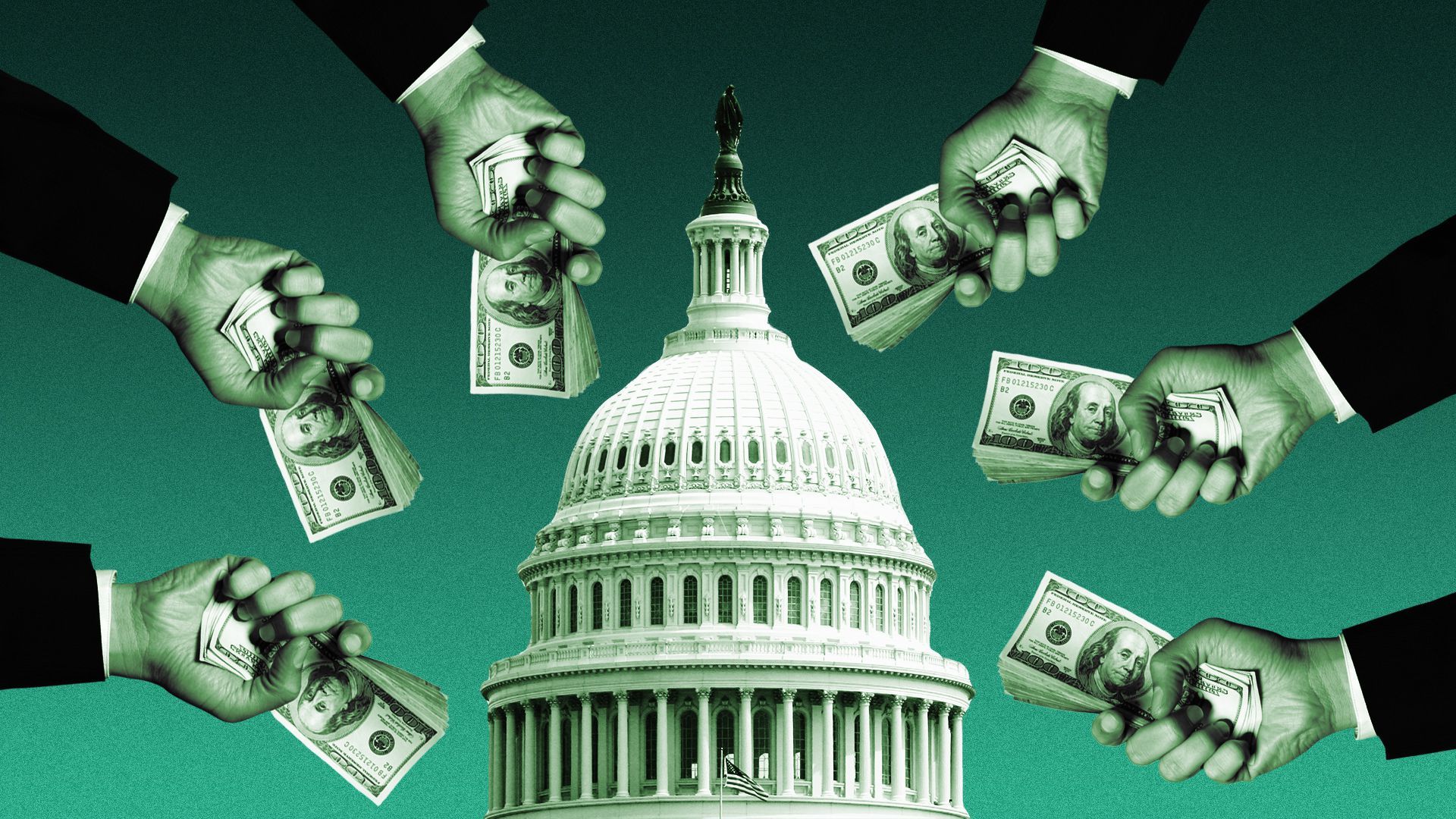
Illustration: Shoshana Gordon/Axios
Many energy companies and trade organizations boosted their lobbying spending in 2023, despite the Hill's legislative stagnation, Nick writes.
Why it matters: The industry desperately wants Congress to make it easier to build projects funded by the IRA and infrastructure law.
- It's generally not possible to tell what stance groups and companies are taking on a given bill in federal lobbying filings, but they offer a good crystal ball of what to watch.
Zoom in: The latest round of lobbying disclosures, filed yesterday, shows that the energy industry zeroed in on federal "permitting reform," trade issues and IRA implementation in the last quarter of 2023.
- The American Petroleum Institute reported lobbying on "draft legislation related to judicial review and changes to the Administrative Procedure Act," as well as a draft on "permitting modernization for leases on federal lands and pipelines."
- H.R. 1, the GOP's energy and permitting bill, and House Democrats' transmission policy proposals both showed up in disclosures from the Edison Electric Institute and other trades.
- Hydrogen was another recurring theme. The American Clean Power Association and companies like BP America are focused on implementation of the 45V tax credit — the subject of a very public letter war between industry and environmental groups.
By the numbers: Oil companies and utilities remain the dominant lobbying force in the energy space, even if they're spending less than they did during the Obama era. Some notable numbers:
- American Petroleum Institute: $1.7 million in Q4 and $6.2 million total in 2023 (compared with $4.4 million in 2022).
- American Clean Power Association: $430,000 in Q4 and $1.9 million total in 2023 (compared with $1 million in 2022).
- Edison Electric Institute: $2.9 million in Q4 and $11.5 million total in 2023 (compared with $10.5 million in 2022).
- Nuclear Energy Institute: $560,000 in Q4 and $2 million total in 2023 (compared with $1.6 million in 2022).
- Exxon Mobil: $2 million in Q4 and $6.4 million total in 2023 (compared with $7.7 million in 2022).
- Shell USA: $1.7 million in Q4 and $7 million total in 2023 (compared with $6.7 million in 2022).
- BP America: $1.5 million in Q4 and $4.1 million total in 2023 (compared with $3.9 million in 2022).
- Occidental Petroleum: $4.4 million in Q4 and $12.2 million total in 2023 (compared with $10.5 million in 2022).
- Orsted North America: $360,000 in Q4 and $1 million total in 2023 (compared with $570,000 in 2022).
- Southern Company: $2.9 million in Q4 and $10.9 million total in 2023 (compared with $9.2 million in 2022).
- NextEra Energy: $2 million in Q4 and $7.6 million total in 2023 (compared with $7.3 million in 2022).
A few other things caught Nick's eye in the Q4 disclosures:
- The PROVE IT Act — the data bill that's part of the Hill's carbon tariff talks — got lobbying attention from API and the Independent Petroleum Association of America (both have backed the bill).
- API, ACP and wind developer Orsted, among others, have been lobbying on the House's Coast Guard authorization bill. It has a provision limiting foreign offshore workers that developers say could derail the offshore wind industry.
- ACP also reported lobbying on the Leveling the Playing Field 2.0 Act, a bill they and other business trades "strongly oppose."
- That legislation would strengthen the Commerce Department's authority to conduct circumvention investigations (like the solar probe that caused so much fuss last year).
2. Industry leader: Biden better than Trump on biofuels

Geoff Cooper. Photo: courtesy of Renewable Fuels Association
This year is make or break for the future of the biofuels industry, Renewable Fuels Association CEO Geoff Cooper told Jael.
Why it matters: Biofuels have become powerful in D.C. thanks to their nexus at the center of energy markets, agriculture policy, and arguably the industry's relevance to the Iowa caucuses.
- But as we've explained, the industry sits at a crossroads. Federal ethanol minimums in gasoline expired. Biofuels groups are fighting for favorable treatment under the IRA. And the sector could face headaches if Donald Trump is re-elected.
Cooper met with Jael at the Pret a Manger near the EPA's headquarters. His remarks have been edited for clarity.
What do you think drives the administration's decision-making on your issues, broadly speaking?
I know there's a lot of people in my industry that think this administration has a one-track mind when it comes to decarbonizing light-duty transportation. They see all these headlines about electric vehicles and think this is all the administration cares about. But … we've seen a broader approach.
Take a look at the renewable fuel standard, for instance. They've been very favorable for us. Some of the things they've done to facilitate higher blends of ethanol in gasoline like E15. They have been quite supportive of renewable fuels.
Donald Trump has told Iowans he "fought for Iowa ethanol like no president in history." But who's been better, Trump or Biden?
When Mr. Trump was president, we did see some progress on some key priorities for ethanol and renewable fuels. But we also had those small refinery exemptions that were granted. The RFS was sort of picked apart from the inside by EPA at that time.
And again, we always felt Mr. Trump himself was pretty good on ethanol issues, biofuel issues. But it was the people around him — first Scott Pruitt, then Andy Wheeler.
If you look at key metrics around the health and growth of the industry … I think if you compare, look at those metrics over the last three years, versus the preceding four years, you'd see [we've] done better under this administration.
Go deeper: Read what Cooper told us about the growing bipartisan pushback to CO2 pipelines.
3. Catch me up: Lots o' letters, bundles o' bills

Illustration: Shoshana Gordon/Axios
🌽 1. Corny flight fuel: Sens. Amy Klobuchar and Jerry Moran have a bipartisan bill to boost production of "sustainable" aviation fuel, or SAF.
- The bill would also establish a common definition of SAF. It arrives amid wrangling over what kinds of biofuel can qualify for an IRA credit.
⚡️ 2. EVs go postal: The Postal Service has EV charging stations now. Vrrrooom!
🏦 3. Angry Basel blues: A bipartisan letter's out today opposing proposed CFTC regulations aimed at strengthening banks against leveraged risk.
🤖 4. Energy odd couple: A new Senate bill from Sherrod Brown and Ted Cruz would halt DOE's proposed distribution transformer efficiency rules amid concerns about shortages.
✅ Thank you for reading Axios Pro Policy, and thanks to editors Chuck McCutcheon and David Nather and copy editor Brad Bonhall.
View archive