Axios World

June 01, 2023
Welcome back to Axios World.
- We start tonight's edition (1,944 words, 7 minutes) in South Africa, before visiting the Russia-Ukraine border and looking into a bizarre and tragic incident involving Israeli and Italian spies.
🇫🇷 Heading to Cannes Lions? Check out our daily lineup of Axios events and request an invite here.
1 big thing: South Africa grapples with two Russia-related crises
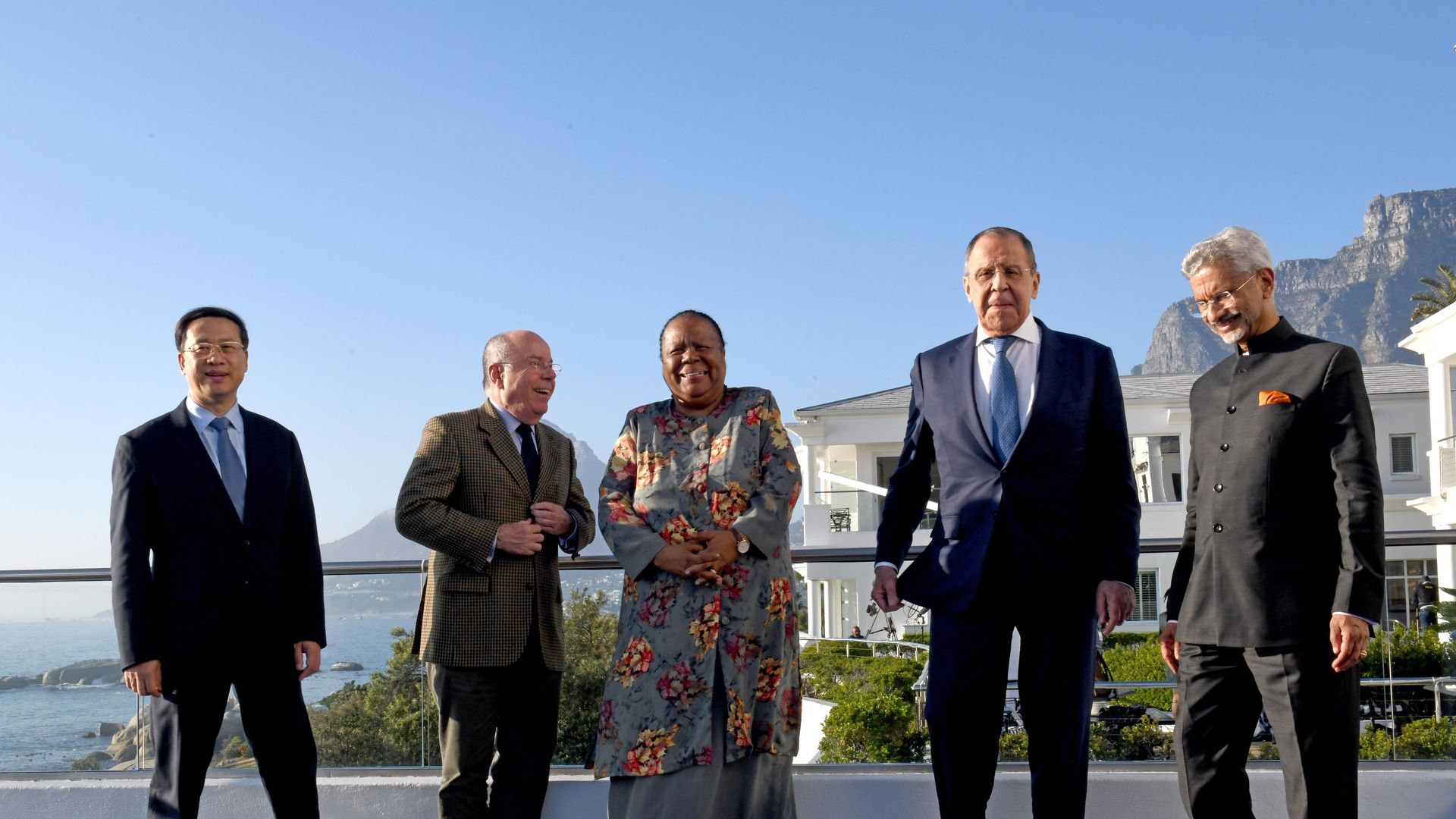
From left, Chinese Deputy Foreign Minister Ma Zhaoxu, Brazilian Foreign Minister Mauro Vieira, South African Foreign Minister Naledi Pandor, Russian Foreign Minister Sergey Lavrov and Indian Foreign Minister Subrahmanyam Jaishankar at today's BRICS meeting in Cape Town. Photo: Handout via Getty
Two Russia-related controversies are gripping South Africa: U.S. accusations that weapons were shipped from Cape Town to Russia, and Vladimir Putin's invitation for an upcoming summit despite an international arrest warrant.
Why it matters: South Africa is trying to maintain its warm relations with Russia, its official neutrality on the war in Ukraine, and its economic relationship with the U.S. That juggling act is proving very difficult to sustain.
Driving the news: South Africa is hosting top diplomats from the other BRICS countries — Brazil, Russia, India and China — ahead of a leader-level summit in August.
- Foreign Minister Naledi Pandor said today that the government is examining its "legal options" should Putin decide to attend the summit.
- MPs from the ruling African National Congress (ANC) have proposed legislation to nullify Pretoria's obligation to arrest leaders wanted by the International Criminal Court. Meanwhile, the opposition Democratic Alliance (DA) plans legal action to force authorities to arrest Putin if he visits.
- Influential former President Thabo Mbeki told a local radio station he expects the summit to be relocated: "Because of our legal obligations we have to arrest President Putin, but we can't do that."
Then there are the explosive allegations from U.S. Ambassador Reuben Brigety that weapons were secretly shipped from South Africa to Russia.
- A Russian cargo ship, the Lady R, turned off its transponder before making an unscheduled stop in December at a naval base in Cape Town, where it was loaded at night.
- Brigety said on May 11 that he would "bet my life" that weapons and ammunitions were loaded onto it — comments that reportedly angered not only his host country, but also some colleagues at the State Department, who didn't want a rift with Pretoria. He has since softened his tone but not walked back the claim.
- Senior South African officials have denied and angrily denounced the allegations, but President Cyril Ramaphosa appointed a retired judge to investigate them.
State of play: Like its BRICS partners Brazil, China and India, as well as many other countries in Africa, South Africa has largely refrained from directly criticizing Russia's invasion, abstained from UN votes on that topic, and called for peace talks.
- Ramaphosa also blamed NATO after the invasion and went ahead with military exercises with Russia in February.
The big picture: Many senior ANC figures first developed ties to Moscow — including education and military training, in some cases — when the Soviet Union was backing the anti-apartheid struggle. The countries have maintained close ideological links since the ANC took power in 1994.
- Nelson Mandela and his successor Mbeki criticized what they saw as an imbalanced global order, while also positioning South Africa as a "bridge" between the Global South and the economic powers in the West, says Christopher Williams, a research fellow at the University of the Witwatersrand in Johannesburg.
- Pretoria moved closer to Moscow and Beijing following the 2008 financial crisis, the election of Jacob Zuma in 2009, and South Africa's invitation to join the BRICS in 2010.
- A strategic partnership agreement signed in 2013 made Moscow the closest thing Pretoria has to a formal ally.
Yes, but: The economic relationship is fairly minimal, and a controversial multibillion-dollar nuclear power project Zuma pursued with Russia never got off the ground.
- Still, both Russia and South Africa regularly criticize what they see as the hypocrisy of the West and international institutions — for example, the ICC's decision to pursue war crimes charges over the invasion of Ukraine but not over the invasion of Iraq.
What to watch: The government appears to be looking for a work-around whereby the BRICS summit will be moved or Putin won't attend in person, Williams says. Meanwhile, Ramaphosa gave the panel investigating the Lady R. incident eight weeks to file its report.
- If Brigety's allegations are borne out, the U.S. will likely be disinclined to renew South Africa's preferential trade status, Williams says.
2. War in Ukraine coming home to Russia
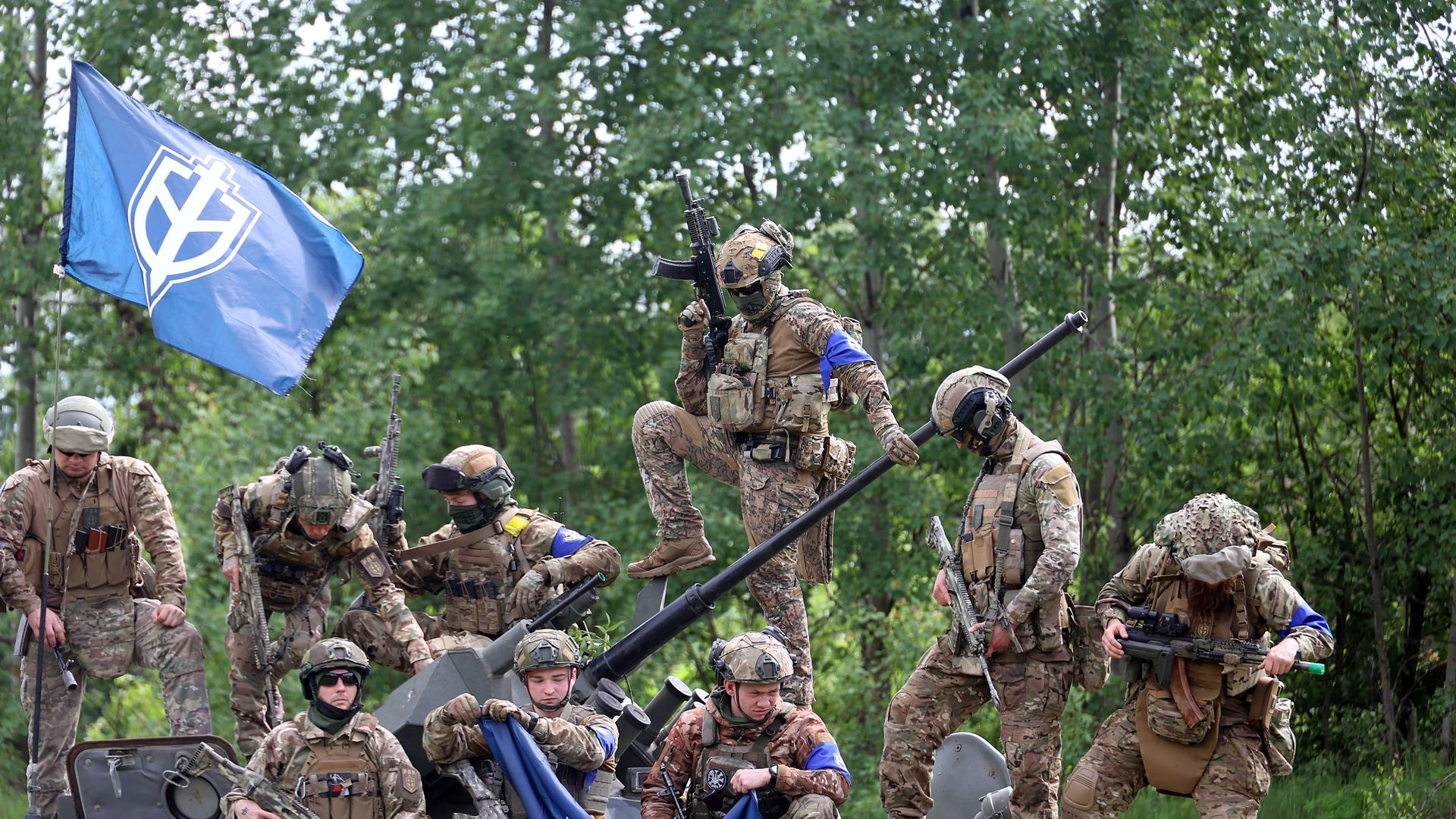
Fighters from the anti-Putin Russian Volunteer Corps, which claimed credit for a recent raid in Belgorod. Photo via Getty
Russia says its forces repelled a cross-border raid into the Belgorod region today by pro-Ukraine paramilitaries.
Driving the news: The raid was reportedly by the same militia groups, led by anti-Putin Russians, who conducted a two-day operation in Belgorod last week.
- Meanwhile, local authorities have reported an increase in shelling at industrial sites and other facilities on the Russian side of the border.
- Belgorod's governor announced a voluntary evacuation effort for children yesterday.
Zoom out: Residential areas of Moscow also came under attack on Tuesday for the first time since explosions first sounded in Kyiv 460 days earlier.
- The Russian capital had previously been largely shielded from the conflict, apart from the effects of sanctions. Kyiv, meanwhile, has faced attacks almost daily for a month, with three more people killed overnight.
Breaking it down: The Kremlin is following its standard playbook, writes Russian political analyst Tatiana Stanovaya: downplay the setbacks; paint Ukraine as the aggressor; insulate Putin from the fallout. But it might not work:
- "Saboteurs on tanks in the Belgorod region and drones in Moscow are a completely new level of danger, in fact, a physical threat to the population."
What to watch: The attacks in both directions could be aimed in part at shaping the battlefield and the narrative ahead of Ukraine's coming counteroffensive.
In related news... NATO leaders are squabbling over what to offer Ukraine, short of immediate membership, ahead of their summit in July.
3. Africa news roundup
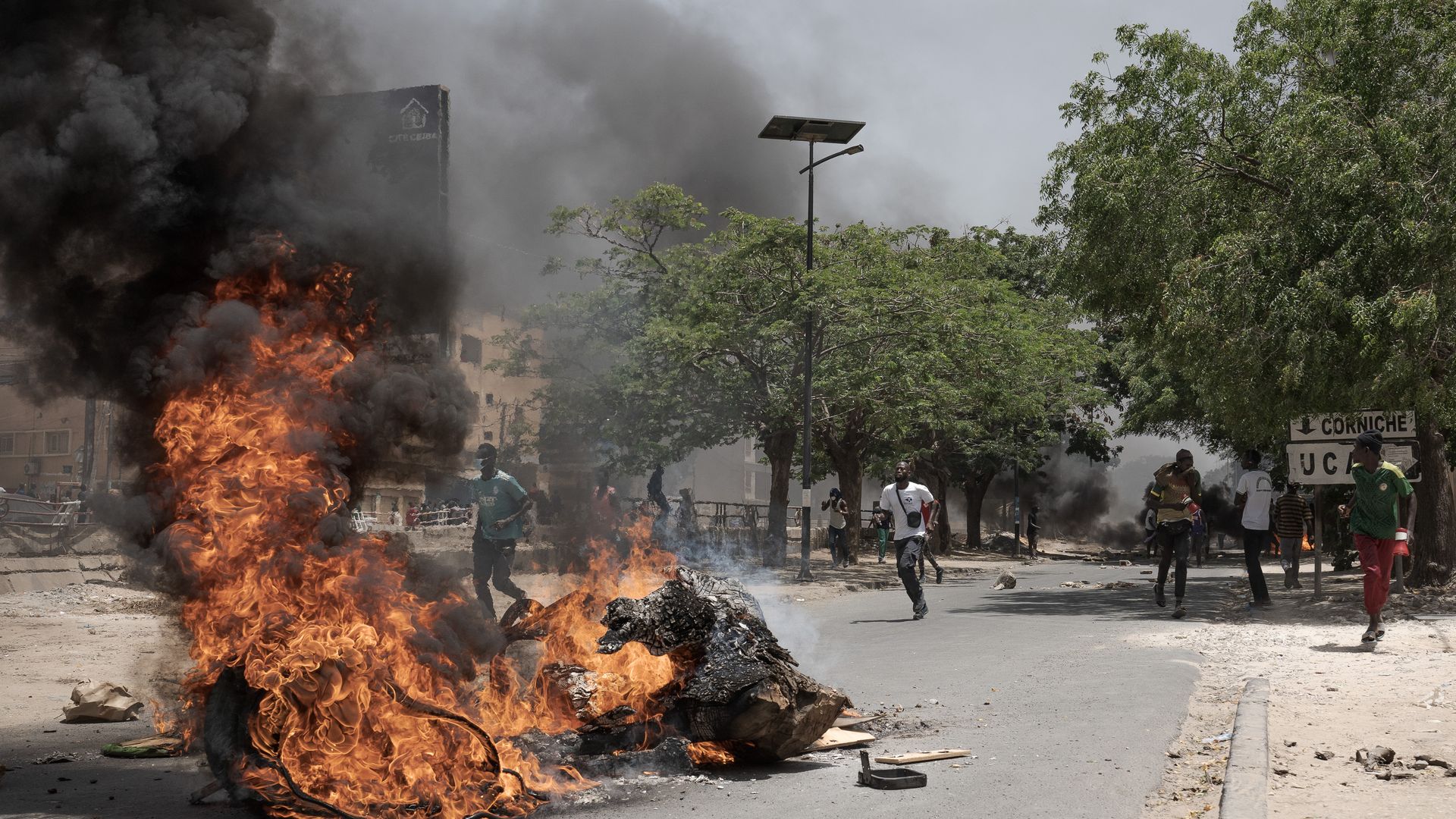
Protests today in Dhakar, Senegal. Photo: Annika Hammerschlag/Anadolu Agency via Getty
1. A court in Senegal sentenced opposition leader Ousmane Sonko to two years in prison today for "corrupting the youth," prompting large protests and clashes with security forces.
- Why it matters: Sonko denies the charges, but the conviction means he's currently ineligible to run in the presidential election next February. His allies say President Macky Sall is trying to get him out of the way in order to seek a constitutionally dubious third term.
2. New Nigerian President Bola Tinubu is off to a shaky start after an apparently off-the-cuff remark during his inauguration about ending fuel subsidies sent Nigerians streaming to gas stations, prompting long lines and shortages.
- He later clarified that the change wouldn't come into effect until the end of June.
3. The U.S. today announced sanctions on both sides in the conflict in Sudan.
- State of play: The Sudanese Army said yesterday that it was cutting off talks with the rival Rapid Support Forces. A cease-fire that has been only partially observed expires on Saturday.
4. Ugandan President Yoweri Museveni declared today that no one can stop his country from enforcing one of the world's harshest anti-homosexuality laws.
- Driving the news: Biden called for the law's "immediate repeal" and threatened sanctions on Monday.
5. Talks aimed at resolving differences between Kenyan President William Ruto and opposition leader Raila Odinga have been suspended, meaning large anti-government protests could soon resume.
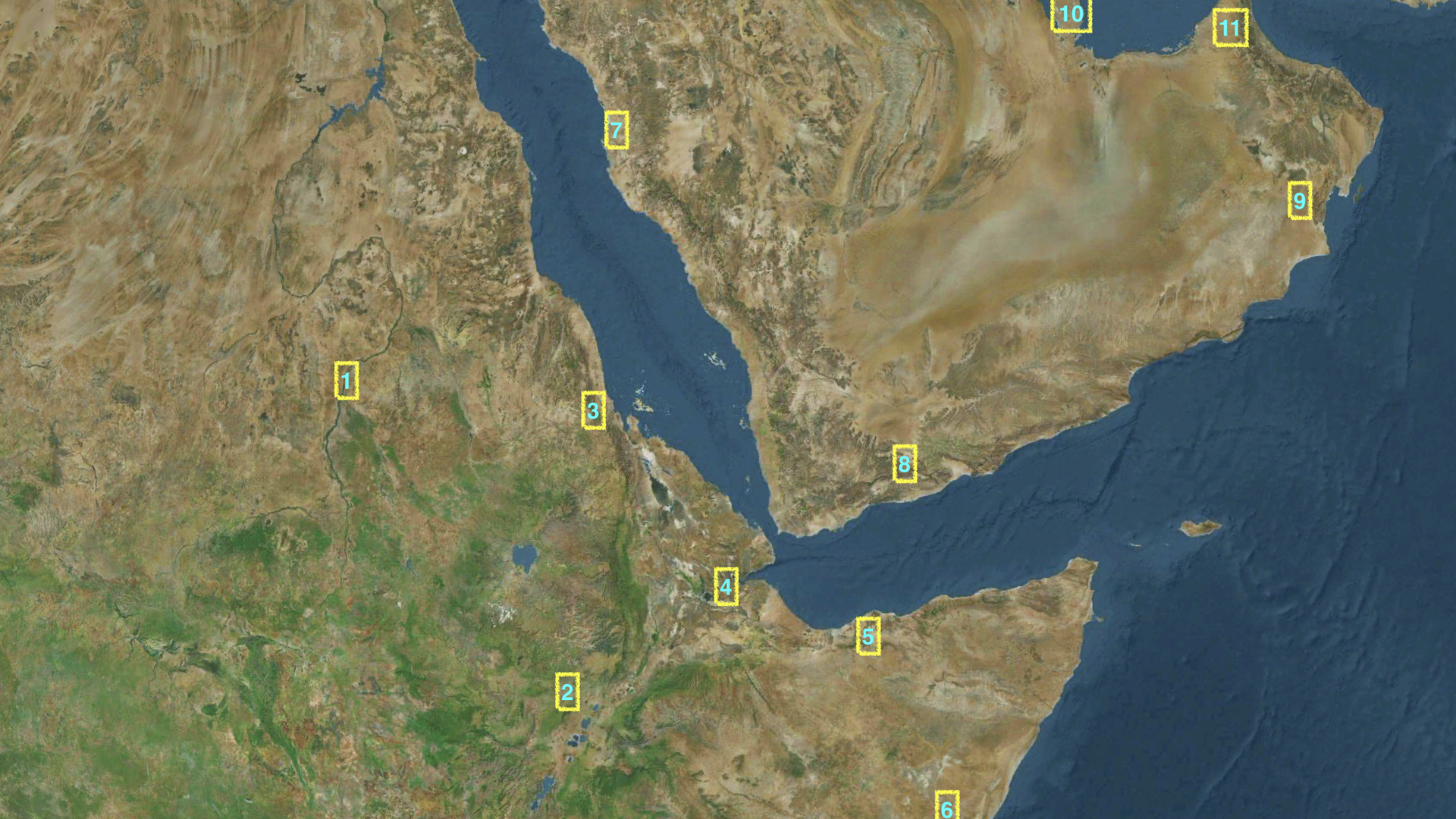
Bonus: Where in the World?
Screengrab via Apple maps
Can you name the cities and countries or territories labeled above?
1. Capital city from which tens of thousands of people began fleeing civil conflict last month
2. City that hosts African Union HQ
3. Country sometimes called the "North Korea of Africa"
4. Small coastal country, and the only country that hosts both U.S. and Chinese military bases
5. Self-governing but unrecognized state that broke away from #6
6. Horn of Africa country facing a looming famine
7. Saudi Arabia's major port city and commercial hub
8. War-torn country with one of the world's worst humanitarian crises
9. Sultanate that has brokered U.S.-Iran diplomacy
10. and 11. Small energy-rich kingdoms that play an outsized role in regional affairs.
Scroll to the bottom for answers.
4. Interview: Why the Czech Republic stands with Taiwan
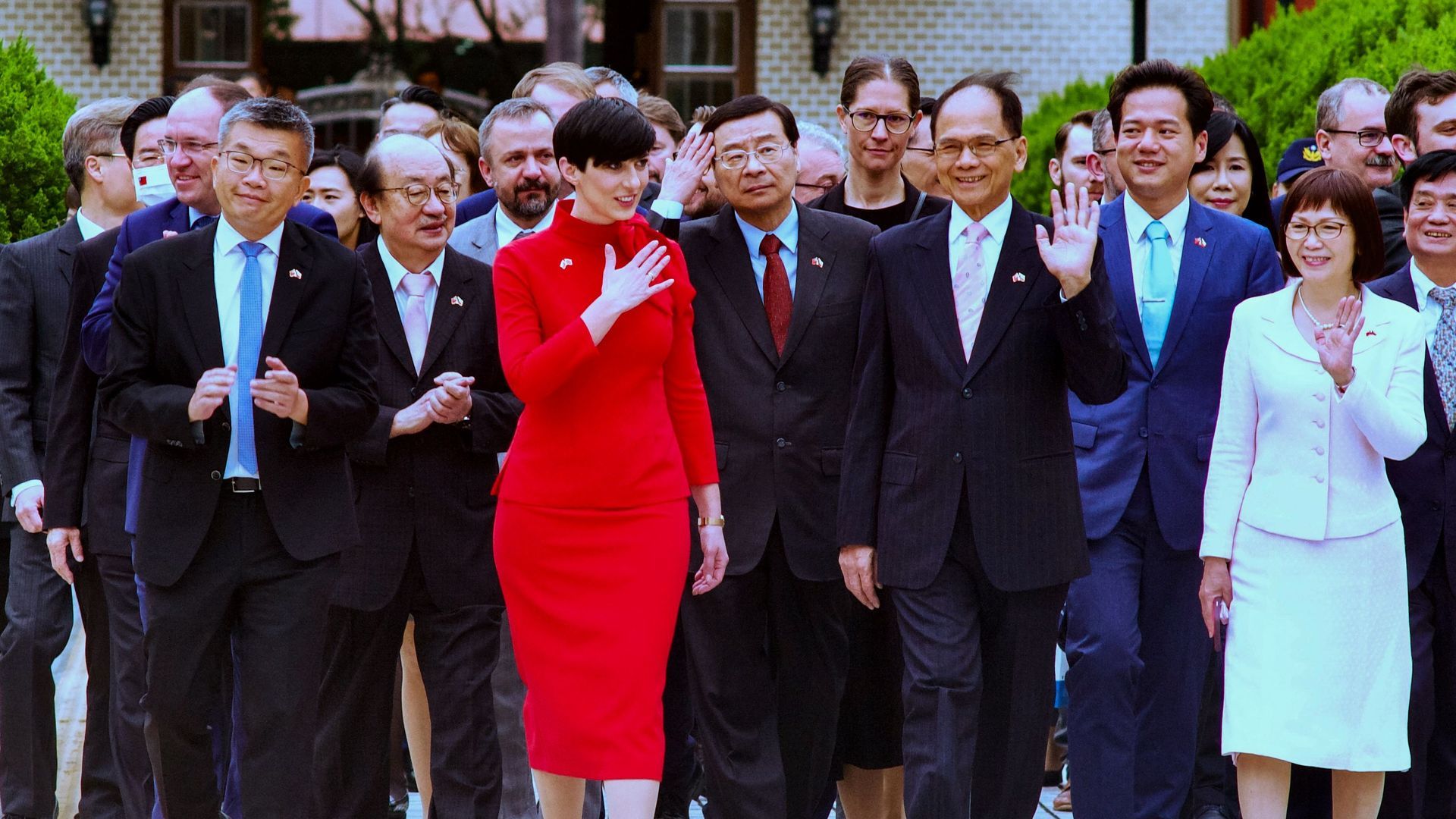
Taiwan Parliament Speaker You Si-kun (third from right) accompanies Markéta Pekarová Adamová (center), speaker of the Czech Chamber of Deputies, upon her arrival in Taipei. Photo: Sam Yeh / AFP via Getty Images.
The Czech Republic is proud to be one of Taiwan's most vocal backers in Europe, despite threats from Beijing, the speaker of the Czech Chamber of Deputies says.
Driving the news: Speaker Markéta Pekarová Adamová led a 150-strong delegation to Taipei at the end of March. The agenda included not only talks on trade, but also on arms.
- Her delegation arrived two weeks after Petr Pavel, a former senior NATO general, replaced the China-friendly Miloš Zeman as the Czech Republic's president.
- Pavel spoke by phone with Taiwanese President Tsai Ing-wen in January after being elected, saying at the time that he hoped to meet Tsai. No European head of state has ever met a Taiwanese president.
- China's Foreign Ministry said the Tsai-Pavel call had “trampled on China’s red line" and urged Prague to “undo the negative impact of this incident so as to avoid irreparable damage to China-Czech relations.”
What they're saying: "We really value cooperation with partners that are democratic," Adamová said in an interview with Axios and two other media outlets last week in Washington.
- "This is not natural maybe for all the countries, they might be more pragmatic. But I think with Taiwan, it's combined with pragmatism as well." She says investments from Taiwan account for more jobs in the Czech Republic than investments from China.
Between the lines: Adamová told us that within the EU, only Lithuania has backed Taiwan as strongly as the Czech Republic. That comparison hints at the risks of Prague's approach.
- After Lithuania allowed Taiwan to open a "Taiwanese Representative Office" in Vilnius in 2021, Beijing blocked Lithuanian exports and even products like German car parts that used inputs from Lithuania.
- Secondary sanctions of that sort could be "devastating to Czech industry," a CFR analysis notes.
- Yes, but: Adamová argues that Beijing realizes its approach to Lithuania backfired, and can't afford to lose larger markets in Europe.
5. Data du jour: What it would take for China to reach net zero
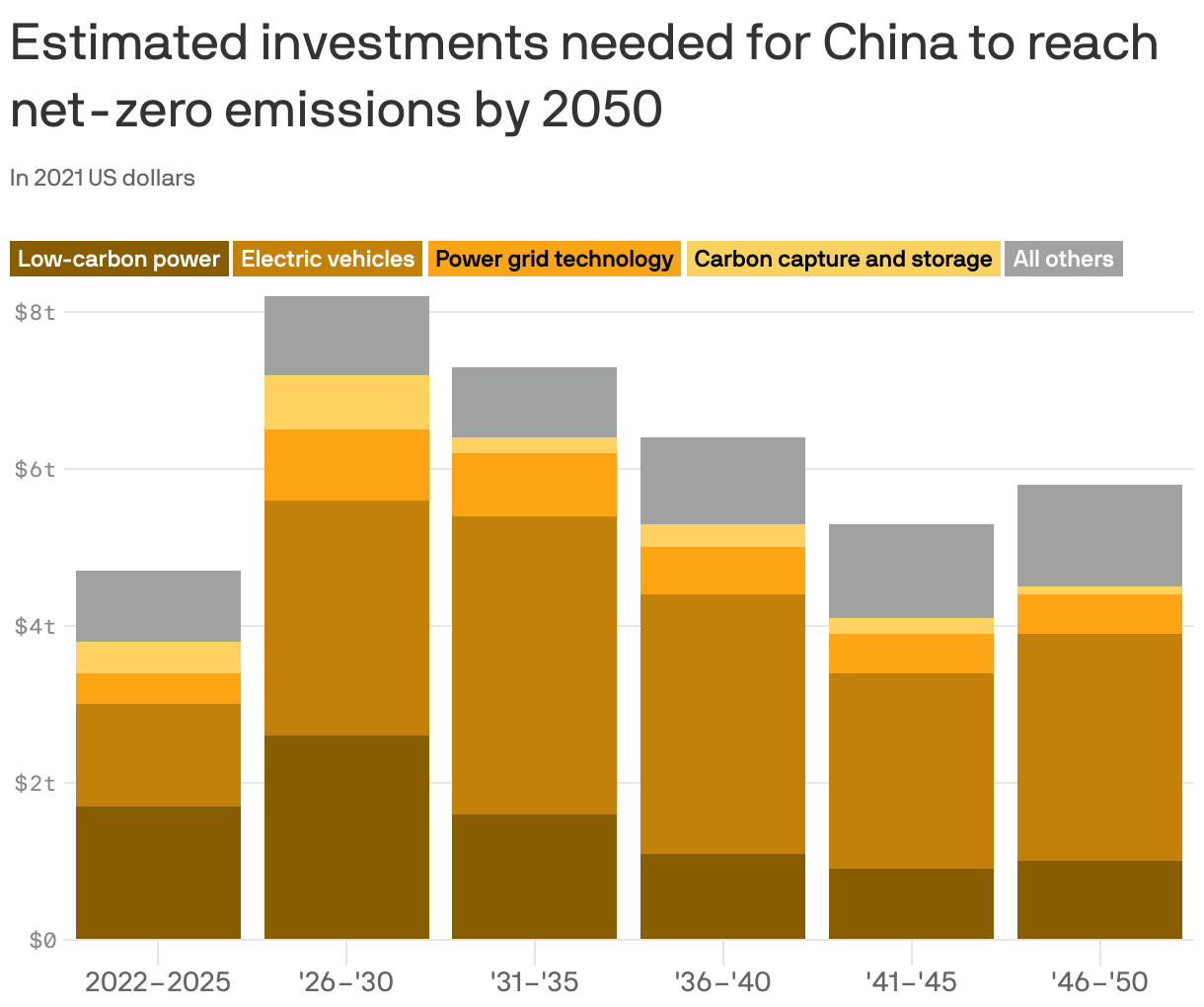
In theory, the world's biggest emitter could hit net-zero by 2050, Axios Generate's Ben Geman writes.
- The price tag: $38 trillion, with investment tripling to $1.66 trillion annually by the end of this decade, according to a BloombergNEF analyis.
- State of play: China is the global leader in renewables deployment — but also in coal-fired power generation.
More China headlines
Beijing rejected a U.S. request for the country's defense ministers to meet this week at the Shangri-La Dialogue in Singapore.
- The two superpowers are hardly on speaking terms, Axios China's Bethany Allen-Ebrahimian writes.
The flipside: Tesla CEO Elon Musk and JPMorgan CEO Jamie Dimon both visited China this week.
- Despite D.C.'s growing antagonism, business leaders still hope to showcase China's importance to economic growth, Axios' Javier David writes.
- Worth noting: U.S.-China trade is still at record-high levels.
6. Three offbeat headlines heading into the weekend
Twenty-one Italian and Israeli spies were aboard a boat that capsized and sank Sunday in a storm on Lake Maggiore in Northern Italy
- Two Italian spies and one former Mossad agent died, along with the Russian-born wife of the boat's skipper. Some injured agents were reportedly extracted from hospital beds to protect their identities.
- Speculation is running wild in the Italian press as to whether this was an operation — snooping on rich Russians, perhaps — or simply a "spy party" turned tragic. Local authorities say it was a birthday celebration.
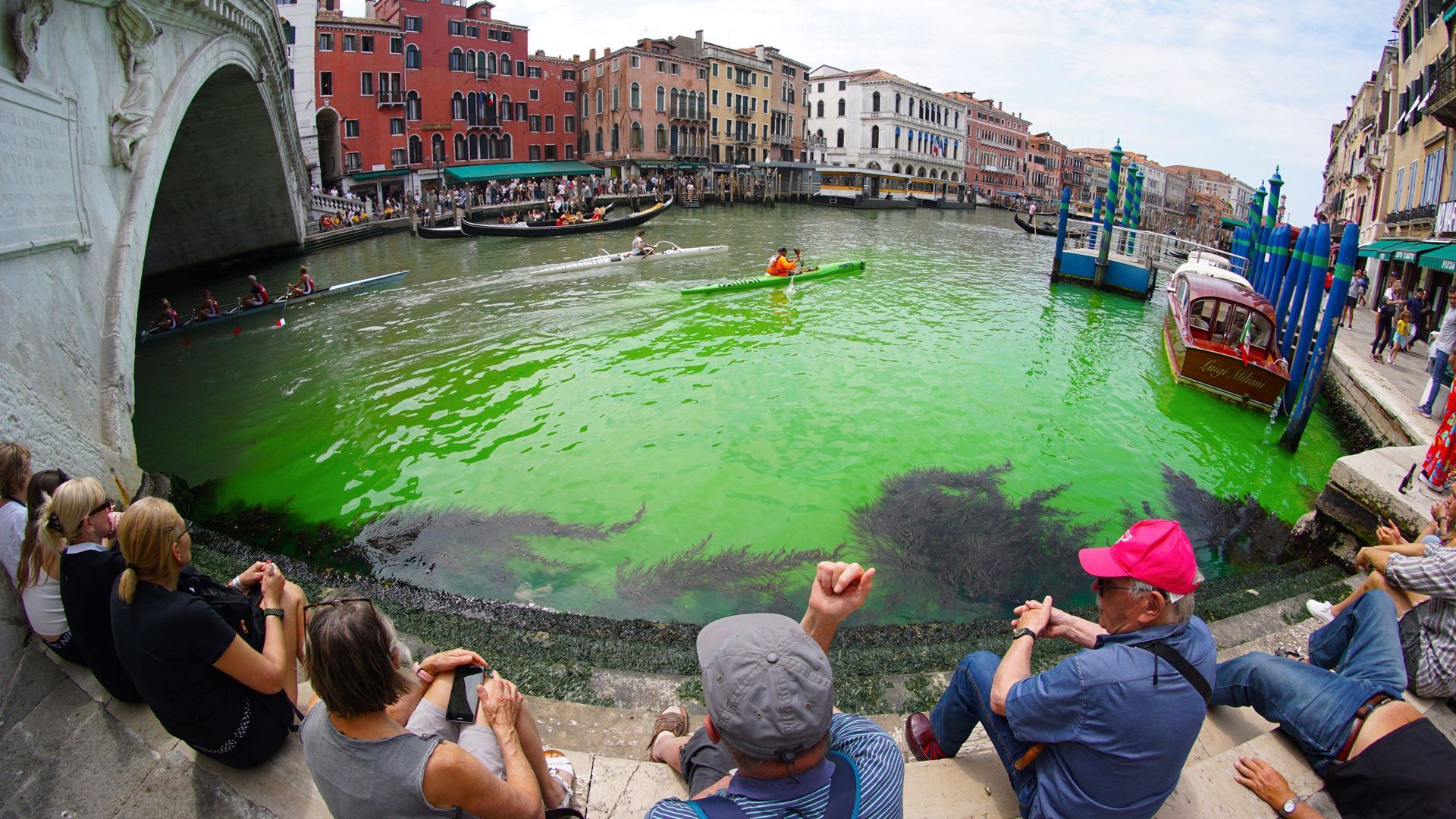
- Environmental regulators in Italy say they've figured out what turned Venice's Grand Canal bright green: the chemical fluorescein.
- Japanese Prime Minister Fumio Kishida's son has resigned as his political affairs secretary after photos emerged of an end-of-year party at which the younger Kishida and other guests posed for photos as if they were members of the Cabinet or holding a news conference.
7. Stories we're watching
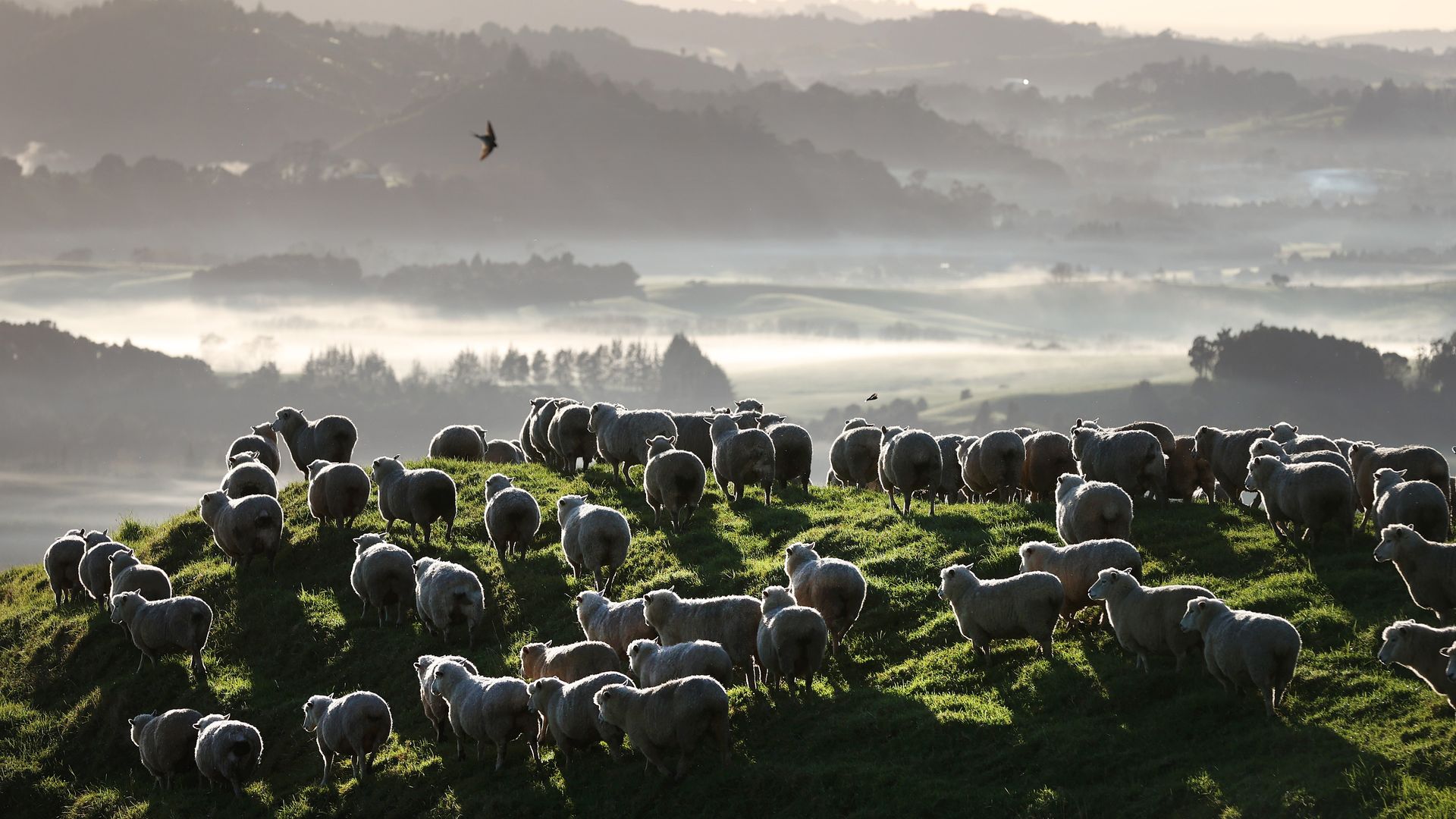
New Zealand seems like a nice place to be a sheep. Photo: Fiona Goodall/Getty Images
- ErdoÄźan wins re-election
- It's the summer of international travel — despite high prices
- U.S. warns of conflict in space as China plans moon landing
- Europe moves to regulate AI; don't expect global rules
- Food price controls on the menu in the U.K.
- Canada wildfires trigger air quality alerts
- New alarms over Antarctic ice melt
Quoted:
"Some said you had missed an opportunity to shut up. I think we also lost an opportunity to listen to you."— French President Emmanuel Macron, invoking Jacques Chirac, on the failure to listen to Eastern European countries about Russia.
Answers: 1. Khartoum; 2. Addis Ababa; 3. Eritrea; 4. Djibouti; 5. Somaliland; 6. Somalia; 7. Jeddah; 8. Yemen; 9. Oman; 10. Qatar; 11. UAE.
Sign up for Axios World

Take a tour of the most important stories shaping our world