Axios What's Next

May 14, 2024
The used EV market is showing signs of life, Alex reports today — good news for anyone who wants to go electric without breaking the bank.
Today's newsletter is 1,004 words ... 4 minutes.
1 big thing: Used EVs pick up steam
Electric vehicles accounted for 4.3% of sales on used car sales platform Carvana in the first quarter of 2024 — up from 1.8% in the same period last year.
Why it matters: It's another sign that there's finally a decent market for used electric cars — important for the overall EV transition, as new electric models still tend to be prohibitively expensive for many would-be buyers.
Follow the money: EVs' average selling price on Carvana dropped 16% year over year in Q1 2024, falling from $37,000 to $31,000.
- That's still pricey, but much less than $50,000-plus for your average new EV.
- The EV premium — that is, the average price differential of used EVs compared to their internal-combustion counterparts — fell from $13,000 to $7,000, Carvana says.
Zoom in: EVs made up the biggest share of Carvana's total Q1 2024 sales in Washington, D.C. (11.9%), California (9.6%) and Washington (8.9%) — numbers that generally mirror other measurements of EV adoption by state.
- And they cracked 4% of total sales for the first time in Florida (5.2%), Arizona (5.2%), Montana (5.1%) and more.
Caveat: Carvana represents only a slice of overall used car sales, so its data is best understood as a reflection of broader trends.
Between the lines: A credit of up to $4,000 for used electric and plug-in hybrid vehicles is making previously owned EVs even more affordable, Carvana says.
- The Nissan Leaf, Tesla Model 3 and Chevrolet Volt were the company's top-selling credit-eligible models in the first quarter of 2024.
What they're saying: "The significant, multi-year growth in new EV sales is a leading indicator of the potential of the used EV market," Carvana CEO Ernie Garcia said in a statement.
- "As a larger selection of EVs makes its way into the used fleet, prices normalize and tax credits become available, more used car buyers will have the opportunity to access the EV category."
Reality check: EVs made up less than 1% of all used car sales in 2023, Carvana notes based on Kelley Blue Book and MarketCheck data.
The bottom line: The rising popularity of used electric cars at more affordable prices underscores why so many automakers are scrambling to introduce cheaper EVs amid a slowdown in electric sales growth.
Editor's note: Cox Enterprises, which owns Kelley Blue Book through Cox Automotive, also owns Axios.
2. OpenAI debuts new, voice-focused model
OpenAI yesterday unveiled a new flagship AI model with more powerful capabilities — including smarter, faster real-time voice interactions.
Why it matters: OpenAI, whose ChatGPT kicked off the generative AI race, is now trying to hold its lead with rivals like Google in hot pursuit.
The big picture: OpenAI CTO Mira Murati said the new GPT-4o — that's a letter "o" for "Omni" — is a "huge step forward" for ease of use and speed.
Zoom in: In one demo, OpenAI showed one of its workers getting a real-time deep breathing tutorial.
- Another showed ChatGPT reading an AI-generated story in different voices, including super-dramatic recital, robotic tones and even singing.
- In a third, a user asked ChatGPT to look at an algebra equation and help the person solve it, rather than simply providing an answer.
OpenAI also showed the new chatbot working simultaneously across languages — helping translate between English and Italian, for instance.
- In all the demos, GPT-4o showed considerably greater personality and conversational skills than previous incarnations.
What's next: A bigger update to the underlying model is due to be unveiled later this year, Murati tells Axios.
🖖🏻 Alex's thought bubble: Universal translator, here we come.
3. Now trending: Sabbaticals


More companies are offering sabbaticals and more workers are taking them, according to data from Gusto, a payroll platform.
The big picture: A tight labor market, remote work and Gen Z expectations are all driving the trend, Gusto chief economist Liz Wilke tells Axios.
By the numbers: The share of workers likely on sabbatical — defined by Gusto as someone who is off for three weeks or more during a two-month period — rose from 3.3% in January 2019 to 6.7% as of January this year.
- The trend among Gen Zers was even more pronounced, jumping from 1.7% to 8%.
What they're saying: "Gen Zers are taking a lot more advantage of that benefit because they really value work-life balance," says Wilke.
The bottom line: Employers with less scale and capital to woo workers than the Walmarts of the world are "trying to respond in ways that they can," which is why Wilke says smaller businesses are offering the perk.
- And for workers who struggle with feeling like they can't or shouldn't take vacation, sabbaticals take some of that pressure off because the "company basically decides that [they] take the time off instead," she adds.
4. 📸 One fun thing: Backyard aurora
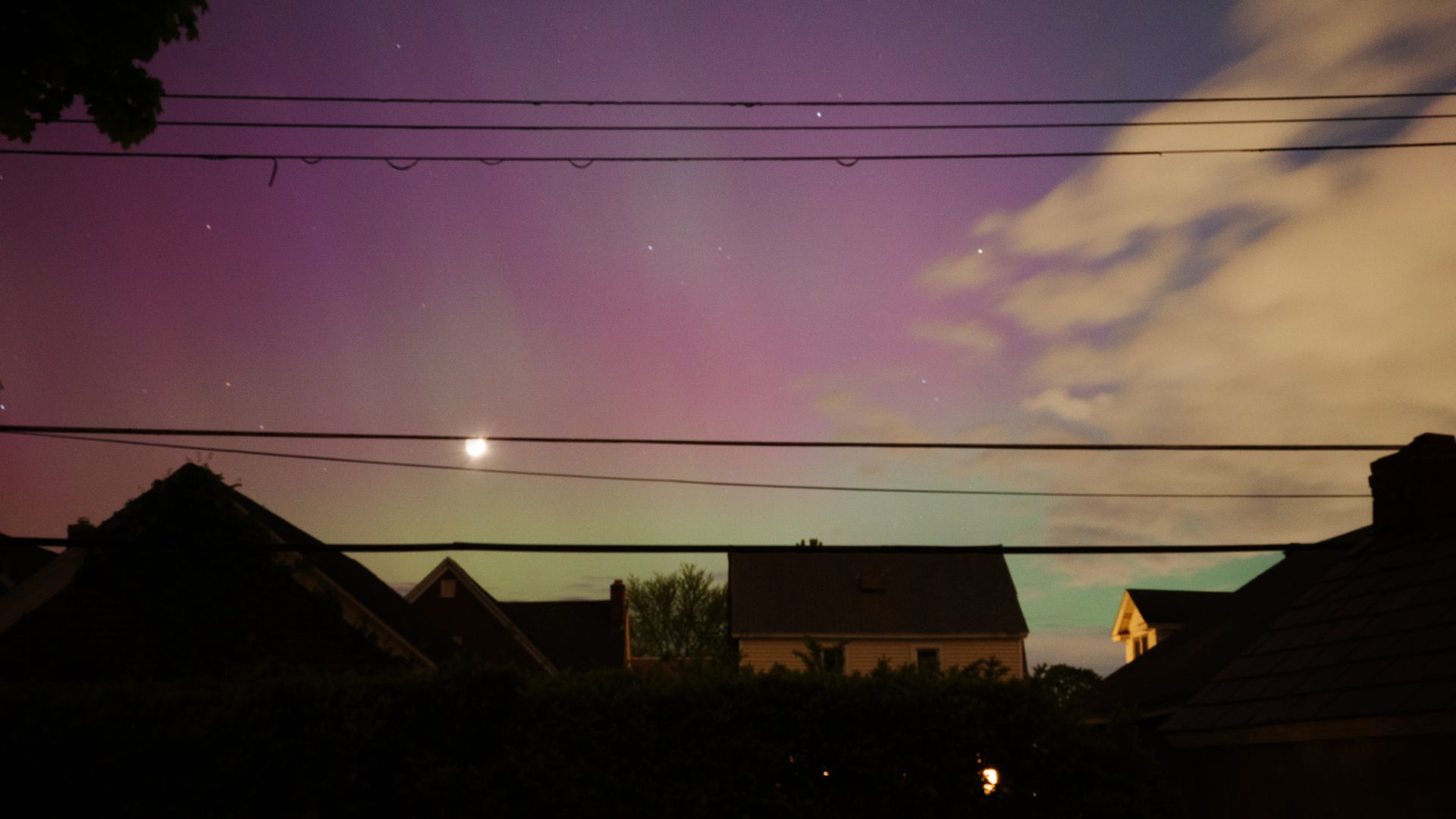
As a space phenomena junkie, this past weekend was an absolute treat.
- Living in upstate New York, I keep tabs on the National Oceanic and Atmospheric Administration's space weather forecast for any chance to glimpse the northern lights — and boy, did they deliver this past weekend.
I usually head up to the inky-black skies of the Adirondacks for a chance to spot them when conditions are right.
- But thanks to the recent solar storm, they showed up in my backyard — in Albany city limits, light pollution be damned.
How it works: To snag the above photo, I put my Ricoh GR IIIx on a tripod in shutter priority mode, set for 30 seconds at 3200 ISO.
The big picture: The aurora showed up not just in the typical northern latitudes, but across the U.S. and the world.
- Like the recent solar eclipse, there's something special about being part of an event that so many people are trying to see at the same time.
I hope you got to see them, too.
- But if you didn't, don't feel too much FOMO. The sun is in a period of what's called "solar maximum," when solar activity is expected to be high, generating more of the coronal mass ejections that can cause strong aurora on Earth.
Editor's note: The chart in Jennifer's recent story on where the class of 2024 wants to work has been corrected to reflect that the location data is based on job applications submitted by 2023 and 2024 graduates on Handshake (not from 2024 graduate survey data).
Was this email forwarded to you? Get your daily dose of What's Next by signing up here for our free newsletter.
Sign up for Axios What's Next