Axios What's Next

December 12, 2023

1 big thing: Teens "constantly" online
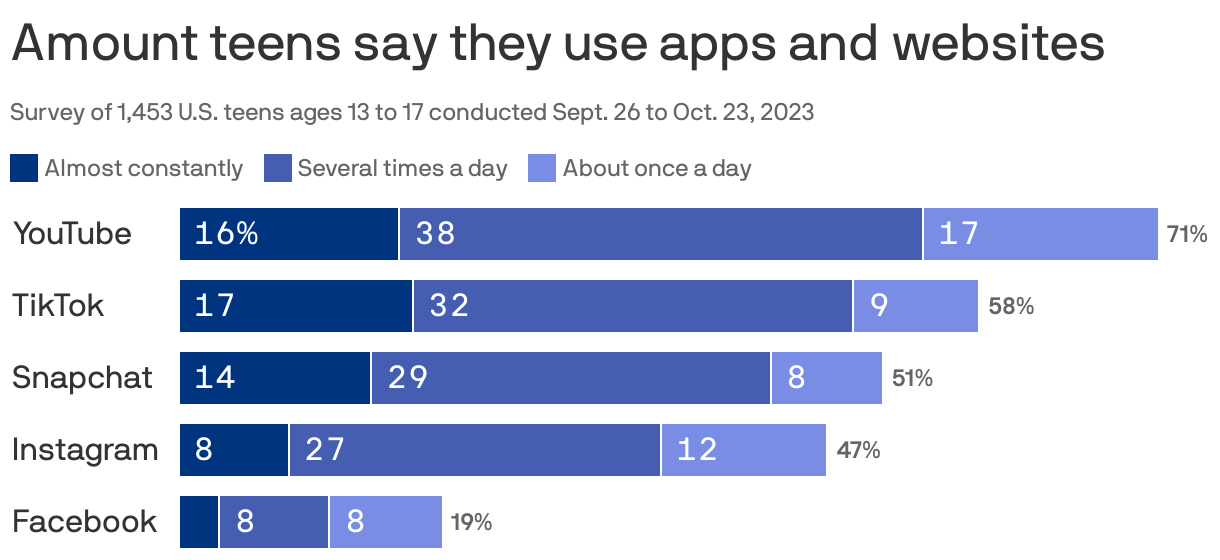
Nearly 1 in 5 teens say they're on YouTube or TikTok "almost constantly," according to a Pew Research Center report.
Why it matters: The report paints a picture of a rising generation whose lives are dominated by a handful of social platforms — amid ongoing debate over the possible mental health harms that could result.
Driving the news: Pew's latest survey on teens and technology — which polled 1,453 kids online, ages 13-17 — found roughly the same amount of internet use as last year, but substantially more than when the survey was conducted in 2014-2015.
- Nearly half of teens say they use the internet "almost constantly" — which is on par with what they said last year, but about double the 24% who said this in 2014-2015.
- Roughly 9 out of 10 use YouTube, making it by far the most popular social media channel for teens — and 71% use it once a day or more.
- Most teens use TikTok (63%), Snapchat (60%) and Instagram (59%), but use of Facebook (33%) and Twitter (20%) is declining.
By the numbers: A separate poll by Gallup this year found that teens spend an average of 4.8 hours on social media daily.
📲 Zoom out: While debate over adult social media use tends to focus on the spread of disinformation, debate about teen use tends to focus on the risks of cyberbullying, harassment and abuse — and on whether the medium fosters eating disorders and self-harm.
- U.S. Surgeon General Vivek Murthy issued a warning this year about the threats that social media poses to kids' mental health, which range from sleep disruptions to suicidal thoughts.
Yes, but: Many teens say that these platforms improve their lives, entertaining them and making them feel less lonely.
What's happening: Now that social media has become an essential part of growing up, doctors and parents are figuring out how to safeguard kids, given that government efforts to regulate the tech giants that control the platforms generally haven't panned out.
- Boston Children's Hospital — which runs a leading treatment program for children with internet disorders — just updated its guide to social media use for families, developed by the hospital's Digital Wellness Lab.
What they're saying: "There's a lot of cultural debate over the impact on [teens'] mental health," says Monica Anderson, a lead researcher on the Pew report.
- "For us to understand the impact, it's important for us to get these baseline measures."
Details: The Pew report looked at differences in teen social media use by gender, race, age and household income.
- Gender: Teen girls are more likely than boys to say they use Instagram (66% vs. 53%) and to say that they "almost constantly" use TikTok (22% vs. 12%) and Snapchat (17% vs. 12%).
- Teen boys are more likely than girls to use Discord (34% vs. 22%) and Twitch (22% vs. 11%).
- Race and ethnicity: White teens are less likely than Black and Hispanic teens to say that they're on YouTube, Instagram and TikTok "almost constantly."
- 80% of Black teens report using TikTok, compared with 70% of Hispanic teens and 57% of white teens.
- 32% of Hispanic teens say they are on TikTok "almost constantly," compared with 20% of Black teens and 10% of white teens.
- Age: Older teens are more likely than younger ones to use most of the platforms.
- For instance, only 45% of 13- and 14-year-olds said they used Instagram, versus 68% of 15- to 17-year-olds.
- Household income: Teens in households earning less than $30,000 a year were more likely to say they use Facebook and TikTok than teens in higher-earning households.
The bottom line: Reading books and watching television are starting to sound like quaint pastimes.
2. The snag in Europe's AI law

Illustration: Annelise Capossela/Axios
3. 📉 Strike slowdown


The number of workers out on strike in November dropped by about a third compared to the previous month, Axios Markets' Emily Peck reports from the latest jobs report.
- Yes, but: The figure was still notably high compared to the past decade.
Why it matters: The 35,000 workers who returned to their jobs last month — autoworkers and actors among them — helped boost the overall jobs numbers.
The bottom line: It's been quite a year for strikes — and with the labor market still tight, next year could be another doozy.
4. One fun thing: This hotel is a zoo

A rendering of Spekboom Lodge. Image: Courtesy of San Antonio Zoo
Axios What's Next

The next decade of big, sweeping changes will unfold in cities and communities where new technologies like 5G, AI and drones are transforming how we work, live and play together. What’s Next will guide you through the revolution.