Axios What's Next

July 30, 2024
Small cars are selling big — but mostly because they're what people can afford, Joann reports today.
- Axios House is heading to the DNC in Chicago! Join us on Aug. 19-20 for newsworthy conversations exploring topics and issues shaping the 2024 presidential election.
- Check out our agenda for the week here.
Today's newsletter is 1,075 words ... a 4-minute read.
1 big thing: Small cars are hot again
Americans are snapping up small cars again, not because they want to, but because it's what they can afford.
Why it matters: Higher sticker prices, plus lofty borrowing rates, are making it harder for people to buy the new car of their dreams, so they often have to settle for a smaller vehicle or look for a bargain on a used car.
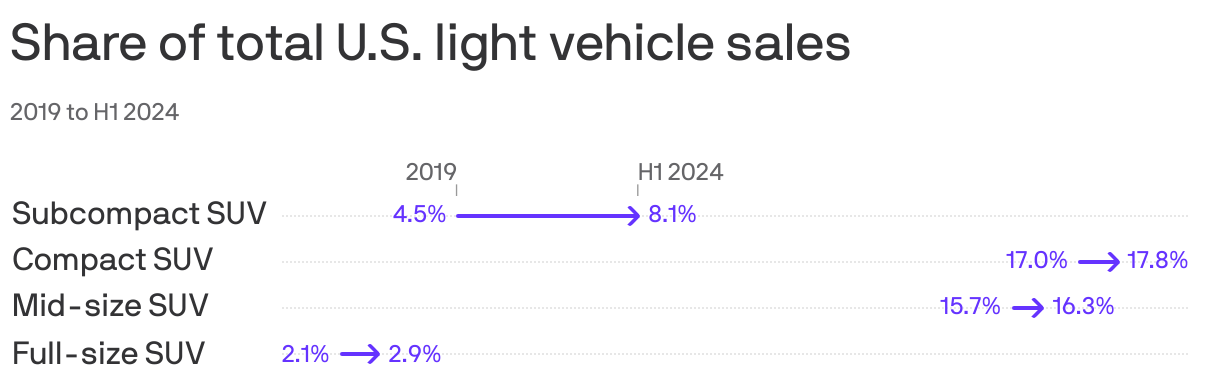
Driving the news: Small car sales are outpacing the rest of the market this year, according to Cox Automotive data.
- While overall vehicle sales were up about 2% nationwide in the first half of 2024, subcompact crossover utilities grew more than 20%.
- Compact cars and SUVs also increased 18% and 12% respectively, per Cox.
- Full-size pickup truck sales, meanwhile, were down 4% for the first half of the year.
Yes, but: Trading down isn't the sacrifice it used to be — today's small cars are roomier than ever, and often come with standard technology and safety features that satisfy budget shoppers' premium tastes.
- "You don't really have these stripped-down vehicles anymore," says Rebecca Lindland, senior director of industry data and insights at Cars.com.
- "But that's also part of the affordability challenge. Consumers on average are paying $11,000 more for a new car than they were five years ago," she tells Axios.
- "If you have not gone car-shopping in five years, your sticker shock will be real."
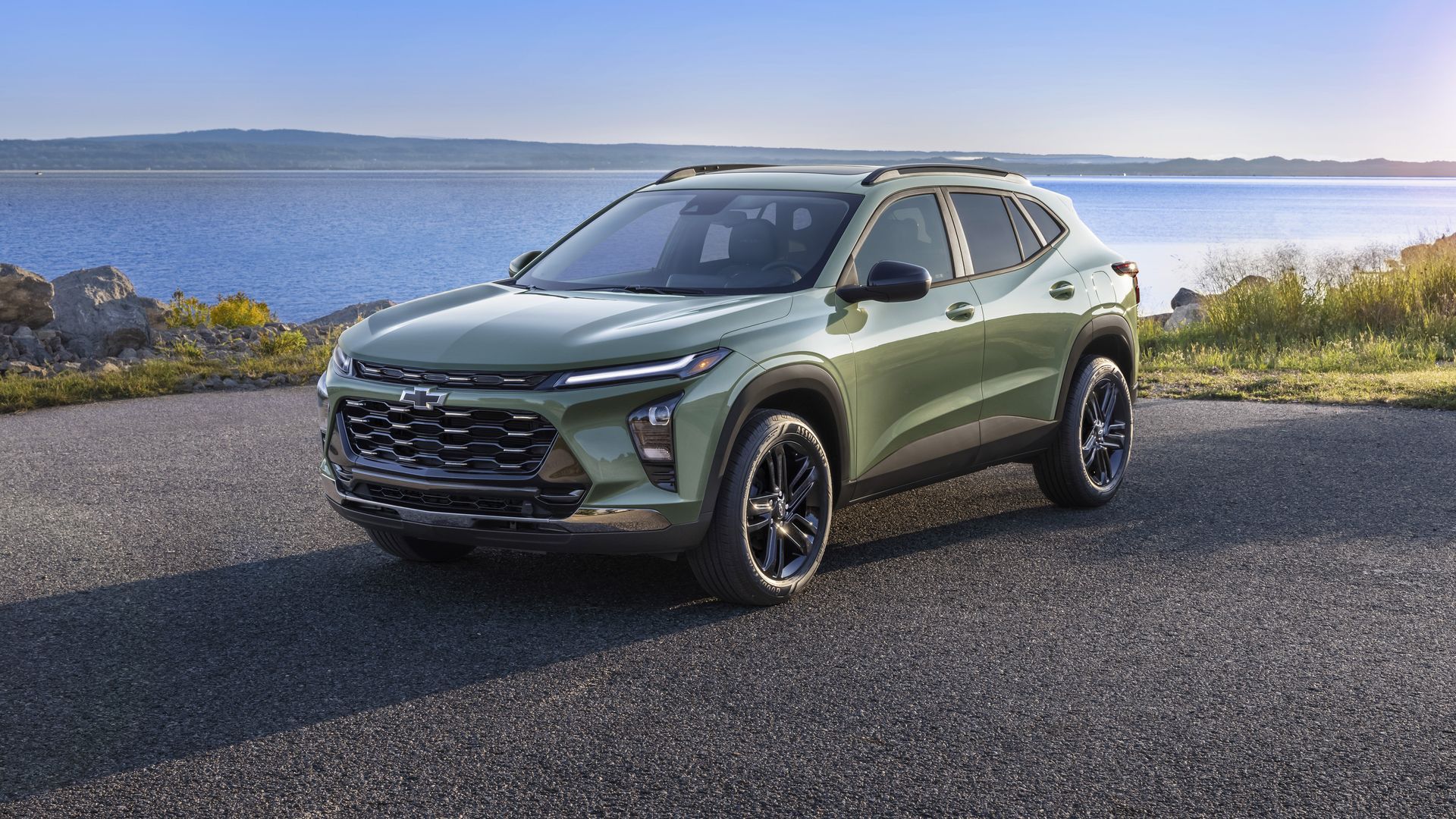
Zoom in: The Chevrolet Trax, with a starting price of $21,495, is perhaps the best example of the trend.
- General Motors redesigned the small SUV for the 2024 model year, making it larger and less expensive but with more technology than the previous version.
- Even the base model comes with standard safety features like automatic emergency braking and lane-keeping assist, while higher-trim versions include Apple CarPlay, a Wi-Fi hotspot and adaptive cruise control — all for well below $30,000.
- Consumers love the Trax, with sales up 230% compared to the first six months of 2023.
- Other subcompact SUVs, like Mazda's CX-30 (starting at $24,995) and Honda's HRV (starting at $25,100), are also selling fast.
Compact cars are also booming, led by strong sales of the Nissan Sentra (+55%), Honda Civic (+38%) and Toyota Corolla (+26%).
- U.S. automakers pretty much gave up on small sedans in recent years, although the popularity of small SUVs like the Trax is keeping them in the entry-level game.
Between the lines: The threat of inexpensive electric cars from China will also drive automakers to shift to smaller, more affordable vehicles.
- That's the best way for automakers to compete with cheap Chinese EVs, Ford CEO Jim Farley said recently.
- "We have to start to get back in love with smaller vehicles. It's super important for our society and for EV adoption," Farley told The Guardian. "We are just in love with these monster vehicles, and I love them, too, but it's a major issue with weight."
- "These huge, enormous EVs are never going to make money: The battery is $50,000, even with low-nickel, LFP chemistry. They will never be affordable."
What to watch: Ford and Tesla both plan to introduce small, entry-level EVs priced under $30,000.
The bottom line: Affordability is a real issue that pushes people away from the cars they really want to the ones they can afford.
Note: Cox Automotive's parent company, Cox Enterprises, also owns Axios.
Editor's note: The chart has been corrected to reflect that the 2019 data is annual (not year to date). This story has also been updated to correctly identify the model name and starting price of Mazda's subcompact SUV.
2. Cables cut in latest Olympics sabotage


Fiber optic cables in several regions of France were cut yesterday morning in what appears to be a coordinated act of sabotage.
Why it matters: This is the second attack on French infrastructure in a matter of days, underscoring the security threats around the Paris Olympic Games.
Driving the news: "A new major sabotage of long distance cables took place last night in France around 2:15 a.m.," Nicolas Guillaume, CEO of internet service provider Netalis, wrote on X yesterday.
- Six French regions — Bouches-du-Rhône, Aude, Oise, Hérault, Meuse and Drôme — were affected by the outages, Le Monde reported.
- Orange, the telecom provider for the Paris Games, was not affected, per Le Monde.
The big picture: The cable-cutting incident comes days after coordinated arson attacks disrupted France's high-speed rail networks ahead of Friday's opening ceremonies.
3. Zoom is the new political rally
Gatherings of tens of thousands of Vice President Kamala Harris' supporters are raising millions of dollars for her campaign — on Zoom.
Why it matters: It's a new era of virtual rallies.
- Online events are cheaper to organize and easier to attend, and they're poised to become a powerful tool for fundraising and voter outreach this fall.
Driving the news: Just hours after President Biden bowed out of the 2024 presidential election, over 90,000 people joined a Zoom call organized by Win With Black Women.
- The event raised at least $1.5 million for Harris in three hours, the group said.
- A similar call held by Win With Black Men attracted around 232,000 attendees and brought in at least $1.3 million.
- A "White Women: Answer the Call" Zoom event was attended by around 200,000 participants and raised over $8.5 million.
The big picture: These Zoom calls raised millions for Harris' campaign without her even making an appearance on screen.
- "I have never seen this level of virtual support," Imani Cheers, a professor of media and public affairs at George Washington University, tells Axios.
- "What we're seeing now at the moment is a beautiful intersection of concerned citizens utilizing digital media and virtual technology to campaign, to gather, to organize and — fundamentally — to fundraise."
What's next: The Harris campaign says it's planning to build on the success of the events by also holding calls related to youth, women, labor and LGBTQ+ issues.
4. One fun thing: "Summerween"
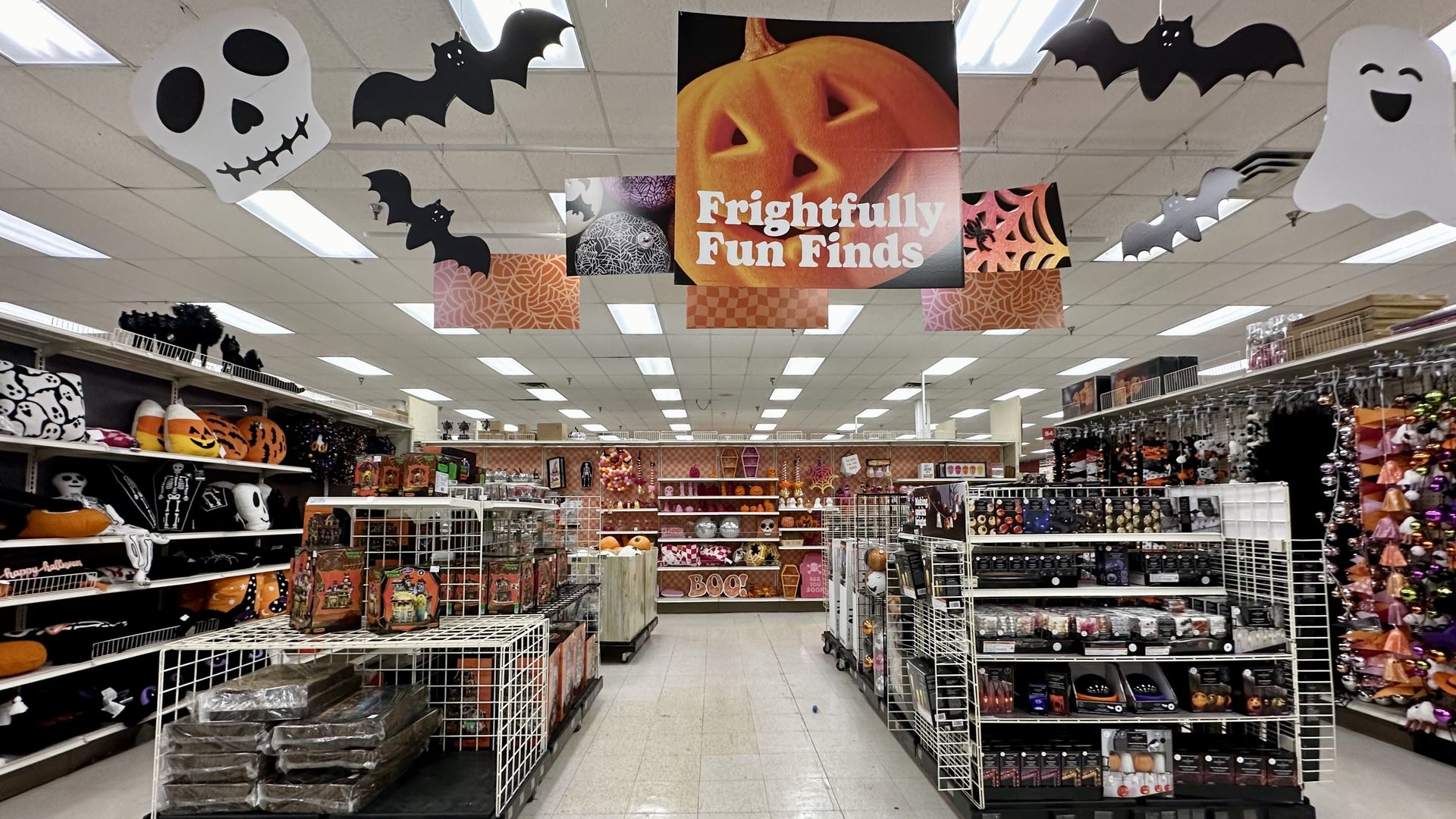
Retailers are promoting Halloween earlier than ever, driving a new "Summerween" trend.
Why it matters: Halloween is big money for retailers, and there's a race among retailers to push holiday merchandise early.
- The holiday drove $6.4 billion in candy sales alone last year, the National Confectioners Association tells Axios.
The big picture: Home Depot was the first major retailer to offer fall holiday decor online this year — including its famous 12-foot skeletons, which went on sale in April.
- Lowe's and Target are also selling Halloween merchandise online earlier than in past years.
- And Michaels dropped its first Halloween collection of the season in stores in late June — also earlier than ever, execs tell Axios.
What's next: More Halloween merch will arrive in stores in late August and early September, once back-to-school offerings are cleared out.
Big thanks to What's Next copy editor Amy Stern.
Was this email forwarded to you? Get your daily dose of What's Next by signing up here for our free newsletter.
Sign up for Axios What's Next