
Axios Vitals

March 24, 2023
😎 Happy Friday, Vitals readers. Today's newsletter is 994 words or a 4 minute read.
1 big thing: State public option plans keep hitting obstacles
Illustration: Megan Robinson/Axios
State efforts to control health costs through public options are stalling in the face of resistance from providers and lackluster enrollment, even as talk of a federal version recedes, Axios' Arielle Dreher writes.
Why it matters: The states' underwhelming attempts offer an ominous warning for lawmakers seeking to lower health costs: insurers and providers aren't going to willingly cooperate with programs that threaten their profits and revenues.
- And lower health care costs are, in the end, a hit to someone's profits and revenue.
The big picture: The public option was supposed to resemble government-run health care for moderates uncomfortable with "Medicare for All." But it flopped on the first try in Washington state and is drawing meager interest there and in Colorado.
- Nevada, New Mexico, Minnesota and Connecticut are among the other states either weighing bills to create public options or nudging similar plans forward.
- A key will be whether they can attract more consumers and save money through partnerships with insurers or whether they'll have to force the carriers to participate, a recent Commonwealth Fund comparison found.
Where it stands: Washington state's first-in-the-nation public option launched in 2019 but hit obstacles when insurers didn't voluntarily contract with the state and offer plans in each county. That was partly because hospitals also balked at a program they said made low payments and policies that tied reimbursements to Medicare rates.
- Colorado tried to avoid the Washington experience by launching a public option this winter and requiring insurers to offer three tiers of service in all counties where they offer individual or small-employer plans. But that's run into concerns about too high premiums and too few members.
- Nevada's public option isn't due to take effect for another three years but already is in limbo after newly elected Gov. Joe Lombardo (R) said the state legislature should repeal or significantly revise the Democratic-driven legislation that created it.
The bottom line: Early results cast doubt on whether public option plans will achieve their goals if they depend on providers and insurers to willingly take a pay cut.
2. Why America was uniquely vulnerable to COVID
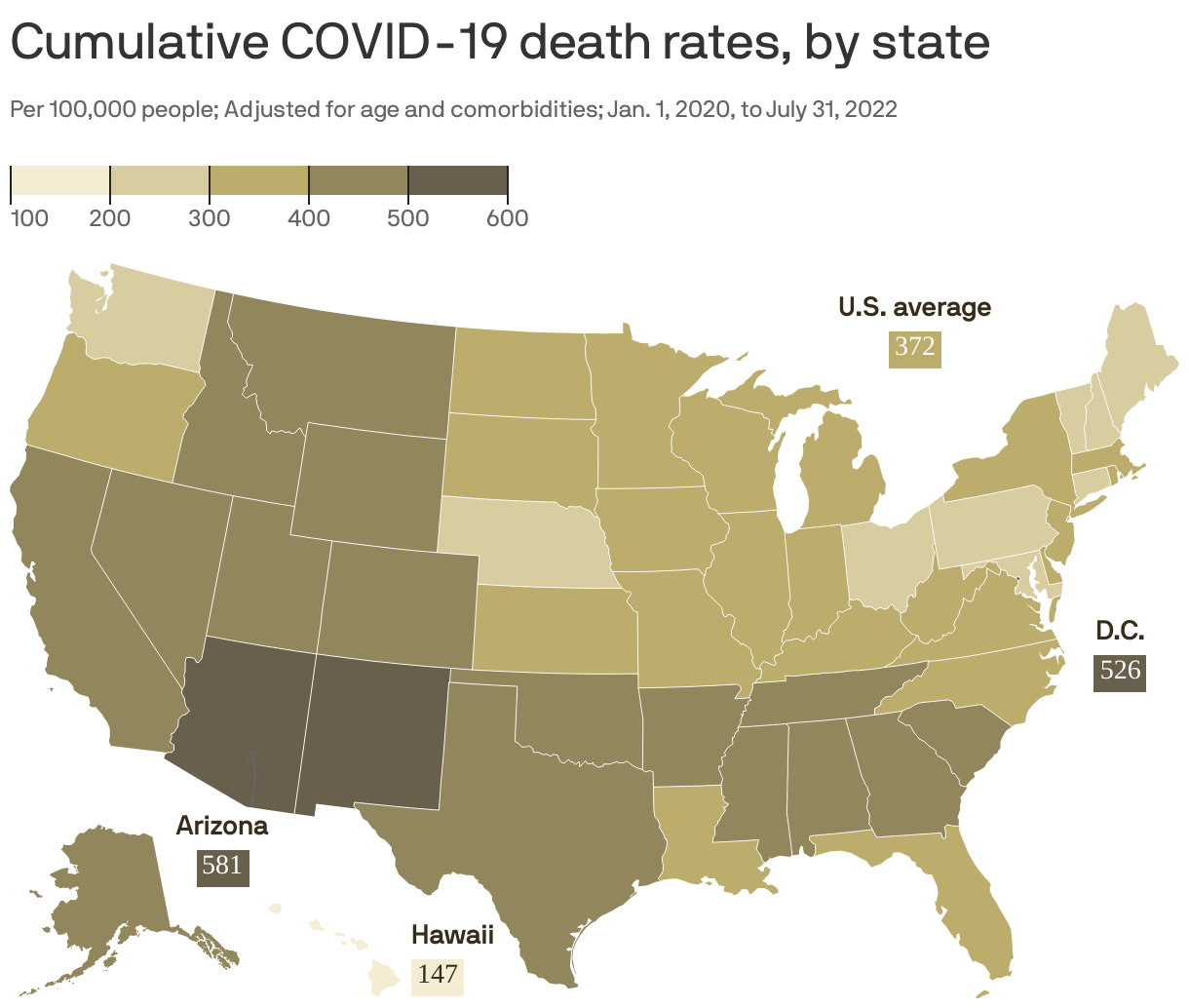
The pandemic experience varied sharply from state to state, with some of the highest adjusted death rates reported in Arizona, the District of Columbia and New Mexico, according to an analysis published in The Lancet.
Why it matters: It's among the first deep dives to explore the social and economic factors at play during the pandemic in the U.S., and found a nearly four-fold variation in COVID infection and death rates between states.
What they're saying: "What is clear from our study is that COVID-19 exploited and compounded existing local racial inequities, health disparities, and partisan politics," co-lead author Thomas J. Bollyky, director of the Council on Foreign Relations' Global Health Program in the USA, said in a statement.
By the numbers: States with higher poverty, lower rates of educational attainment, less access to quality health care and lower levels of interpersonal trust saw disproportionately higher rates of COVID infections and deaths.
- When adjusting the data to account for age and comorbidities, Arizona saw the highest COVID death rate (581 per 100,000 people) in the nation. Washington, D.C. (526 per 100,000) and New Mexico (521 per 100,000) were the second and third worst.
- On the flip side, Hawaii had the lowest adjusted COVID death rate with 147 fatalities per 100,000 people. It was followed by New Hampshire 215 per 100,000) and Maine (281 per 100,000), respectively.
3. N.C. lawmakers approve Medicaid expansion
North Carolina is poised to become the 40th state to expand Medicaid after lawmakers in its state House green-lighted a plan on Thursday.
Why it matters: The approval comes after Republican leaders blocked earlier plans that would have expanded coverage to hundreds of thousands of the state's working poor, Axios' Lucille Sherman has reported.
- Democratic Gov. Roy Cooper, a supporter of Medicaid expansion, is widely expected to sign the legislation.
Catch up quick: Medicaid expansion, a key component of the Affordable Care Act, means increased access to federal health insurance coverage for low-income residents, in exchange for a 10% state match of the federal spending.
- Once the bill becomes law, in addition to expanding health care to around 600,000 North Carolinians, the state is expected to receive an estimated $8 billion annually, according to the state health and human services department.
What to watch: North Carolina is among a handful of Republican-led states that are showing new openness to Medicaid expansion after years of opposing the idea.
- Holdout states like Georgia, Wyoming, Alabama and Texas has also shown some signs of considering expansion as leaders court rural voters, assess new financial incentives and confront the bipartisan popularity of extending health care coverage, Axios' Caitlin Owens wrote last fall.
4. Utah passes law limiting kids' social media use

Photo: Matt Cardy/Getty Images
Utah became on Thursday the first state to enact legislation that restricts children and teens from using social media without their parent's consent, Axios' Sareen Habeshian writes.
Driving the news: Gov. Spencer Cox (R) signed two bills into law aimed at limiting when and where anyone younger than 18 years old can interact online, and to stop companies from luring minors to certain websites.
- It came the same day TikTok's CEO testified before the House Energy and Commerce Committee on the company's ties to the Chinese government, data practices and its harmful effects on children, Axios' Zachary Basu and Stef W. Kight report.
Between the lines: The proposed legislation comes as experts and policymakers nationwide are warning about the mental health consequences social media may have on young users.
What they're saying: "Youth rates of depression and other mental health issues are on the rise because of social media companies," Cox said in a tweet Thursday. "As leaders, and parents, we have a responsibility to protect our young people."
😃 1 last thing: Turns out, the chattiest coworkers can be found in the healthcare industry, according to a survey of about 1,000 Americans by the e-learning platform Preply. Now, what specialties do we think they're talking about?
Thanks for reading, and thanks to senior health care editor Adriel Bettelheim and senior copy editor Bryan McBournie for the edits.
Sign up for Axios Vitals

Healthcare policy and business analysis from Tina Reed, Maya Goldman, and Caitlin Owens.