
Axios Vitals

September 02, 2020
Good morning.
- Six-ish months into the pandemic, I'd love to hear your thoughts on the newsletter and our coverage. What do you like? What do you miss? What's most useful during these strange times?
Today's word count is 926, or a 3-minute read.
1 big thing: The convalescent plasma fallout continues
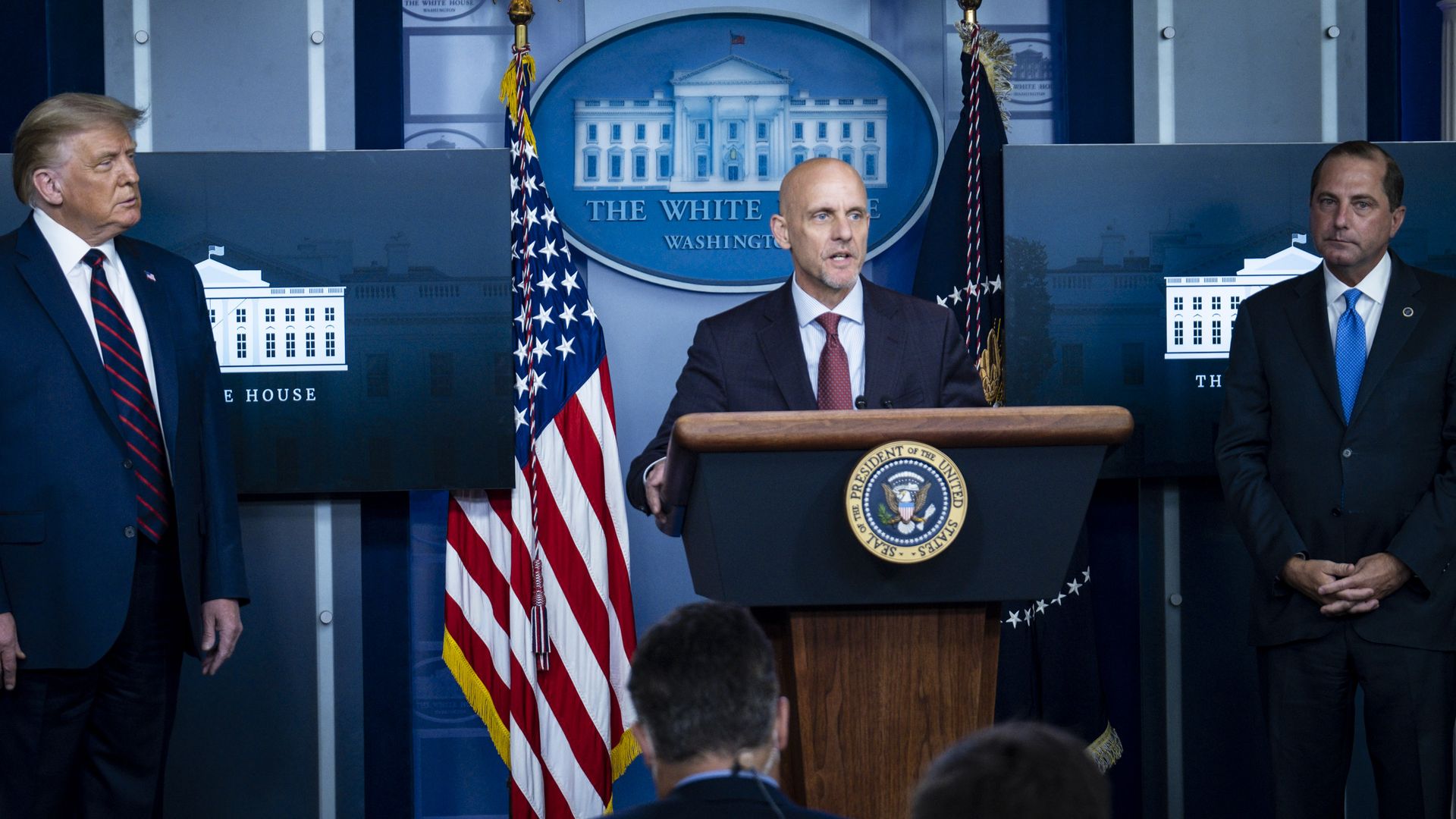
President Trump, FDA commissioner Stephen Hahn and HHS Secretary Alex Azar. Photo: Pete Marovich/Getty Images
The National Institutes of Health yesterday released a statement undercutting the Food and Drug Administration's emergency authorization of convalescent plasma as a coronavirus treatment — an escalation of an extraordinary public disagreement between federal agencies.
Why it matters: Thankfully, the main question surrounding the treatment is whether it works, not whether it's safe. But this feud could erode public trust in any future coronavirus treatments and vaccines, potentially for good reason.
Driving the news: An NIH panel of experts reviewed the existing evidence on convalescent plasma, including the FDA's analysis, and determined that "there are currently no data from well-controlled, adequately powered randomized clinical trials that demonstrate the efficacy and safety of convalescent plasma for the treatment of COVID-19."
- Although it said that serious adverse reactions to convalescent plasma are rare, the panel wrote that it's still unknown whether the treatment makes patients more susceptible to reinfection.
What they're saying: "The public is best served when health agencies are aligned in the kind of advice they're giving to providers and patients. Different agencies can have different interpretations of data, but the actionable advice should reflect a consensus view so patients have clear guidance," former FDA commissioner Scott Gottlieb told me.
- Another former FDA commissioner, Robert Califf, told Bloomberg that "if you just took random data and divided it into enough subgroups just by chance alone you would find differences."
- The translation, via Bloomberg's Anna Edney: "It seems the agency did what it doesn't like pharma cos to do — analyze the data a bunch of different ways until something works."
The other side: "Surprised by media uproar on Treatment Guidelines on convalescent plasma for #COVID19. Guidelines mirror EUA: possible benefit, seems safe, randomized trials needed. ... No news here," NIH director Francis Collins tweeted last night.
2. Half of Americans fear health-related bankruptcy


The number of Americans who worry about bankruptcy if they have a serious health issue has spiked over the last year and a half — particularly among men, people of color and young adults, according to a new survey from West Health and Gallup.
Between the lines: Health care costs were a huge issue even when the economy was good and we weren't in a global pandemic. Now, millions of people have gotten sick, lost their jobs, lost their health insurance, or all three.
Details: 15% of adults said that at least one person in their household has medical debt that they won't be able to repay within the next year, including 20% of adults of color and 12% of white adults.
- Unsurprisingly, a much larger percentage of lower-income households say the same, compared to higher-income households.
- A quarter of adults say that they'd have to borrow money to pay a $500 medical bill.
The bottom line: The pandemic is making all of our existing health care problems worse.
3. Catch up quick
Illustration: Sarah Grillo/Axios
Small businesses and workers in college towns are hurting as the pandemic pushes universities to go online, Axios' Erica Pandey writes.
Apple and Google are expanding their digital coronavirus exposure notification system so that it can notify people without the regional health authority needing to create a separate app, potentially expanding the adoption of the technology.
The Centers for Disease Control and Prevention plans to issue an order temporarily halting residential evictions until Dec. 31 to prevent the spread of the coronavirus, the White House announced on Tuesday.
New York City is delaying the reopening of its schools by 10 days, Mayor Bill de Blasio (D) announced Tuesday, as part of a deal to avert a teachers' strike.
Housekeeping note: Our cases maps will now only be updated once a week, and will be in Friday's newsletter.
4. A new vaccine distribution framework
The National Academies of Sciences, Engineering, and Medicine issued a draft framework for how to distribute a coronavirus vaccine yesterday, unsurprisingly prioritizing high-risk health care workers, first responders and patients most at risk of severe infections.
Why it matters: There are a lot of people who can make a strong case for why they should be at the front of the line for a coronavirus vaccine, but supplies will be limited initially and the most at-risk populations still number in the tens of millions.
- "Initial discussions suggest, depending on how some of the target groups are defined, large numbers of Americans would qualify as members of priority groups, a reality that will likely require additional tough decisions to be made," STAT's Helen Branswell writes.
Yes, but: Which vaccine — or vaccines — get approved first will have a significant impact on how quickly the U.S. can move through priority groups, and could even effect what these priority groups are.
- And executing the kind of detailed distribution plan outlined by the National Academies will be no small feat. Plenty of other blueprints and roadmaps for things like testing and safely reopening have gone nowhere or been ignored over the last few months.
Related: The Washington Post reported yesterday that the Trump administration has decided to go it alone on developing and distributing a coronavirus vaccine, after refusing to join the World Health Organization's efforts to provide equitable doses for all countries.
5. California's generic drug experiment
California's state legislature approved a measure this week that would allow it to become the first state to develop its own line of generic drugs, including insulin, to tackle rising pharmaceutical prices, Axios' Marisa Fernandez writes.
Why it matters: If passed, the motion would put California in direct competition with major generic and brand-name drug manufacturers.
- Still, it could take years for the state to successfully bring products to the market.
How it works: Taxpayers would pay for the $1 million to $2 million in startup funding costs, in addition to staff costs, state fiscal analysis shows.
- The bill specifically would require the state to make "at least one form of insulin, provided that a viable pathway for manufacturing a more affordable form of insulin exists at a price that results in savings."
- No other specifics of which drugs would be secured by the state were included.
What's next: Gov. Gavin Newsom (D) will have until Sept. 30 to sign or veto the measure.
Sign up for Axios Vitals

Healthcare policy and business analysis from Tina Reed, Maya Goldman, and Caitlin Owens.