Axios Media Trends

December 03, 2024

Today's Media Trends, copy edited by Sheryl Miller, is 1,980 words, a 7½-minute read. Sign up.
Mark your calendar: Axios co-founders Mike Allen and Jim VandeHei have launched a new membership providing deep reporting on how Washington works.
- I'll be joining them on Dec. 16 for a virtual executive briefing. Join AM Executive Briefing to attend.
🪧 Situational awareness: The strike at the Pittsburgh Post-Gazette, launched in October 2022, is officially the longest ongoing work dispute in the country.
1 big thing: 🔊 Scoop... Alexa's AI news push
Amazon is reaching out to news publishers about opportunities to license their content for the next generation of Amazon's Alexa voice assistant, slated to debut next year, Axios has learned.
Why it matters: The company plans to debut a new, smarter version of Alexa, using generative AI to power customized responses to real-time user queries about the news.
- Alexa currently provides answers to news queries from various sources, such as Reuters, Associated Press, Wall Street Journal and USA Today, but it's not set up to answer real-time questions about breaking news events with as much precision.
- It wants its updated version of Alexa to be able to answer more complex user queries, such as the status of polls during an election.
State of play: The tech giant is eyeing preliminary tests with several publishers who it hopes can serve as launch partners for the revamped Alexa late next year, according to a person familiar with its plans.
- It's currently testing new ways to incorporate news answers into Alexa via text and photo query results. The company isn't testing generative AI video outputs as part of its revamped Alexa offering at this time.
- Publishers will be compensated for their content via a licensing agreement, and answers to users' news queries will be attributed to Amazon's publishing partners.
- Amazon is looking to partner with an array of content partners at the national and local levels.
Amazon also works with a handful of media companies to distribute news content through flash briefings — short briefings anchored by news personalities — on Alexa-powered devices.
- Some partners only provide audio flash briefings, like NPR. Others, like Bloomberg, also power video flash briefings on voice assistant devices with screens.
The big picture: The AI era is proving lucrative for media publishers looking to offset a slowdown in ads and subscription fatigue.
- OpenAI is paying Dotdash Meredith a minimum of roughly $16 million per year to license its content, per Adweek.
- News Corp.'s deal with OpenAI is reportedly worth up to $250 million over five years.
What to watch: Looking ahead, Amazon wants to add more news partners as it scales the devices and platforms Alexa powers.
- Alexa powers Amazon devices such as Echo speakers and connects to devices such as Amazon Ring video doorbells and third-party devices, such as Google's Nest Cam and Samsung's SmartThings Hub.
2. 🤖 Deepfake head fake
AI-driven deepfakes weren't the disinformation catastrophe that tech companies and global governments feared ahead of major elections this year, Meta president of global affairs Nick Clegg told reporters Monday.
Why it matters: The spread of broader conspiracy theories by world leaders has proven to be a much more challenging threat than AI-doctored photos or videos.
By the numbers: During the election periods of major races globally this year, content verification ratings from Meta's international fact-checking partners on AI content related to elections, politics and social topics represented less than 1% of all fact-checked misinformation, per Clegg.
- The company said its systems rejected 590,000 user requests to generate AI images of President-elect Trump, Vice President-elect JD Vance, Vice President Harris, Gov. Tim Walz, and President Biden in the month leading up to the election.
- Clegg said he didn't see much activity in terms of bad actors trying to game Meta's rules around labeling AI-generated imagery in ads.
Reality check: Images and videos created using generative AI still lack precision, and that makes it possible, at least for now, for experts to debunk them.
- Most mis- and disinformation that goes viral today features manipulated context, such as a mislabeled photo location, rather than doctored media.
The big picture: The most problematic deepfakes aren't necessarily the most believable ones, but rather, the ones shared by people in power to help propel narratives or conspiracies that support their campaigns.
3. 💰 OpenAI weighs ad model
OpenAI's potential plan to incorporate ads in products like ChatGPT is hardly surprising — but should still serve as a wake-up call for AI makers and users.
Why it matters: AI chatbots cost a fortune to run and remain available for free.
- The company raised $6.6 billion in an October funding round, but it's also losing billions of dollars per year.
- To date, its revenue has come from a mix of business customers along with consumers who pay $20 per month for a premium version of ChatGPT.
Driving the news: OpenAI CFO Sarah Friar told the Financial Times that OpenAI is weighing the inclusion of ads in its products but wants to be "thoughtful about when and where we implement them."
- Other AI providers have also begun exploring or incorporating ads in chatbots and AI-powered search engines. That includes Microsoft and Perplexity, as well as startups like Adzedek.
Zoom in: There is a range of means by which advertising can merge with the conversational experience of a chatbot — and the "how" is important.
- Currently, creators of custom chatbots can incorporate ads using technology from Microsoft and Adzedek. These tools will deliver a related but distinct and clearly marked ad along with the response to a user's query.
- OpenAI and others could do something similar. As long as the ads are clearly marked and don't otherwise affect a chatbot's response, the experience is comparable to what happens today with search engine ads.
Yes, but: Ad-based business models have driven internet companies to ratchet up engagement strategies and track users' activities for better ad targeting.
- AI makers will be tempted toward similar tactics — with an additional risk arising from the technology's known power to persuade and bond with users.
- A chatbot-turned-salesperson could be both lucrative and annoying. An AI companion that sneaks in a sponsored message, or an AI agent that makes choices for you based on ad dollars, could be predatory.
4. 🍿 PG rating boosts box office

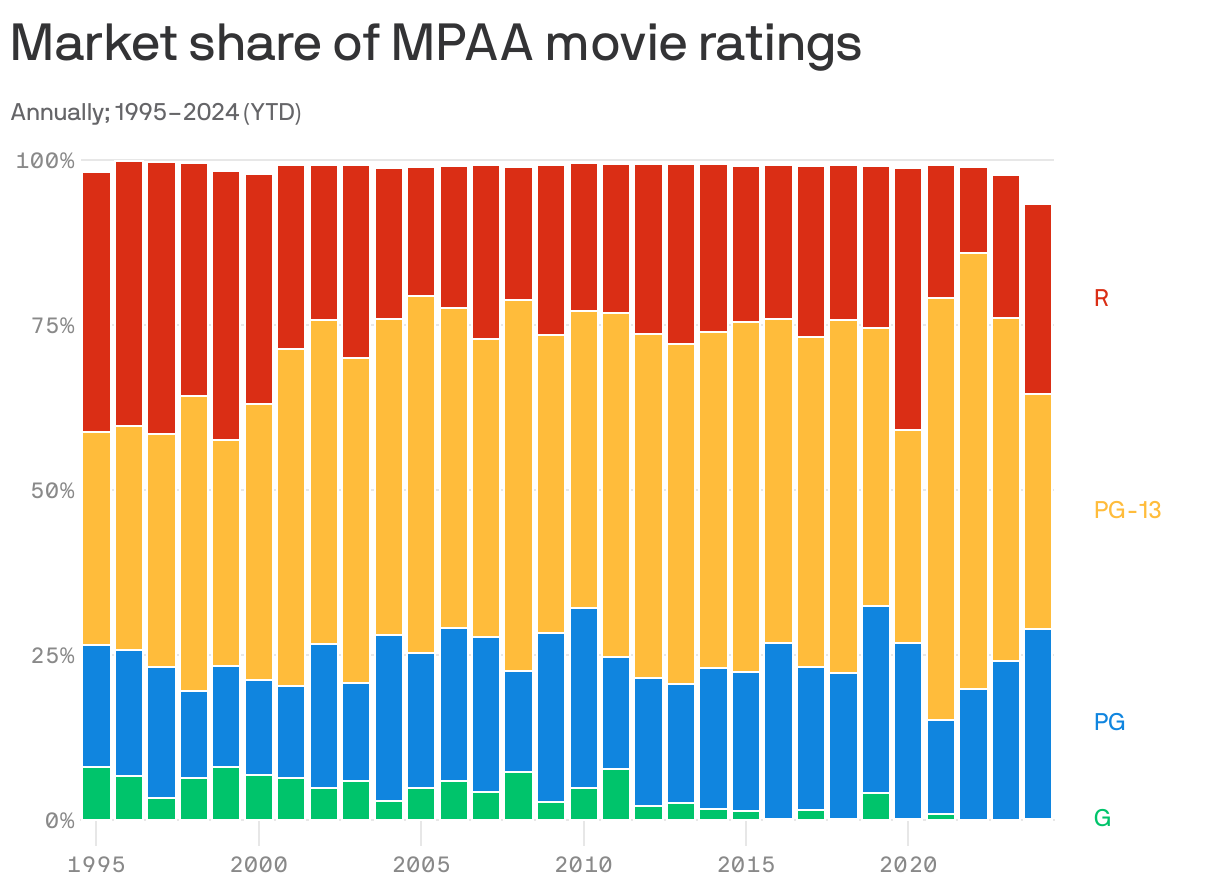
PG-rated films have made up one-third of ticket sales at the domestic box office this year, the highest percentage since 1995.
Why it matters: "PG is the new PG-13," said Paul Dergarabedian, senior media analyst at Comscore. "It no longer has the stigma of not being hard-edged enough."
By the numbers: As of Dec. 2, one-quarter of all domestic box office ticket sales this year were for animated films, according to an Axios analysis of data from Box Office Mojo. Four of the 10 highest-grossing domestic films this year are animated.
- Disney's "Inside Out 2" set multiple records in its $155 million domestic debut earlier this year.
- Disney's "Moana 2" led to a record-breaking Thanksgiving box office weekend, bringing in a whopping $221 million in domestic sales over the five-day Holiday.
- Universal's "Despicable Me 4" brought in $122 million in its July Fourth holiday weekend domestic debut. The film has driven "Despicable Me" to become the first animated franchise to cross $5 billion in global box office sales.
The big picture: Family-friendly hits have brought much-needed momentum back to the box office, following a fall slump.
- Universal's "Wicked," rated PG, set a record for the biggest opening weekend for a Broadway adaptation last weekend with a $114 million domestic debut.
- Combined with "Moana 2" and Paramount Pictures' "Gladiator II," the film helped drive $420 million in domestic ticket sales over the five-day domestic opening — a new record.
Between the lines: Despite steady increases in ticket prices over the past few years, families with children have leaned into movie-going as a cheaper alternative to weekend trips away.
- "It's like a mini vacation," Dergarabedian said.
Flashback: Family-friendly films struggled during the COVID-19 pandemic, as more studios, especially Disney, moved their movie debuts to streaming platforms.
- R-rated films spiked during that time but subsequently took a hit.
What to watch: Family-friendly hits are expected to continue carrying the box office into the new year.
- Disney's "Mufasa: The Lion King," a photo-realistic animated film, debuts Dec. 20.
- Paramount's "Sonic the Hedgehog 3" premieres on the same day.
5. Big Tech walls closing in

A slew of federal investigations and new laws restricting tech companies threaten to significantly alter the social media and search landscape for decades to come.
Why it matters: Lawmakers globally have been talking about reining in Big Tech for years. Now, it's finally happening.
Driving the news: Australia on Thursday became the first country ever to pass a law that bans social media for children under 16.
- Companies like Meta and X say the bill, which was introduced and passed within a week, was rushed. They argue more time is needed to figure out how to implement the new rules to avoid hefty fines.
Reality check: For tech firms with massive reach, it's virtually impossible to create hundreds of different versions of their products to meet the rules and regulations of every nation or state.
- When one country passes a punitive law, it tends to spread globally.
Zoom out: Tech companies are cozying up to President-elect Trump in an attempt to cushion the blow.
- Meta CEO Mark Zuckerberg ate dinner with Trump at Mar-a-Lago last week. A spokesperson said, "It's an important time for the future of American innovation."
- Meta is preparing to face off against the Federal Trade Commission in a historic antitrust trial next year. The lawsuit was brought by the FTC four years ago, during the first Trump administration. The FTC seeks to possibly unwind Meta's critical acquisitions of WhatsApp and Instagram.
Tech leaders who typically avoid politics, such as Google CEO Sundar Pichai, Microsoft CEO Satya Nadella and Apple CEO Tim Cook, have all publicly congratulated Trump on his win.
- Google faces two major U.S. federal antitrust investigations for its advertising and search businesses that could force the company to possibly divest its Google Chrome browser and parts of its ad tech machine.
- Canada's Competition Bureau last week also sued Google for alleged anti-competitive online ad practices and is seeking a divestiture of some of Google's ad tech.
- The FTC opened a wide-ranging investigation into Microsoft's business, per AP.
What to watch: Trump's personal incentives could impact how the new administration enforces regulatory penalties and investigations.
- TikTok's fate still lies in the hands of three federal court judges, who have until Jan. 19 to determine if the app should be banned if not sold to a U.S. firm. The Justice Department would be responsible for enforcing the ban.
- Trump, who has reversed his position on TikTok and now says he doesn't support a ban, could try to get a Republican-led Congress to pass a repeal of the law that called for the ban in the first place. He could pressure the DOJ not to enforce the ban.
6. Post-election news fatigue


You can't blame cord-cutting for the post-election viewership slump at MSNBC and CNN.
Why it matters: Sports and entertainment events have set new viewership records on TV over the past two weeks, but cable news continues to face week-over-week declines.
By the numbers: The Dallas Cowboys' Thanksgiving Day victory over the New York Giants drew 38.5 million viewers on Fox, representing the most-watched NFL telecast this regular season on any network.
- NBC's presentation of the 2024 Macy's Thanksgiving Day Parade drew record viewership, with 31.3 million people watching on NBC and Peacock, up 10% from last year.
Meanwhile, viewership for all three major cable news networks in prime time and total daytime hours has fallen notably since the week of the election, with prime-time ratings for CNN and MSNBC falling to their lowest levels for the year.
- Fox News continues to benefit from its rivals' decline.
- While viewership on Fox News is down from election week, it's up compared to Fox News' average prime-time audience figures this year.
Startling stat: Following the election, the vast majority (72%) of the prime-time audience across the three major cable news networks has watched Fox News.
The big picture: News consumption reached a peak in 2020, amid a contentious election and the first year of the COVID-19 pandemic.
- While it did see a small engagement bump following a series of newsy election events over the summer, engagement has leveled out since.
Sign up for Axios Media Trends