Axios Media Trends

August 19, 2025

Good afternoon. Today's Media Trends, edited by Christine Wang and copy edited by Sheryl Miller, is 1,943 words, a 7½-minute read. Sign up.
📅 Next month in NYC: We're bringing Media Trends to life with Axios' inaugural Media Trends Live on Sept. 18.
- Speakers include: Shari Redstone, IMAX CEO Richard Gelfond, Snap Inc. CEO Evan Spiegel, FCC Commissioner Anna Gomez, Ankler Media CEO Janice Min, Charlamagne tha God and many more.
- Get your ticket here.
1 big thing: Print comeback
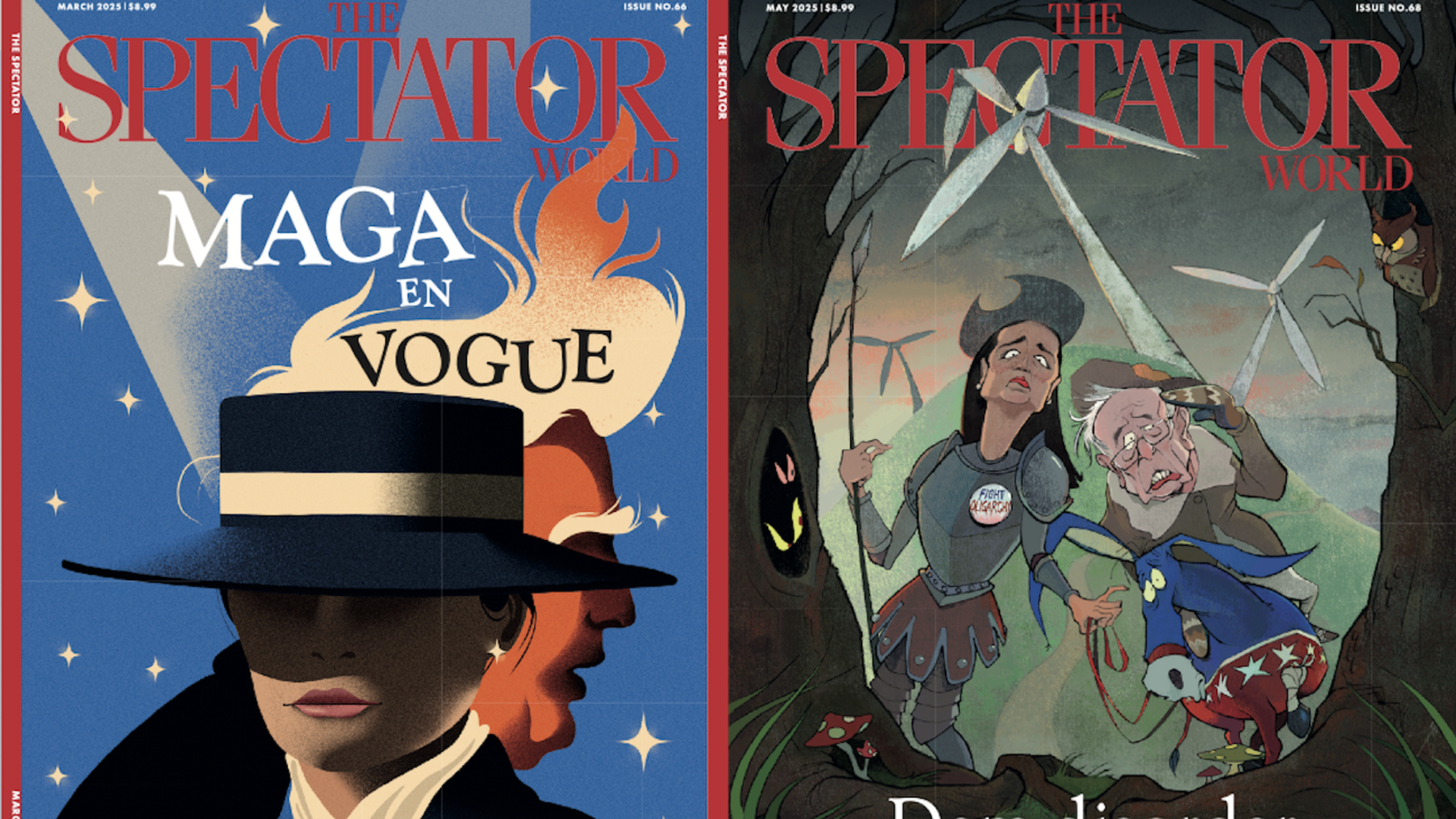
The Spectator's U.S. edition plans to double its print output to 24 issues annually as part of a broader relaunch this fall, deputy editor Kate Andrews tells Axios.
📰 Why it matters: It's part of an industrywide print revival in the U.S. as publishers look for more ways to upsell jaded digital advertisers in the AI era.
- 🇬🇧 It also comes after other U.K.-based publishers like The Guardian, Reach, Financial Times, Hello! magazine, The Sun and The Daily Mail look to expand deeper into the U.S.
Zoom in: For The Spectator, which launched a U.S. print version in 2019, reader demand for more print products has been significant, per Andrews.
- "We find that when we offer print as part of a package (or events for our subscribers), it tends to attract new readers," Andrews said.
- In addition to doubling its subscription print offering, The Spectator U.S. will also bring its print product to newsstands this fall.
Between the lines: For advertisers, subscription print magazines offer a highly engaged audience that's hard to come by in the AI era.
- "We do find that in marketing, some kind of print product helps us in every other aspect," Andrews said, referring to the ability to upsell advertisers.
📚 The big picture: Several publishers, including The Onion, The Cut, Complex, Nylon, Spin, Us Weekly, Swimming World, Sports Illustrated, Saveur and Ebony, have all launched or relaunched print editions amid reader and advertiser demand.
2. 🤝 Breaking: $6B local megadeal


Nexstar, the largest local broadcast group in America, has agreed to acquire Tegna, the fourth-largest local broadcaster, in an all-cash deal valued at a whopping $6.2 billion.
📡 Why it matters: The merger would create the largest local broadcast company in the country by far.
- Barring any forced divestitures, the company would span 265 local TV stations across 132 of the country's 210 television designated market areas.
🏛️ The big picture: The deal will serve as a litmus test for the Trump-era Federal Communications Commission, which will ultimately decide whether a merger of this magnitude should be approved.
- FCC chair Brendan Carr has long advocated for repealing decades-old local broadcast consolidation rules.
- The Biden administration opposed this type of consolidation, killing Tegna's $5.4 billion attempt to combine with Standard General in 2023.
🔍 Zoom in: The deal, announced this morning, will see Nexstar pay $22 per share to acquire all of Tegna's outstanding shares.
- The all-cash transaction includes Tegna's net debt, as well as estimated transaction fees and expenses.
Between the lines: The deal price puts a significant premium on Tegna's stock that likely made it easier for Tegna to eliminate any other possible suitors from its dance card.
- The purchase price represents a whopping 31% premium to Tegna's average 30-day average stock price ending Aug. 8, per Nexstar. Shares closed Monday at $20.18.
Zoom out: Local broadcasters have celebrated the Trump administration's push to roll back old local broadcast rules in favor of more consolidation, which has reignited deal interest.
- Sinclair, the third-largest local broadcaster in the country, last week said it launched a strategic review of its broadcast business, which includes 178 television stations in 81 markets.
- Late last night, reports emerged that Sinclair was interested in a broadcast merger with Tegna, which may have prompted Nexstar and Tegna's announcement this morning.
What to watch: Any of these deals could run into FCC ownership cap issues, but it's possible Carr would issue temporary waivers to approve the deal, on the assumption that regulators could raise the ownership cap threshold.

3. 🗃️ More digital cuts
Refinery29 has quietly laid off staff as it plans to shutter its U.K. office, Axios has learned.
Why it matters: It's the latest cost-cutting move by the woman-focused outlet under its new management amid ongoing turmoil across digital media.
Zoom in: U.K. employees were notified last week of layoffs alongside the office being closed, sources told Axios.
- Others are also being let go, including senior editorial staff and directors outside the U.K.
Catch up quick: Vice Media sold Refinery29 to Sundial Media Group, parent company to Essence magazine, amid a broader asset sale last year.
- Sundial, which was recently renamed to Sundial Technology & Media Group, planned to revive the struggling publication, most notably through events.
- These cuts follow a December round of layoffs and the abrupt exit of Refinery29 CEO Cory Haik.
🌍 The big picture: Digital media brands once pursued international expansion as a clear path for growth. A decade later, those same outlets are pulling back and refocusing on survival in the U.S.
Read the full story with a Media Trends Executive membership
4. 📈 Newsmax fails up


Newsmax shares popped 15% yesterday after the conservative cable network said it would pay Dominion Voting Systems $67 million to settle a defamation lawsuit over airing 2020 election lies.
Why it matters: The settlement — which does not appear to require any sort of retraction or apology — clearly hasn't spooked Newsmax's investors, many of whom are retail traders.
💰By the numbers: Newsmax's stock closed at $13.93 per share yesterday, 15% above its Friday close of $12.11, boosting its market value by more than $200 million (well above the total settlement payout).
Zoom out: The stock spike suggests Wall Street investors were expecting a more punitive outcome.
- Fox News, which has a much larger audience than Newsmax, notably settled with Dominion over the same issue for $787 million in 2023.
5. 📺 Streaming nearly half of all TV consumption
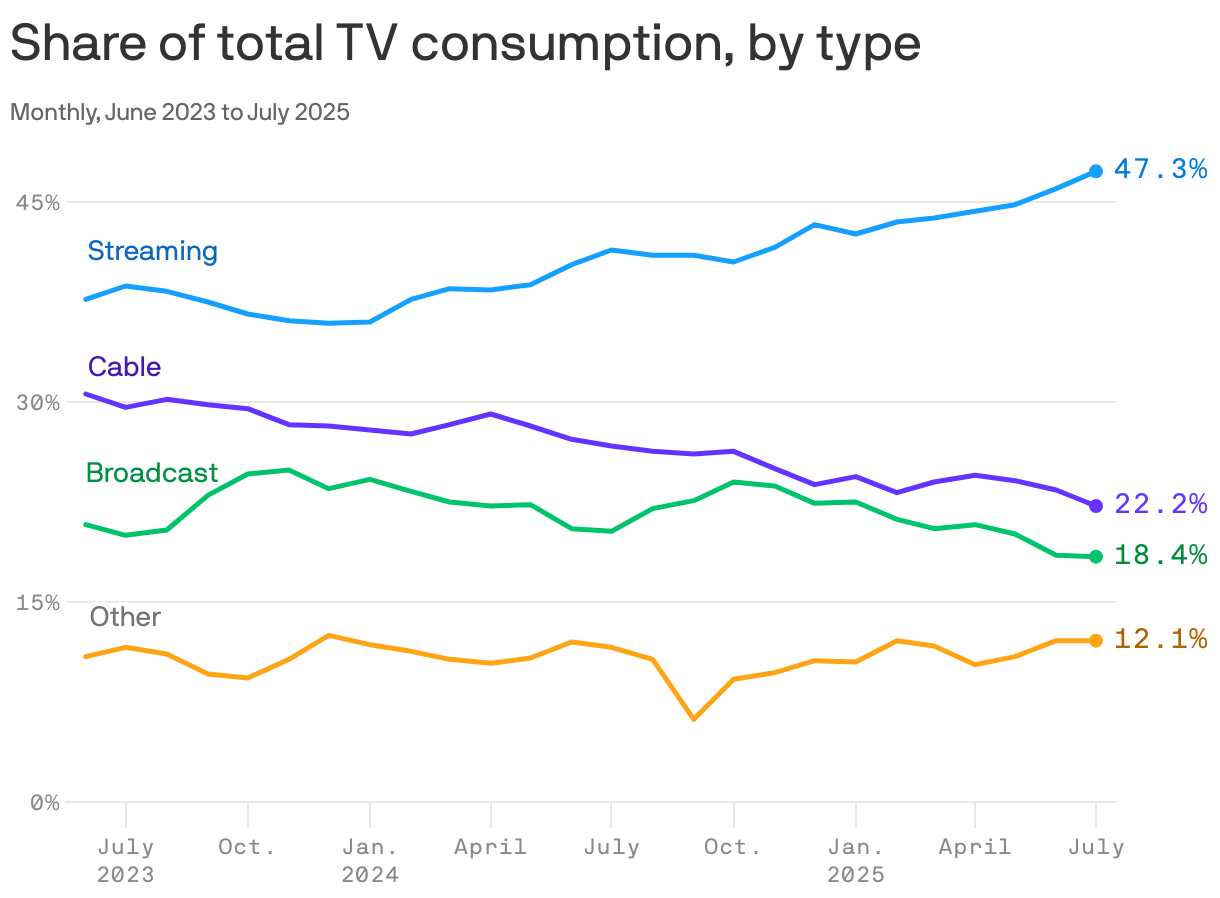
Streaming represented nearly half of all TV viewership in the U.S. last month, according to Nielsen.
🔌 Why it matters: The shift is mostly attributable to cable's decline and cord-cutting. Broadcast continues to hold steady, thanks to its broad accessibility and sports rights.
Zoom in: Nielsen attributes last month's uptick to a steady pipeline of new streaming releases, particularly on Netflix, which held eight of the top 10 most-streamed shows in the U.S. last month.
- Netflix, YouTube and Roku all hit platform highs in terms of consumption last month.
- YouTube by far has the highest engagement of any single TV platform. More than 13% of total TV viewership belonged to YouTube last month.
6. 👀 MSNBC's eyebrow-raising rebrand

MSNBC, the progressive cable network owned by NBCUniversal, is rebranding to MS NOW, an acronym that stands for My Source for News, Opinion and the World.
🤭 Why it matters: The new name and logo were quickly mocked online, with many questioning whether it makes sense to ditch a household name amid an increasingly crowded digital landscape.
Yes, but: The rebrand helps separate Comcast's NBCU from the progressive cable network at a time when politics is becoming a bigger factor in the regulatory oversight of big media conglomerates.
- The "NOW" language also mirrors that used by NBCU for its 24/7 streamer, NBC News NOW.
Zoom in: Prime-time ratings for MSNBC continue to steadily outpace CNN, but are still far behind Fox's, although the gap between Fox and MSNBC has closed slightly since President Trump was inaugurated.


🦚 The big picture: The rebrand is part of a wider effort by NBCU to create a distinction between the cable networks it plans to spin out and the remaining NBCU parent company.
- Cable networks that will be spun out into Versant, including CNBC, Golf Channel, GolfNow, MSNBC and SportsEngine, will drop NBCU's iconic peacock logo.
What's next: NBCU parent Comcast expects the Versant spinout to be completed by the end of the year.

7. 🤖 Newsrooms tap AI experts
Newsrooms are scrambling to hire AI leads as they explore AI tools, deals, lawsuits and processes.
💵 Why it matters: News companies don't typically have the deep pockets that tech firms do when it comes to hiring engineers and technical experts. But they're starting to make the investment.
Driving the news: On Tuesday, Politico named Francesca Barber as executive vice president, AI and innovation.
State of play: Time, Fortune and CNN are among major outlets that have recently named top AI leaders to guide editorial standards and product development.
8. 🎙️ Podcasting enters its Hollywood era
Taylor Swift's decision to unveil her new album on her boyfriend Travis Kelce's hit "New Heights" podcast with his brother Jason represents a new reality for podcasting that resembles Hollywood more than traditional radio.
Why it matters: The first wave of major investment in the industry focused on long-form shows that required heavy upfront production and marketing costs.
- 🎥 Now that video has taken over the medium, the podcast industry is shifting to focus more on celebrity talent, brand placement and social media virality.
Driving the news: Two influential podcast organizations, Sounds Profitable and Podcast Movement, are merging, executives exclusively tell Axios' Kerry Flynn.
- The deal underscores podcasting's rise and shift from a specialist form of audio storytelling to a key player in the Hollywood and creator ecosystem.
Zoom out: The news earlier this month that Amazon would restructure its Wondery podcast division and lay off 110 employees marked the industry's clear shift away from a focus on serialized content to more celebrity talent-driven video podcast shows.
- 💸 Amazon reportedly paid more than $300 million for Wondery in late 2020, at the height of the serialized podcast era.
- 🎧 That followed Spotify's acquisitions of podcast production company Gimlet Media and short-form podcasting app Anchor in 2019. Spotify later invested more than $1 billion in podcasting, before pulling back in recent years to focus on profitability.
The bottom line: "For people who pinned their hopes and dreams on the narrative-audio craze, the market looks increasingly unlikely to mint any more mega-millionaires," Bloomberg's Ashley Carman notes.
9. Courts strike down conservative bias allegations

A federal judge yesterday blocked the Trump administration's Federal Trade Commission investigation into Media Matters, arguing the probe violated the liberal watchdog group's freedom of speech.
Why it matters: Conservatives have targeted advertising and media groups with allegations of bias for months, but to little avail, thanks to strong First Amendment speech protections.
⚖️ Catch up quick: The news comes days after a different federal judge struck down a bias complaint from Rumble, a conservative alternative to YouTube, against Diageo and other major advertisers.
- Last year, a judge tossed a complaint by X against the Center for Countering Digital Hate, saying the case targeted the nonprofit group because it aimed to silence its research about rising hate speech on X.
- Last summer, the Supreme Court ruled that laws seeking to curb how internet platforms moderate and curate their content likely violate the First Amendment in some cases.
- States like Florida and Texas had passed legislation drafted by lawmakers who alleged tech companies were biased against conservative viewpoints.
Yes, but: The pressure campaign has at times proven effective.
- X filed a federal antitrust lawsuit last year against the World Federation of Advertisers, a major advertising trade group and its industry coalition called the Global Alliance for Responsible Media. GARM shuttered a few months later.
- The FTC approved a $13 billion merger between two ad giants in June on the condition that they agreed to not collude on barring ads based on politics. Both firms agreed to those conditions, despite their unprecedented nature.
What to watch: The FTC is reportedly investigating many other groups over alleged bias against conservatives.
Sign up for Axios Media Trends