Axios Media Trends

April 08, 2025

Good afternoon. Today's Media Trends is 2,118 words, an 8-minute read. Sign up.
- I'll be speaking at the Luminate Data and Entertainment Summit today in Los Angeles. Register.
1 big thing: Exclusive ... Netflix's D.C. whisperer
/2025/04/08/1744096954980.gif?w=3840)
Netflix has tapped Clete Willems, a veteran D.C. trade attorney, as its chief global affairs officer, Axios has learned.
- Willems will be based in Washington and will report directly to Netflix co-CEO Ted Sarandos beginning later this month.
Why it matters: Willems has experience working for both the Trump and Obama administrations.
- His global economic and trade policy expertise is essential to Netflix, which does business in more than 190 countries.
The intrigue: Willems will only oversee the company's global policy strategy, not communications.
- Netflix was reportedly looking to combine both functions after former communications chief Rachel Whetstone and former vice president of public policy Dean Garfield departed in October.
- The company is still searching for someone to lead its communications efforts.
Between the lines: Willems joins Netflix from Akin Gump, a prominent law and lobbying firm, after five years.
- He previously served as deputy assistant for international economics to President Trump in his first term, and legal adviser and chief counsel at the Office of the U.S. Trade Representative during the Trump and Obama administrations.
The big picture: Streamers have never had a unified voice in Washington, in part because their parent companies have such diverse interests.
- Netflix was part of the first major streaming industry alliance formed in 2023. While streamers like Paramount+, Max and Comcast's Peacock also joined the group, Big Tech firms like Apple and Amazon were noticeably missing.
- Netflix was the first streamer to join the Motion Picture Association, the trade group for top studios, in 2019. It previously was part of the now-defunct Internet Association, whose membership was broader and more focused on tech.
Between the lines: Consolidation within the entertainment industry has made it harder for any one company to feel fully represented by a single trade group. That's forced firms to invest more in their own lobbying efforts.
- Companies like Disney, Warner Bros. Discovery and Comcast/NBCU are part of a wide array of trade groups that represent everything from cable to broadband.
- These companies may be more impacted by certain policy changes than Netflix and vice versa.
- Studios like Disney, for example, are more exposed to a potential Chinese ban on Hollywood films in response to tariffs.
- In contrast, global policies that aim to make streamers pay more for internet bandwidth could have a larger effect on Netflix.
What to watch: Compared with other Big Tech companies, Netflix is less affected by U.S. tariffs because of its reliance on subscriptions over hardware sales.
Yes, but: Broader economic uncertainty is expected to hit the advertising market, where Netflix is looking to bolster its business. Netflix is also part of the Interactive Advertising Bureau (IAB).
2. WaPo eyes micropayments

The Washington Post is having active talks internally about using micropayments to expand access to its journalism, executive editor Matt Murray told me on stage at the Society for Advancing Business Editing and Writing (SABEW) conference Friday.
Why it matters: Many have tried but few have succeeded in introducing micropayments to journalism. Credit card minimums and older financial systems have made micropayments harder to facilitate in the U.S. than in other markets like China.
Zoom in: Murray said the company has been seeing a lot of success from early experiments with "flex payments," or payments that allow users to unlock the Post's journalism at smaller increments.
- The Post, he said, has piloted a flex payment that allows users to pay for access on a seven-day basis, which helps capture reader dollars during notable news cycles, like the election.
Zoom out: Flex payments are one of many experiments the Post is trying to regain profitability.
- The company has also introduced a subscription product for professionals, called WP Intelligence. It's investing more in live events.
The big picture: The Post's morale has been hit hard by a slew of high-level staff departures and blowback to owner Jeff Bezos' opinion section changes.
- On stage, Murray defended both Bezos and CEO Will Lewis, saying change within newsrooms can be unpleasant, but is necessary.
Asked if Bezos was 100% committed to continuing to own and grow the Post and whether he would remain patient with its turnaround, Murray said, "yes and yes."
- "Every conversation I've had with Jeff is he's committed to journalism," he said.
- He remarked that the company's "Democracy Dies in Darkness" slogan introduced in the first Trump era would remain with the company, in part because "I know it's important to Jeff that it's there."
Editor's note: This newsletter item was corrected to state that the Post's new subscription product is called WP Intelligence (not WP Ventures).
3. Minecraft awakens sleepy box office


"A Minecraft Movie" set records over the weekend with the biggest box office debut for any video game adaptation in history.
Why it matters: The film's success took analysts by surprise.
- Box office experts predicted the Jack Black fantasy comedy would bring in $90 million on the high end.
- Instead, it raked in a whopping $163 million in its domestic box office debut, marking the biggest box office weekend opener by far this year.
- The film brought in $313 million in sales internationally, per Comscore, helping to offset production costs of $150 million.
The big picture: Family-friendly entertainment has come to dominate the box office, as more families see movie theater trips as a cheaper alternative to weekend getaways.
- Last year, PG-rated films made up roughly one-third of ticket sales at the domestic box office, the highest percentage since 1995.
What to watch: Video game adaptions have become more popular with the rise of family entertainment on the big screen.
- "A Minecraft Movie" broke the domestic opening weekend record for game adaptations, which was previously held by the 2023 opening of "The Super Mario Bros. Movie."
4. Instagram turns off livestreaming for teens

Teens under 16 will now be barred from livestreaming on Instagram without parental permission, Meta announced Tuesday.
Why it matters: There are at least 54 million users with teen accounts, Meta said.
Zoom out: The new safety measure is an expansion of major changes that impacted millions of accounts starting last year as part of the company's push to better protect young users, Axios' Avery Lotz writes.
- Those policies, announced in September, meant all teenage users were automatically placed under teen accounts — and those under 16 needed a parent's permission to change their settings.
- Since making those changes, Meta said in a Tuesday release, 97% of teens aged 13 to 15 have kept the built-in restrictions.
Driving the news: On top of the new automatic Instagram Live restrictions, teens under 16 will also have to get permission from a parent to turn off a feature that blurs images with suspected nudity in direct messages.
- These updates will be available "in the next couple of months," per Meta's announcement.
Zoom out: Additionally, Meta announced it will begin introducing teen accounts to Facebook and Messenger beginning Tuesday.
- Those accounts will offer similar built-in protections against inappropriate content.
5. Misinfo moves markets
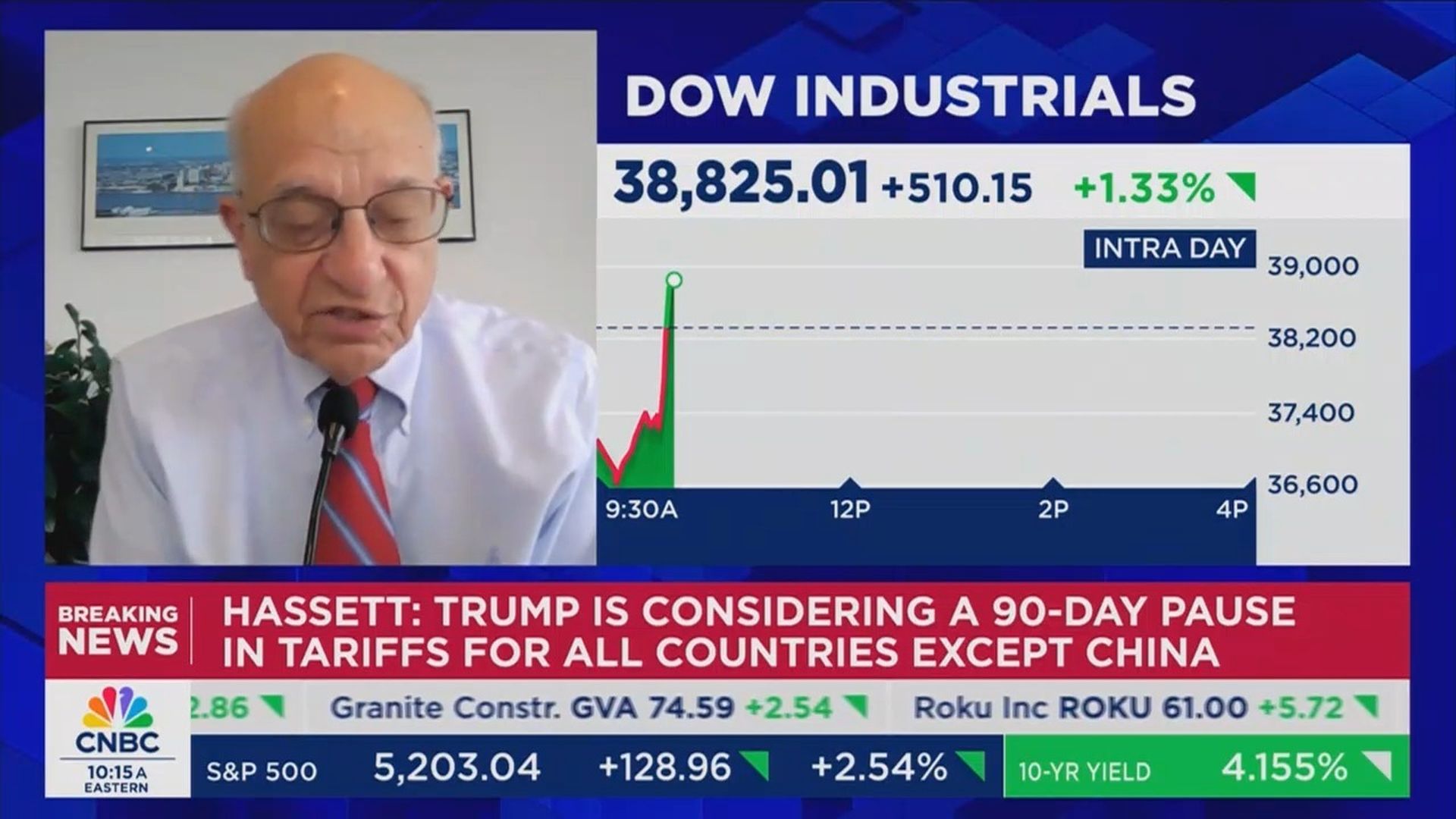
A faulty headline suggesting President Trump was considering a 90-day pause on tariffs outside of China drove a massive market rally on Monday morning, only for stocks to plummet after the report appeared to be false.
Why it matters: Investors are on a hair trigger for any sign of Trump retreating from his maximalist tariff plan.
- The S&P rose more in 34 minutes in one morning than it did in the first 13 years of this century, Axios' Felix Salmon noted.
State of play: Reuters on Monday retracted the story that reported Trump was considering a 90-day tariff pause for all countries except for China, citing White House economic adviser Kevin Hassett.
- The news wire said it published its story "drawing from a headline on CNBC," which posted a chyron with the false information at 10:15am ET.
Here's a rundown of what happened with time stamps:
At 8:24am ET: Hassett was asked on Fox News if Trump would consider a 90-day pause in tariffs, to which he responded, "I think the president is gonna decide what the president is gonna decide."
- The word "yep" came out of Hassett's mouth in response to being asked the question right before he answered, but it was obvious by his answer that the "yep" was not a response to the question, rather an acknowledgement to the anchor that he could hear him and the conversation was pivoting.
At 9:43 am: The S&P 500 begins to rally.
At 10:11am, an anonymous X account (@yourfavorito) posted "HASSETT: TRUMP IS CONSIDERING A 90-DAY PAUSE IN TARIFFS FOR ALL COUNTRIES EXCEPT CHINA mother of all squeezes incoming."
- The author of that account later wrote in response to a journalist asking him about the post that he got that information from CNBC and Reuters, even though both outlets reported the news after his post.
- He later said his post was a response to notes from trade desks. Goldman Sachs said it didn't have evidence that showed they sent email alerts about the news, as claimed by one of the screenshots being shared online.
At 10:15am, CNBC displayed a chyron on its air during a live report that said "HASSETT: TRUMP IS CONSIDERING A 90-DAY PAUSE IN TARIFFS FOR ALL COUNTRIES EXCEPT CHINA," mirroring the language exactly used by the @yourfavorito X account a few minutes before.
At 10:19am, Reuters published a wire story with the headline, "HASSETT: TRUMP IS CONSIDERING A 90-DAY PAUSE IN TARIFFS FOR ALL COUNTRIES EXCEPT CHINA -CNBC."
At 10:24am, CNBC said on air that it couldn't confirm the 90-day tariff pause was correct.
At 10:33am, CNBC reported that the White House denied the report, calling it "fake news."
At 12:28pm, Reuters officially retracted its story.
What they're saying: In a statement, CNBC told Axios: "As we were chasing the news of the market moves in real-time, we aired unconfirmed information in a banner. Our reporters quickly made a correction on air."
- Reuters acknowledged it pulled its headline from CNBC and said, "Reuters has withdrawn the incorrect report and regrets its error."
The bottom line: The costly mishap shows how investors and mainstream news outlets have become deeply reliant on social media during breaking news, sometimes to their own detriment.
6. Exclusive: Disney's next ad move
Disney has expanded the proprietary customer data that underpins its ad tech platform to Europe, executives told Axios.
Why it matters: Expanding its audience graph to more geographies allows advertisers to target ads across regions with different language barriers and local advertising regulations.
Zoom in: The company has also made it possible for advertisers to buy ad inventory for all live events across Disney+, Hulu and ESPN+ simultaneously for the first time using its platform.
- Advertisers can use biddable automation to buy ads in real-time against live programming, which is especially critical for live sports, said Jamie Power, senior vice president of addressable sales at Disney.
The big picture: The expansion comes as Disney's competitors race to build their own global ad tech businesses as the subscription streaming landscape becomes more saturated.
- Netflix, for example, plans to roll out its ad tech stack in the U.S. and other countries this year.
Zoom out: Disney's longtime investment in Hulu, which it bought fully in 2023, gave it a significant lead in the ad tech space.
- In January, the company said its streaming platforms have an estimated 157 million global monthly active users on its ad-supported streaming tiers.
7. G/O unravels

The sale of Quartz and The Inventory last week marked a near completion of the unraveling of G/O Media's portfolio.
- Today, all that's left of G/O Media is gaming news site Kotaku and Black news and culture brand The Root, Axios' Kerry Flynn and I write.
The big picture: Media holding companies that scrambled to scale in the 2010s have found a hard time sustaining their business models in an AI and subscription-focused era.
- In recent years, BuzzFeed has shed assets including Complex and Hot Ones. Vice shed Refinery29 and I-D Magazine.
Catch up quick: G/O Media was born out of the sale of Gawker Media to Univision for $135 million in 2016.
- Univision sold those assets under the rebranded name of Gizmodo Media Group to Great Hill Partners in 2019 for less than $50 million. The company later rebranded itself as G/O Media.
- In the past two years, G/O has sold Lifehacker to Ziff Davis and Jezebel, Splinter and The A.V. Club to Paste Media. It also sold The Takeout to Static Media, Deadspin to Lineup Publishing, and The Onion to Global Tetrahedron.
What to watch: Smaller tech investment firms are eyeing publishing as a way to scale their tech offerings, a model similar to that used by rollup companies such as Recurrent Ventures and The Arena Group.
- Quartz, for example, sold to a Canadian software firm called Redbrick, which is using websites to boost its tech portfolio.
- Two weeks ago, Yahoo sold TechCrunch to Regent, a media investment firm that recently acquired Foundry, which houses a slew of online tech publications, such as PCWorld, Macworld and Tech Advisor.
Sign up for Axios Media Trends