Axios Media Trends

June 25, 2024

✏️ Today's Media Trends, edited by Sheryl Miller, is 2,146 words, an 8-minute read. Sign up.
Situational awareness: Conspiracy theorist Alex Jones' Infowars site and its holding company will be shut down, a trustee appointed by a bankruptcy court said Sunday.
- A bankruptcy judge ruled last week that Jones' assets will be liquidated to help repay the $1.5 billion he owes to the families of the Sandy Hook Elementary School shooting victims, per Axios' Rebecca Falconer.
1 big thing: Exclusive... AP's $100M bet
The Associated Press will launch an independent sister organization to raise at least $100 million to expand state and local news, CEO Daisy Veerasingham told Axios.
Why it matters: The new group, a 501(c)(3) charitable organization, allows AP to raise philanthropic funds to support its local news efforts, which it can't do as a not-for-profit organization.
- "It will help to sustain what we do, grow what we do, and add new and incremental journalism services for the industry," Veerasingham told Axios in an interview.
State of play: The AP Fund for Journalism has already been established, but is awaiting IRS approval, per Veerasingham.
- The Delaware-incorporated organization will have a board of independent directors for which AP executives are recruiting.
By the numbers: AP has an initial fundraising goal of about $100 million. "I haven't put a timeline around that yet, but that's our initial goal," Veerasingham said.
How it works: The funds will be used to support AP's local journalism efforts as well as the work of other organizations or services that support local newsrooms, per Veerasingham.
- The allocation of those funds will be up to the organization's independent directors.
- Within AP, the funds could be used to help build services that can localize big datasets for local newsrooms, Veerasingham said.
- The funding could also help AP build training and services around artificial intelligence for local newsrooms. (AP inked a two-year licensing and tech-sharing deal with ChatGPT parent OpenAI last year.)
- AP will retain complete editorial control of all journalism it will produce with philanthropic funding from the new organization.
The bottom line: AP, established in 1846, relies on a strong local news ecosystem to service its member organizations.
- "We felt that this is the ecosystem the AP has supported since its founding and that it's a space that we need to step in and help shore up."
2. CNN CEO teases subscription product by year's end
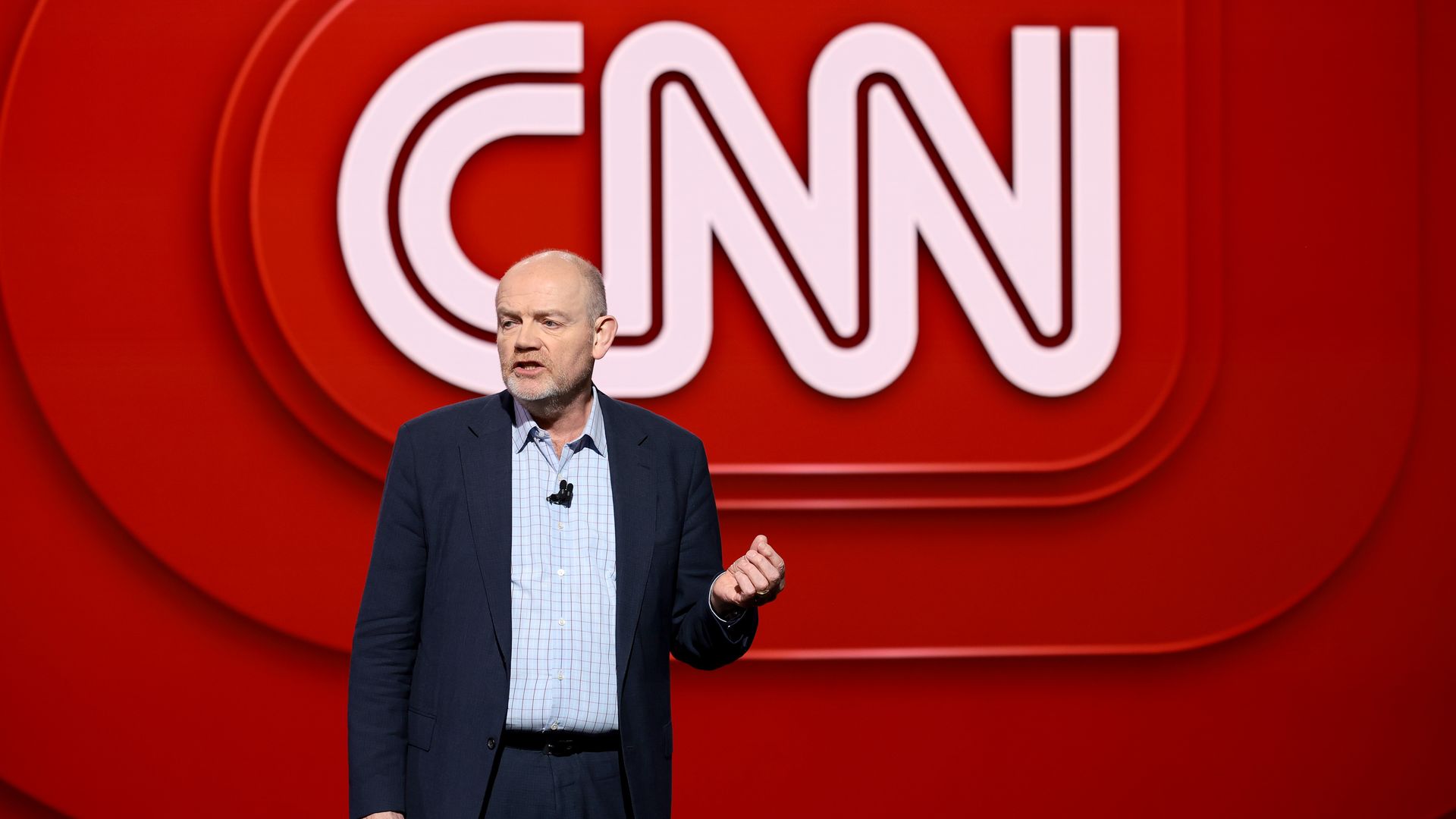
CNN CEO Mark Thompson said he hopes that by the end of this year, "There are meaningful things out in the market that you can see which represent change," to the company's subscription product strategy.
By the numbers: Of the roughly 170 million digital CNN monthly users, there are around 17 million–20 million who are "really engaged," he said in an interview during the Cannes Lions Festival for Creativity last week in France.
- The company is exploring whether there's a direct-to-consumer opportunity for them, he added. "This is going to be about getting even better at engagement and time spent and frequency."
- The interview, hosted by marketing agency Stagwell, also featured the CEOs of the New York Times and Business Insider.
Catch up quick: Thompson has been teasing a consumer subscription product for months. He took over as CEO last October, more than a year after CNN's parent company Warner Bros. Discovery killed its subscription streaming product CNN+.
- CNN is testing a registration wall for heavy site users that doesn't require payment but gives it access to first-party data that it could use to improve its ad products or eventually sell subscriptions.
- Over time, Thompson hopes, "We can identify a really attractive, very strongly engaged, tenured and qualified news audience who I think could be very attractive to advertisers as well."
The big picture: Thompson doesn't have plans to move CNN's business model away from being mostly ad-supported, but he said there's more the company can do to make its products attractive to advertisers.
- "We're thinking hard about verticals," he said, noting the network has "a very big position" in topics like health, longevity and wellness. "If we have more regularity and clarity about that concept, we hope we can get some brands to associate with that," he said.
- Other examples he noted that could work for contextual advertising alignment include tech, entertainment and sports coverage.
- "We understand that there's going to be a range of different brands with different needs and that some of them — particularly, you know, in certain endemic categories — will be more interested in being adjacent to a particular topic rather than general news."
What to watch: Thompson didn't deny a recent Puck report that suggested cuts were coming to CNN, but he said change was inevitable.
- "You're going to see a lot of change, and that includes investment and new hiring. We also need to make sure that as our economics change, we're deploying capital across what we do as smartly as we can."
Disclosure: Sara is a paid contributor to CNN.
3. Thompson: Debate format hasn't changed
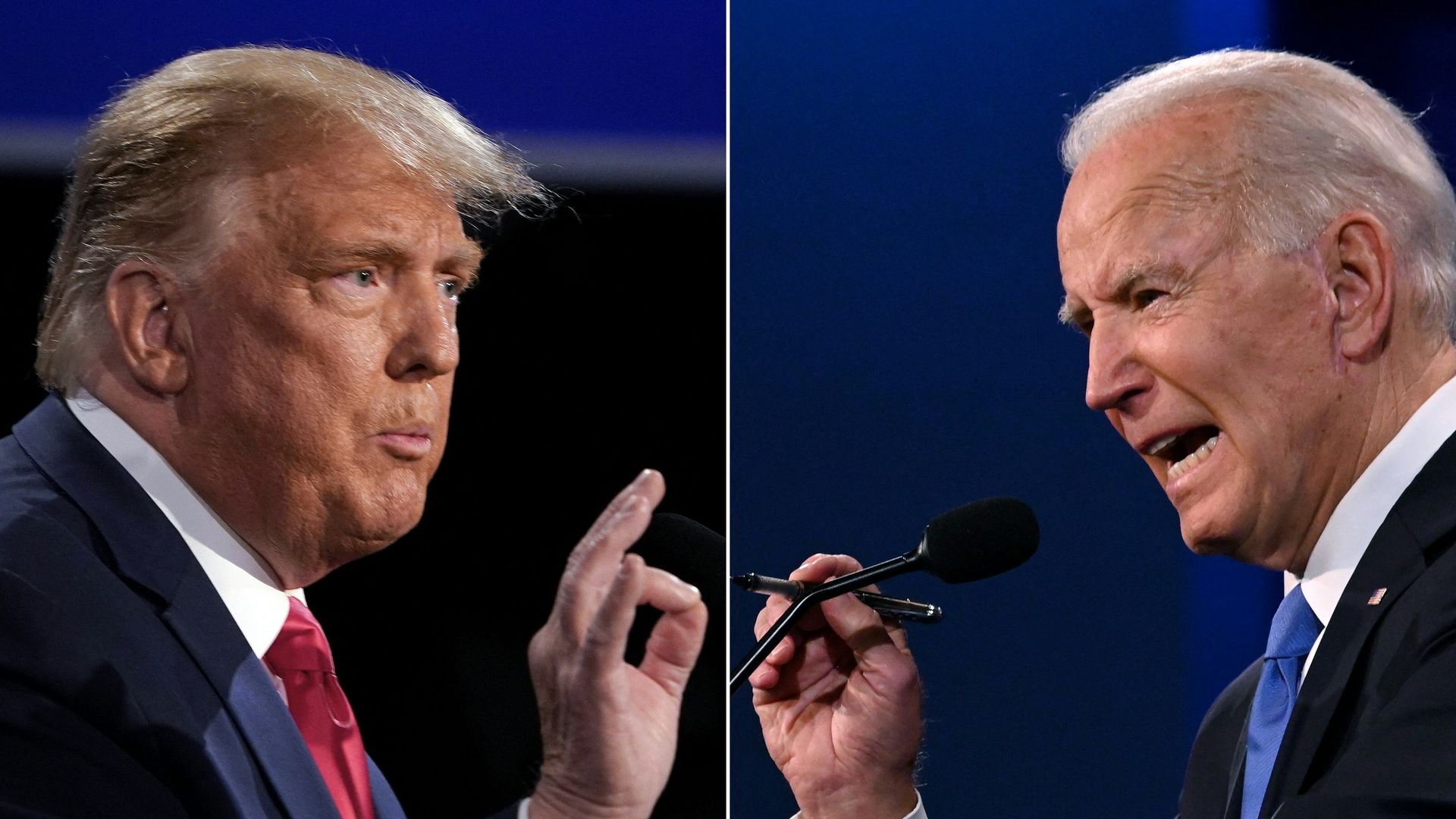
The format for this Thursday's historic debate between former President Trump and President Biden has been kept "absolutely the same right from the start," Thompson told me in the same interview.
- "The format is our format, and the invitation was to take part in that format, in that studio, on that day, with those moderators."
- "There's been no variation in the format from first to last," he added.
Why it matters: His comments refute any suggestions that CNN has changed its debate format or fact-checking strategy to appease either campaign.
- CNN released details about the debate rules earlier this month, which both campaigns have agreed to.
Zoom out: Thursday's prime-time showdown marks the first time in decades that a single TV network — and not the nonpartisan Commission on Presidential Debates — will organize a general election debate, Axios' Zachary Basu writes.
- The moderators and their role in live fact-checking are under intense scrutiny given Trump's long-running war with CNN and false claims about the 2020 election.
Between the lines: CNN's political director David Chalian told the New York Times Monday that Jake Tapper and Dana Bash will focus on facilitating the conversations between the candidates, as the debate "is not the ideal arena for live fact-checking."
- A CNN spokesperson told Axios, the moderators "are not participants in the debate. They are facilitators."
- As such, while they do intend to fact-check major inaccuracies, such as any assertions that the 2020 election was stolen, they don't plan to correct minor details in real time on air, such as inaccurate figures, the spokesperson added.
- Fact-checking of smaller details, as well as major falsehoods, will occur in real time on CNN's digital properties and immediately on air following the debate.
The big picture: Thompson said he wanted "an absolutely classic debate," akin to the historic first television debate ever between John F. Kennedy and Richard Nixon in 1960.
- "What we're hoping for is a moment where Americans and worldwide audiences who are maybe not focused on this event will begin to focus on it, and maybe be more likely to vote — whoever they vote for," he said.
What to watch: In allowing other networks and members of the Washington press pool to simulcast CNN's debate, Thompson anticipates ratings and engagement will be very high.
- "This is an election which American citizens get to vote in, but in many ways, it's an election for the world. ... I think you're going to see a great deal of attention on pretty much every continent on Earth."
4. Reddit eyes search amid Google surge

Reddit is eyeing search advertising amid a traffic surge from Google, its EVP of business marketing and growth Jim Squires told Axios.
Why it matters: Reddit believes more users will want human answers to intent-based search queries as search engines lean further into AI summaries.
- Squires pointed to the fact that there were 23 billion Google search queries last year that included the word "Reddit."
Catch up quick: Reddit struck an annual $60 million AI content licensing deal with Google earlier this year.
- Executives have dismissed the notion that the deal has boosted their search results, instead crediting their product improvements.
The big picture: While licensing its user-generated content could present a bigger business opportunity for Reddit long-term, Squires said the company will remain primarily an advertising business "for the foreseeable future."
- The company, which has yet to post a profit, saw strong advertising and user growth for the first quarter.
- Shares in the company are up 16% since it went public in March.
5. Cannes takeaways: 2024 ad trends

Around 15,000 people across the media, marketing and advertising industries attend the Cannes Lions Creativity Festival in southern France each year. Here's what you need to know if you missed last week's event:
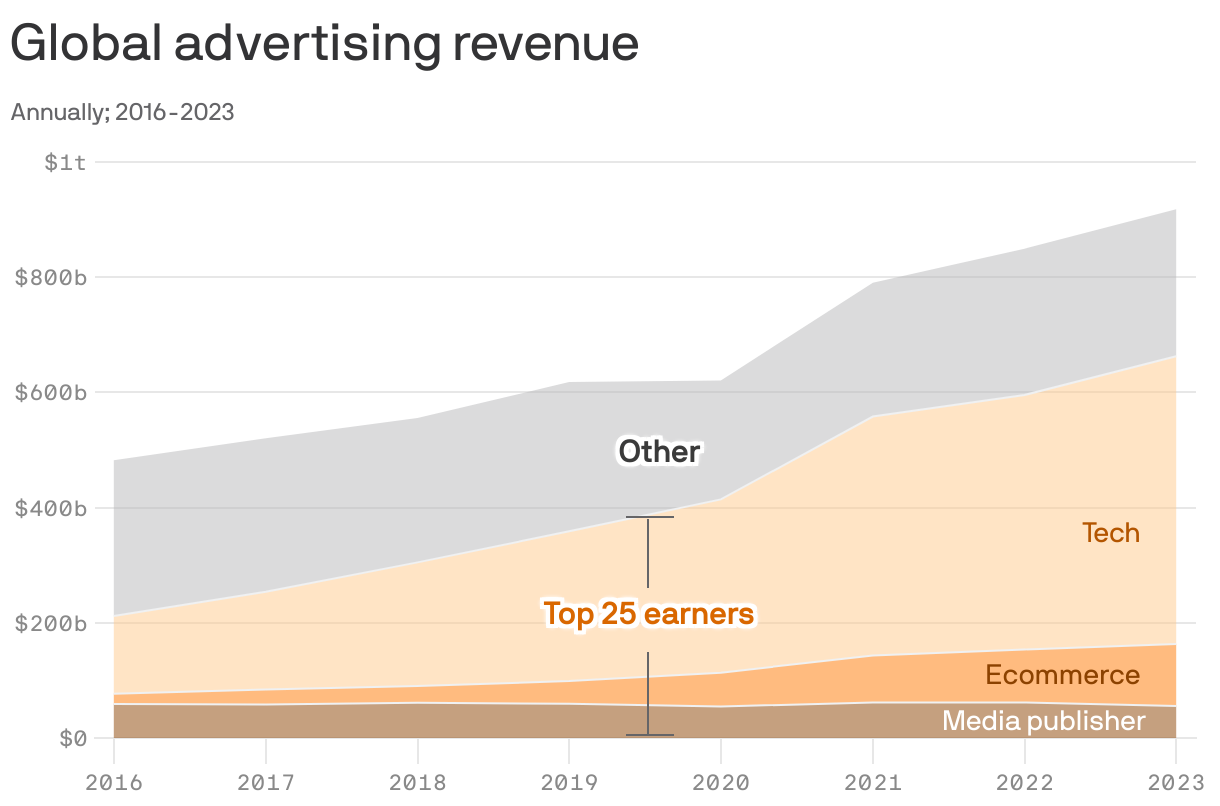
- Barbell economics: Advertising is moving faster into two buckets: hyper efficient vs. high impact. Anything in the middle, mostly cookie-based targeting against banner ads, is being leveled out. Publishers' share of the ad market is shrinking as a result.
- First-party data boom: Retailers, grocers, delivery services and finance companies that have troves of first-party customer data had a bigger presence at Cannes this year. While M&A talk appears to be at a lull, data partnerships between media companies and firms like Insatcart, Uber and Walmart are plentiful, Axios' Kerry Flynn notes.
- Rise of the conveners: The business of connecting the ad industry is getting hotter. Michael Kassan launched a rival firm to his alma mater MediaLink at Cannes. MediaLink still hosted the festival's biggest dinner of the week. Firms like Brand Innovators and The Female Quotient stacked lounges with big programming lineups.
- Politics is out, AI is in: In the aftermath of COVID, there was a huge focus on brands leaning into purpose marketing. Now, as The Drum notes, the focus has shifted to using AI and creators to authentically target customers.
- Power of live: Sports and concerts were a bigger focus this year, as brands continue to look for more ways to connect with consumers around premium, live experiences. The glut in ad supply from streamers like Amazon and Netflix, who are adding more live events, has caused rates to plummet.
6. X CEO: Job becoming "much more positive experience"
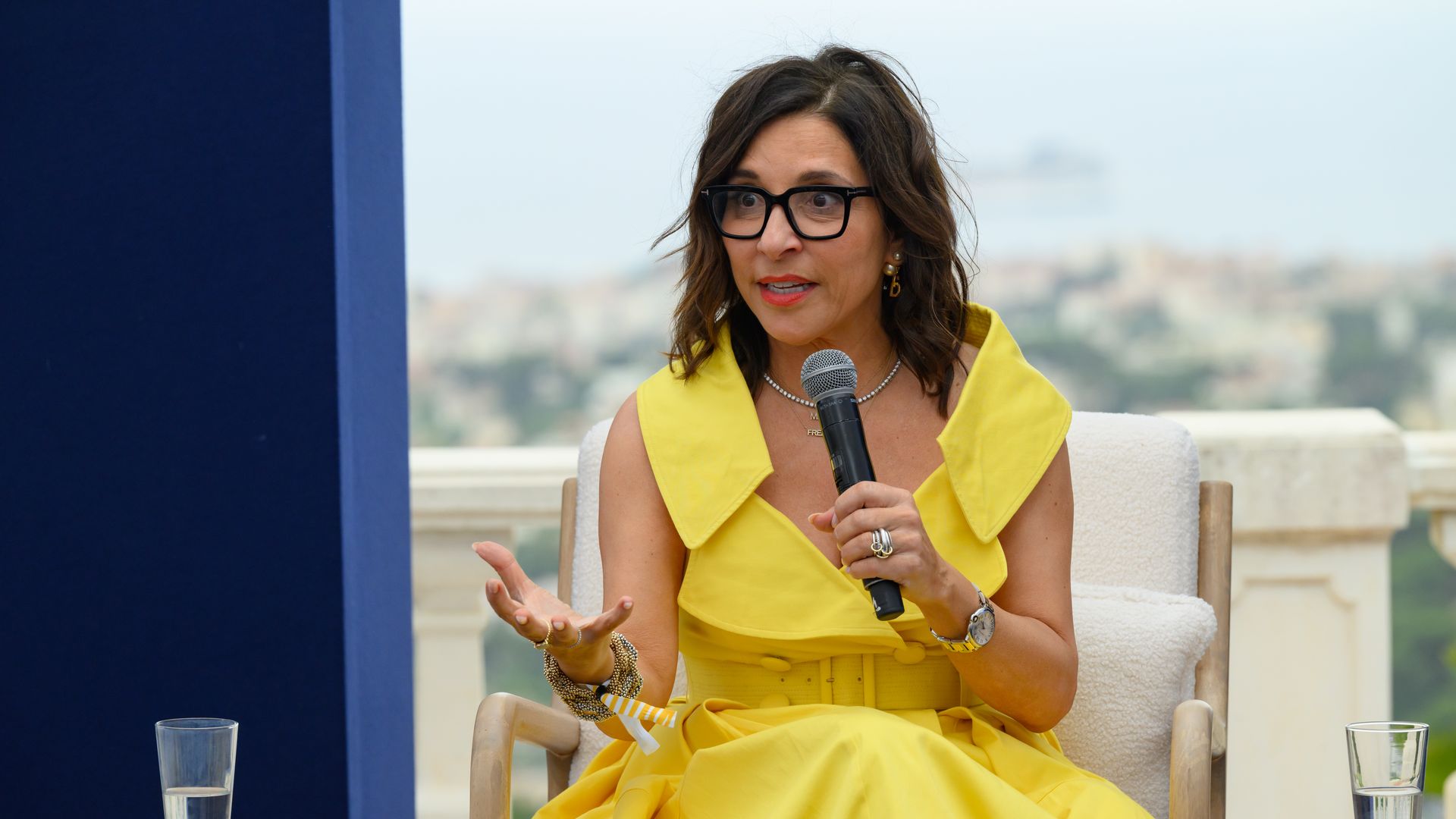
After her first year as CEO of X, Linda Yaccarino said her job is "becoming a much more positive experience."
- "It has been quite the stunning journey," she said.
Yaccarino returned to the annual Cannes Lions advertising festival last week, her first time back since 2022 and since leaving NBCUniversal as its ad sales chief last May.
- She cited the scope of X's ambition and the pace of the innovation as part of what has made her experience different this time around.
Zoom in: Asked about how the brand community was responding to her new role, she said there was a "very outsized reaction from the industry post-acquisition," but now, "we've done the work."
- Yaccarino pointed to the momentum the company has made in its product capabilities, particularly with video.
- She teased a new "TV app" as X's next big innovation, but didn't provide an exact launch timeline.
- She said X is having conversations with sports leagues about producing more docuseries on the platform.
Zoom out: For years, Yaccarino was considered one of the most powerful women in advertising. Today, her role as CEO of X transcends that community, but there's still pressure on her to address their concerns around things like brand safety and misinformation.
- Earlier this year, Yaccarino testified alongside four other Big Tech CEOs at a Senate hearing on child safety. She called the experience, just months into her new role, "unnerving."
- "You had to pay attention to keeping your confidence up," she said, while also noting that she was the only woman testifying. "It's a different experience."
The big picture: Yaccarino's return to Cannes was also notable because she was joined at the festival by X owner Elon Musk. She told Axios that they came to Cannes to "set fact from fiction."
- "There's insatiable interest in our company, insatiable interest in Elon," she noted.
What we're watching: Yaccarino previously said she expects X to be profitable in 2024.
- When asked about it, she said there is "so much momentum" but did not definitively confirm the financial expectations.
7. WaPo's sacrificial lamb
Robert Winnett will remain at the Telegraph instead of joining the Washington Post later this year, the Post's CEO told staffers in a memo Friday.
Why it matters: His decision to stay relieves some pressure from Post CEO Will Lewis, whose decision to name his former colleague as the Post's next editor as a part of a broader newsroom restructuring sparked considerable internal and external scrutiny.
Catch up quick: Winnett and Lewis have come under fire in recent weeks for their alleged involvement in a decades-old British phone hacking scandal and for using reporting tactics — like paying a key source for information — that most major U.S. outlets don't allow.
- That, along with a newsroom restructuring announced last month by Lewis, had begun to shake employee morale.
Winnett is best known in U.K. journalism for his key role in a landmark Telegraph investigation into the expense claims of members of Parliament.
- He'll remain as deputy editor at the Telegraph, a role he has held for the past decade.
What's next: Lewis said the Post will "immediately launch a new search for Editor of our core coverage. We will soon announce both the recruiting firm and process we will utilize to ensure a timely but thorough search for this important leadership role."
Sign up for Axios Media Trends