Axios Media Trends

March 25, 2025

Good afternoon. Today's Media Trends is 1,907 words, a 7-minute read. Sign up.
Situational awareness: The CEOs of PBS and NPR are set to testify tomorrow at an "Anti-American Airwaves" hearing being held by Trump ally Rep. Marjorie Taylor Greene, who leads the House's DOGE subcommittee.
📊 Join Axios Media Trends Executive to get access to our upcoming members-only monthly and quarterly reports. (Use code SARAFRIEND for a special Media Trends reader discount.) Sign up.
1 big thing: Story of the year


The Atlantic story detailing how Trump aides inadvertently invited the magazine's editor to a Signal chat where highly sensitive information about a military strike was shared has easily become the top news story of the year globally, according to new data.
- A spokesperson for The Atlantic said it was "one of the top subscription driving stories" for the magazine of all time.
Why it matters: Rarely do U.S. national security stories gain this much traction so quickly around the world.
- #SignalGate is more than just a revelatory report, it's a viral sensation that's driving meme mania online.
- #SignalGate was the top story in the world across all English-language articles, according to NewsWhip, which measures social media engagement across Facebook and X.
Zoom out: Most stories that go viral on social media tend to be feel-good tales about everyday people or fear mongering stories about accidents or crime.
- The Atlantic has managed to uniquely penetrate the social zeitgeist with just plain journalism, which is rare.
- In fact, three of the top 10 most viral stories tracked by NewsWhip this year were published by The Atlantic.
The big picture: #SignalGate cements The Atlantic's success following a yearslong effort to turn around its business.
- After losing millions of dollars for several years, The Atlantic finally turned a profit last year.
- The magazine, one of the oldest in the country, has successfully built a digital subscription business, thanks in part to strong editorial gets and partnerships with third parties like Apple. Last March, the company said it had more than 1 million subscribers across digital and print.
- The company has hired a slew of big names over the past few months, including poaching Washington Post star reporters Ashley Parker and Michael Scherer in December.
What to watch: Some Trump allies are trying to downplay the story, but even conservatives aren't buying it. (To be clear, a National Security Council spokesperson said, "The message thread that was reported appears to be authentic.")
- Defense Secretary Pete Hegseth yesterday called the story's author Jeffrey Goldberg a "deceitful and highly discredited so-called journalist who's made a profession of peddling hoaxes" when asked about the piece.
- In response to Hegseth's comments, Fox News' chief political analyst wrote on X, "Oh for God's sake, the administration has already confirmed the authenticity of the message."
2. Landmark press freedom ruling remains

The Supreme Court yesterday declined to hear a case seeking to challenge the 1964 precedent set by the landmark New York Times v. Sullivan case that protects news outlets from litigation for publishing critical information about public figures.
Why it matters: The court has turned down several opportunities to revisit the standard over the past few years, despite interest from conservatives.
- Conservative Justices Clarence Thomas and Neil Gorsuch have called for the Supreme Court to revisit the case, which cemented the requirement that public officials need to prove actual malice in defamation lawsuits against the media.
State of play: The Supreme Court turned down a case from casino mogul and President Trump donor Steve Wynn.
- Wynn, also a former finance chair of the Republican National Committee, sued AP in 2018 after it published a story on sexual misconduct allegations against him from the 1970s.
- He appealed the case to the Supreme Court after Nevada's top court dismissed the lawsuit.
The big picture: Publishers are navigating various legal challenges and potential threats over the First Amendment and press freedom.
- The Daily Beast was sued yesterday by senior Trump political adviser Chris LaCivita for defamation. LaCivita alleged the outlet published "malicious" reporting about him during the 2024 campaign.
- Sarah Palin's defamation lawsuit against the New York Times is scheduled for another trial in April. The jury had rejected the former Alaska governor's suit in 2022 about the Times' corrected editorial that erroneously linked Palin to a mass shooting that injured former Rep. Gabby Giffords (D-Ariz.).
- Fox News appears to be headed to court for Smartmatic's $2.7 billion defamation suit over the TV network's false claims about election fraud during the 2020 presidential race. In 2023, Fox agreed to a $787.5 million settlement with Dominion Voting Systems over similar allegations.
3. Legal battle brewing over government-funded media
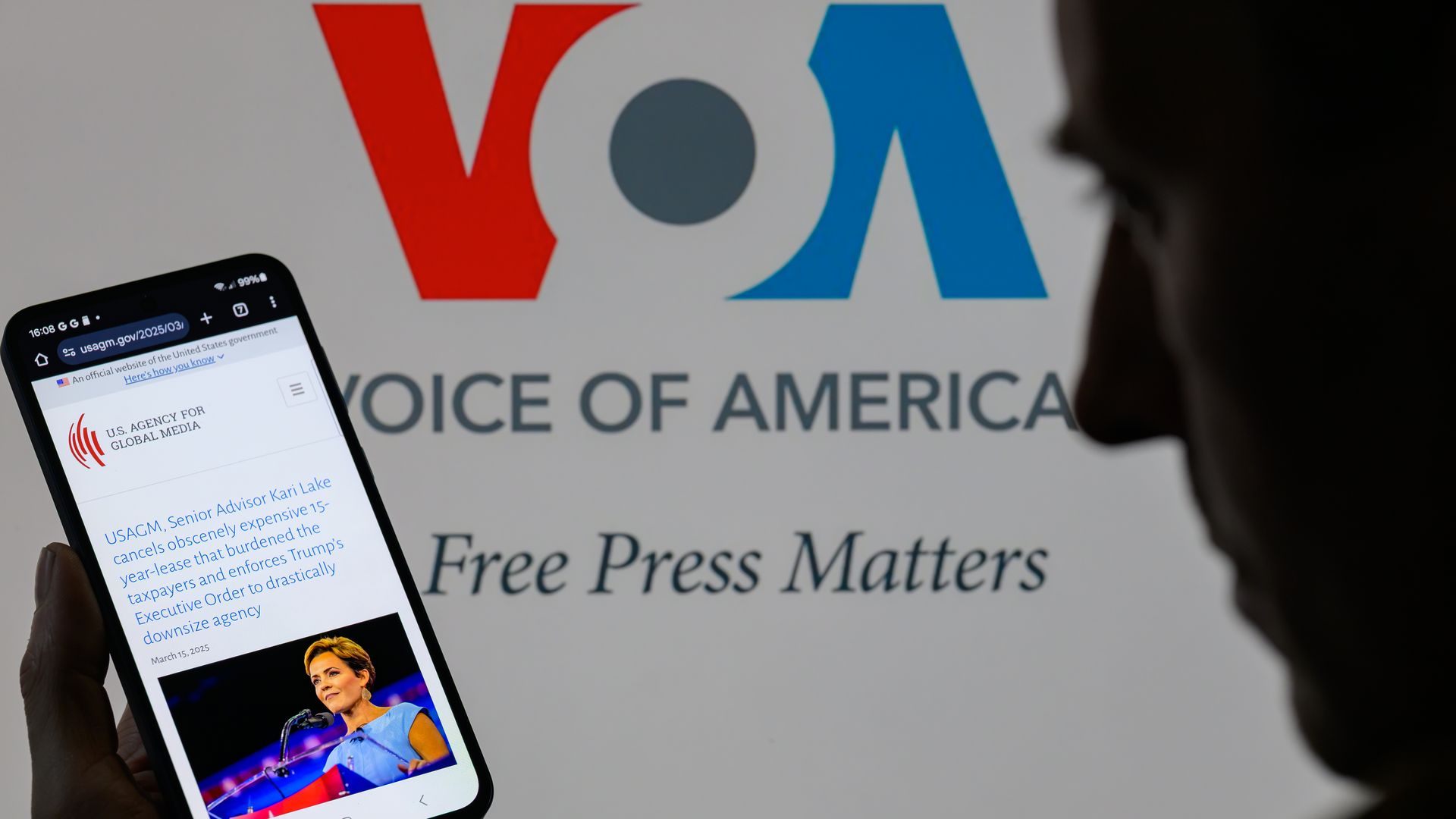
Seven Voice of America and U.S. Agency for Global Media staffers filed a lawsuit against the Trump administration Friday for shuttering USAGM and effectively dismantling the five broadcast agencies it supports.
Why it matters: Their lawsuit followed a separate legal action against the administration from sister broadcaster Radio Free Europe/Radio Liberty last week. Collectively, the efforts suggest that impacted journalists and press advocacy groups won't let government media die without a fight.
Driving the news: Yesterday, the suing VOA staffers filed a motion for a temporary restraining order to freeze any further attempts to gut VOA and its sister broadcasters.
- The initial lawsuit was filed to seek relief from efforts to shutter VOA and its sister networks, said longtime VOA White House bureau chief Patsy Widakuswara, who is named as a plaintiff on the lawsuit.
- Widakuswara is joined by VOA journalist Jessica Jerreat and USAGM director of strategy and performance assessment Kathryn Neeper as named plaintiffs in the complaint.
- There are four unnamed USAGM employees listed as plaintiffs in addition to press freedom groups Reporters Without Borders and the NewsGuild-CWA and government worker advocacy groups.
Between the lines: The RFE/RL lawsuit argues it's illegal for USAGM to pull congressionally appropriated grants to USAGM broadcast agencies.
- A U.S. District Court on Monday held a hearing on the RFE/RL's emergency request for $7.5 million in funds that Congress appropriated for its operations in March that USAGM pulled.
- Shortly before the hearing, USAGM announced its intention to disburse $7.5 million in appropriated funds to RFE/RL, but the broader issue of terminating its full annual grant, which totals more than $70 million, is still being litigated.
- The Open Technology Fund, an independent nonprofit that's a subdivision within the USAGM, has also sued USAGM for withholding funds.
The big picture: The Trump administration believes VOA and other government-funded broadcasters should align their coverage with the goals of the administration, per David Seide, a lawyer representing the VOA employees in their lawsuit.
4. Apple's streaming losses

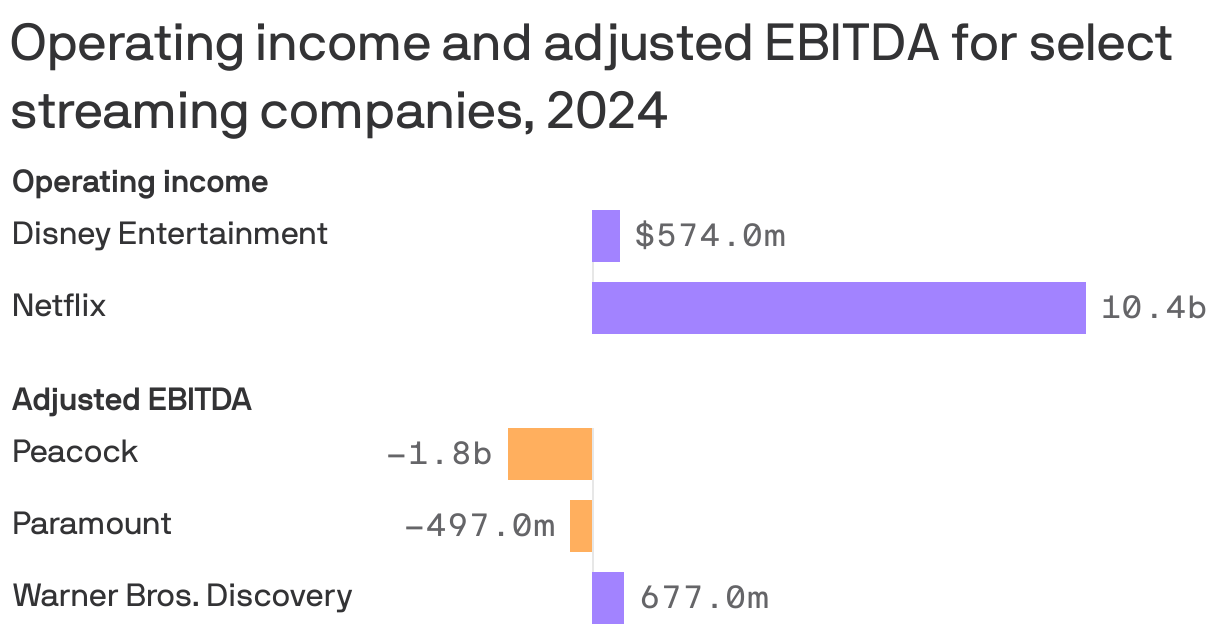
A recent report from The Information said Apple is losing $1 billion annually on Apple TV+, showing how much the tech giant lags some of its competitors in making its streaming bet profitable.
Why it matters: Wall Street is increasingly focused on the profitability of streaming services, especially for media companies that derive most of their revenue from content.
- For Big Tech companies, streaming services support and promote their main businesses like computer hardware for Apple or e-commerce for Amazon.
State of play: In 2024, Paramount and Peacock reported losses while Warner Bros, Disney and Netflix reported profitable streaming businesses. Amazon is eyeing ways to make Prime Video profitable.
Of note: Companies use different metrics to track profitability of specific units. Apple, for example, doesn't report specific figures for each service business, which is why it's not included in our chart.

5. FCC to block media mergers based on DEI policies
The FCC is threatening to block media mergers based on corporate DEI policies.
Why it matters: This creates new layers of complexity and uncertainty for dealmakers, and it reflects how the Trump administration is willing to pull novel levers to end what most CEOs viewed as sensible policies until two months ago.
Driving the news: FCC chair Brendan Carr tells Bloomberg that he only can "approve a transaction if we find that doing so serves the public interest. ... If there's businesses out there that are still promoting invidious forms of DEI discrimination, I really don't see a path forward where the FCC could reach the conclusion that approving the transaction is going to be in the public interest."
- He also mentioned several pending transactions, including Paramount's merger with Skydance, Verizon's $20 billion deal for Frontier Communications, and U.S. Cellular's $4.4 billion wireless unit sale to T-Mobile US.
- The Federal Trade Commission declined to comment when asked by Axios if it plans to take a similar tact.
Zoom in: The FCC doesn't have antitrust regulation powers like the FTC or DOJ, but does need to approve broadcast license transfers and the ability to launch investigations that can drown deals via delay.
- In an interesting twist, however, the FCC also is legally required to "prevent digital discrimination of access to broadband services based on income level, race, ethnicity, color, religion, or national origin."
The bottom line: It's not clear that President Trump's executive order on DEI gives federal agencies the legal authority to block mergers on such grounds.
- But all sorts of institutions — from universities to law firms — have been choosing protection over principle. No reason to think that dealmakers will act any differently.
6. Meanwhile, a slew of exits
Endeavor has completed its acquisition by Silver Lake and is rebranding as "WME Group," which reflects its renewed focus on its talent representation business. The company's founder Ari Emanuel, who will become executive chair of the new firm, received a $174 million payout as part of the deal.
TheSkimm last week was sold to Ziff Davis, one of the largest publicly traded digital media companies. The women-focused newsletter company will sit within Everyday Health Group, Ziff Davis' health content arm.
TechCrunch was sold by its parent Yahoo to Regent, a media investment firm that recently acquired a slew of online tech publications, such as PCWorld, Macworld and Tech Advisor.
Lee Enterprises, the publicly traded newspaper conglomerate, is being eyed for a full buyout by activist David Hoffmann, who has been buying up shares in the company for the past year.
Cox Media, the local TV and radio broadcast company, may be on the block, Bloomberg reports. Apollo Global Management bought a majority stake in the company from Axios' parent company Cox Enterprises in 2019. A sale would reportedly value the company at $4 billion.
7. 💻 1 fun thing: The apps that just won't die

Napster was acquired today in a $207 million deal by Infinite Reality, a VC-backed metaverse unicorn.
Why it matters: Brand equity sometimes outlives the underlying business of internet platforms that were once popular with young users. That can prove irresistible to dealmakers.
Catch up quick: Napster didn't really disappear, although it's gone through a ton of ownership changes since pioneering what would evolve into music streaming.
- That included a 2022 purchase by Hivemind and Algorand, after which it raised funding from VC backers like Pegasus Tech Ventures, SkyBridge Capital, G20 Ventures, Outpost Ventures and F-Prime Capital.
- Now it will join Infinite Reality, which recently raised $3 billion at a $12.25 billion post-money valuation.
Zoom in: Infinite Reality's plan is to reimagine Napster as "a social music platform" that prioritizes active fan engagement over passive listening.
- Similar to companies like Spotify, it says the new platform will allow artists to "connect with, own, and monetize the relationship with their fans."
- The company will introduce features like 3D virtual concert spaces, merchandise and event commerce as well as AI-powered customer service and sales tools.
Zoom out: Infinite Reality is hardly the first platform to invest in a has-been tech platform years after its prime.
- Digg, an early news aggregator, was purchased by its founder Kevin Rose alongside Reddit co-founder and investor Alexis Ohanian earlier this month.
- Tumblr, which was sold to Yahoo for $1.1 billion in 2013, was eventually sold to WordPress parent Automattic for roughly $3 million in 2019.
- Flickr was sold to photo-sharing service SmugMug by Verizon Media in 2018.
- SoundCloud was put on the block early last year by owners Raine Group and Temasek.
The bottom line: Old apps never die. They simply find a way.
This newsletter was edited by Christine Wang and copy edited by Sheryl Miller.
Sign up for Axios Media Trends