Axios Media Trends

April 21, 2026

Good afternoon. Today's Media Trends, edited by Christine Wang and copy edited by Sheryl Miller, is 1,998 words, a 7½-minute read. Sign up.
💼 Axios CEO Jim VandeHei has launched a free Axios C-Suite weekly newsletter. Request to join.
🎤 This Friday in D.C.: Join Axios Live for a WHCD weekend brunch. I'll be interviewing MS NOW President Rebecca Kutler alongside interviews by Axios' Eleanor Hawkins and Mike Allen. Request an invite.
1 big thing: 🤝 Microsoft's AI power play

Microsoft is building universal protocols and tools that will make the agentic web reliable and transactable across all AI platforms.
- It's in active conversations with other AI companies to participate, says corporate vice president for AI monetization Tim Frank.
🔍 Why it matters: Google became the most popular marketplace in the traditional search era. Now, Microsoft sees an opportunity to pull ahead.
State of play: To create a sustainable two-sided marketplace, Microsoft is establishing a set of foundational standards and tools that it hopes will help AI platforms, publishers and brands align on what constitutes fair use information on the internet.
- An example of this type of information would be what time the Sun sets.
- From there, it is building additional layers of infrastructure to sit on top of that baseline that can help publishers, companies and customers transact.
🗽 What's new: The company told brand and publishing partners at a private event today in New York City that it's expanding its Publisher Content Marketplace.
- PCM helps publishers of information that isn't readily available for free on the internet, such as product catalogs, map data and real-time news, get compensated for citations on AI platforms.
- It also announced support for the Universal Commerce Protocol, an open standard for AI-driven shopping developed by Google in conjunction with other major shopping companies, like Shopify.
Zoom out: Microsoft believes its 51-year history, focused mostly on enterprise solutions, established the trust and scale necessary to build the foundational layers of the agentic web.
- "We do not have conflicting interests about operating as a platform," Frank said.
What to watch: While it does plan to charge a technology fee to provide access to its services, Microsoft won't take a cut of any transactions and will keep the fee low to ensure the marketplace is equitable and scales, per Frank.
2. 🎰 Gamifying tragedy
New prediction market tools and viral videos are creating a world where tragedy is increasingly being amplified and gamified.
Why it matters: In an attention economy that rewards shock and extremes, everything has become a reality show.
Driving the news: In a Forbes story about a Louisiana man killing eight children over the weekend, a ForbesPredict box asked readers to predict whether or not Congress would pass new gun safety laws this year.
- 404 Media, which wrote about the prediction box, called it "another sign that the depravity economy has no bottom."
- The feature gives readers a daily login bonus of 800 virtual tokens to make predictions on news topics. No real money is exchanged.
- A Forbes spokesperson noted ForbesPredict is in beta and that the article was viewed by 3% of its audience.
- "We have established guidelines to prevent markets from appearing on certain topics, and this market was removed for not meeting those standards," the spokesperson said. "As we continue to refine and learn on ForbesPredict, we will adapt our controls with stricter checks and safeguards."
Zoom out: The episode renews scrutiny over prediction market traders profiting off war and tragedy.
- It's a consequence of prediction markets bringing trading activity to entirely new fields beyond whether a stock price goes up or down, or what the final score might be in sports.
- Traders have bet on whether Venezuelan leader Nicolás Maduro would be in U.S. custody by Jan. 31 and whether Nancy Guthrie's kidnapper would be arrested by Feb. 28.
- Betting on developments in the Iran war has also raised concerns about incentivizing situations that already threaten lives and global stability.
👀 What they're saying: Polymarket posted on some pages a note defending trading on current events in the Middle East.
- "The promise of prediction markets is to harness the wisdom of the crowd to create accurate, unbiased forecasts for the most important events to society. That ability is particularly invaluable in gut-wrenching times like today," it said.
- "After discussing with those directly affected by the attacks, who had dozens of questions, we realized that prediction markets could give them the answers they needed in ways TV news and X could not."
Between the lines: News companies, including CNN, Time, Dow Jones and CNBC, have struck partnerships with prediction markets in efforts to boost audience engagement while opening a new line of revenue.
- Many frame the announcements as a way to provide readers with more ways of analyzing the news, drawing comparisons to polling data.
Reality check: Most Americans view prediction markets as more similar to gambling than traditional investing, Axios' Nathan Bomey writes, citing a recent poll by Ipsos and the American Institute for Boys and Men.
The big picture: Tragedy and struggle have long inspired entertainment, but new platforms make it easier to exploit current events for financial gain or entertainment, rather than cast a critical or artistic eye on the past.
- Injury-related prop bets have become the norm in online sports gambling.
- Thailand's annual military draft lottery and recruitment process, which dates back decades, is gaining newfound attention as clips of young men fainting or breaking down as they learn of their fate go viral on TikTok.
- True crime fandom is rising as online sleuths look to solve real-time mysteries, often turning ongoing investigations into public spectacles and misidentifying innocent people as perpetrators.
Editor's note: This story was updated to clarify ForbesPredict uses virtual tokens.
3. 👯♀️ Creator copycat conundrum

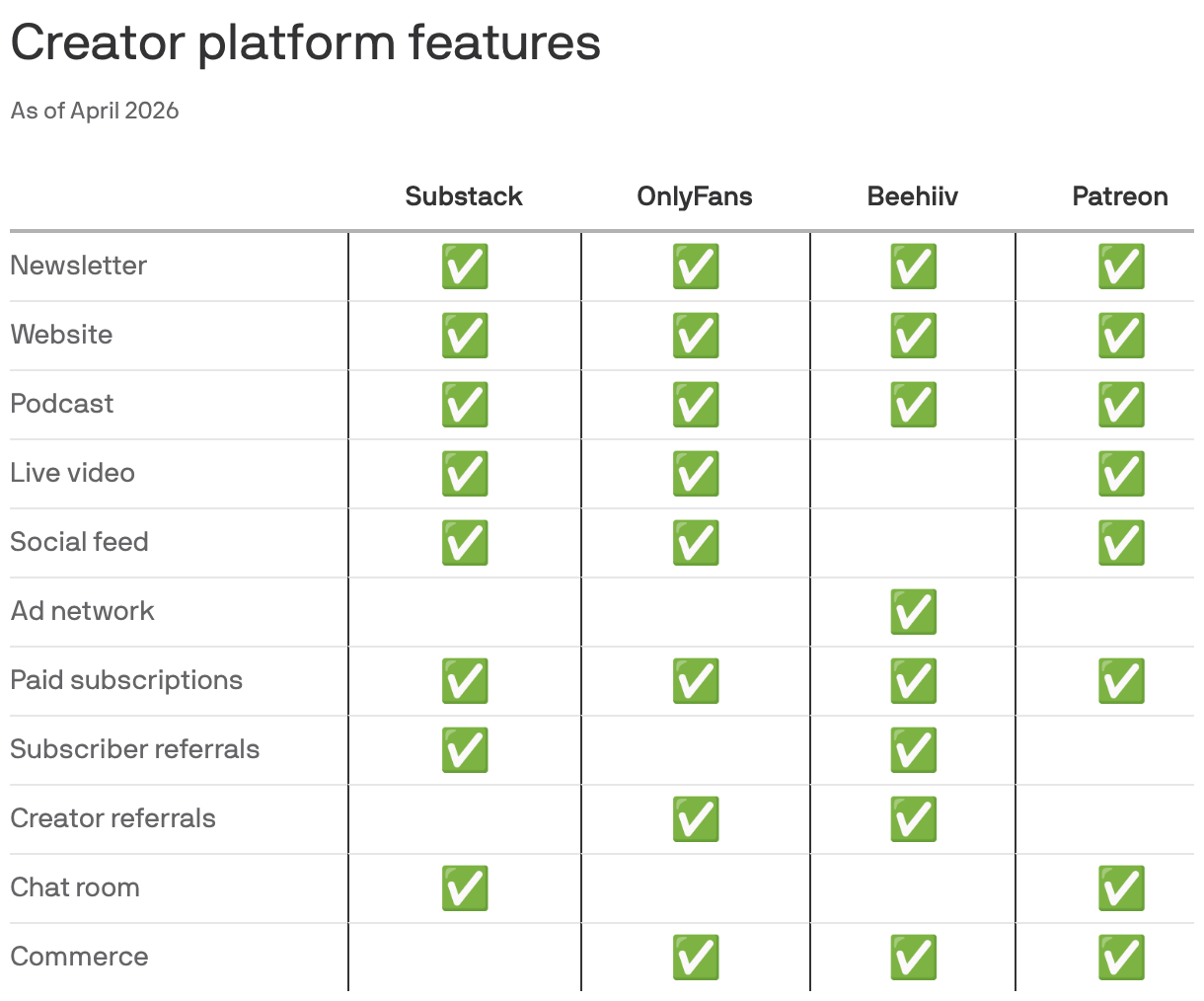
Creator platforms are evolving into one-stop shops and offering full-stack toolkits for publishing and monetizing across formats.
🤳 Why it matters: Differentiation is shrinking, intensifying competition to attract and retain creators.
- Patreon has introduced a new home feed for personalized discovery.
- Substack has expanded beyond its core newsletter format, investing in live video and podcasts. It launched Substack Recording Studio last month.
- Beehiiv, also originally known for newsletters, has introduced podcast hosting and monetization, enabling digital product sales like e-books and coaching.
Reality check: This is a natural by-product of the creator economy becoming more mature. The social media industry went through a similar copycat era.
📣 The big picture: Each quarter, Axios Media Trends Executive members get access to exclusive reports spotlighting the macro and micro trends shaping the industry.
What to watch: Below are a few trends highlighted in our Q1 2026 Platform Insights report.
- 💬 AI's advertising dilemma
- 🛡️ Users get more control over social feeds
- 🎥 Hollywood wants to be TikTok. TikTok wants to be TV.
- ⚖️ Big Tech unscathed from legal battles
- 🛍️ Everything is shoppable
- 💰 Social media subscriptions, mapped
- 👓 Wall Street wary on wearables
- 🗺️ Maps go social
- 🤝 Internet platforms shift ownership
- 📈 Meta challenges Google's ad dominance
What's next: We'll unpack these trends and more tomorrow in a webinar for members at 2pm ET.
🔑 Become a member to get full access to the data and insights — and for a limited time, get nearly 25% off your first year.
4. 🏛️ Another day, another lawsuit
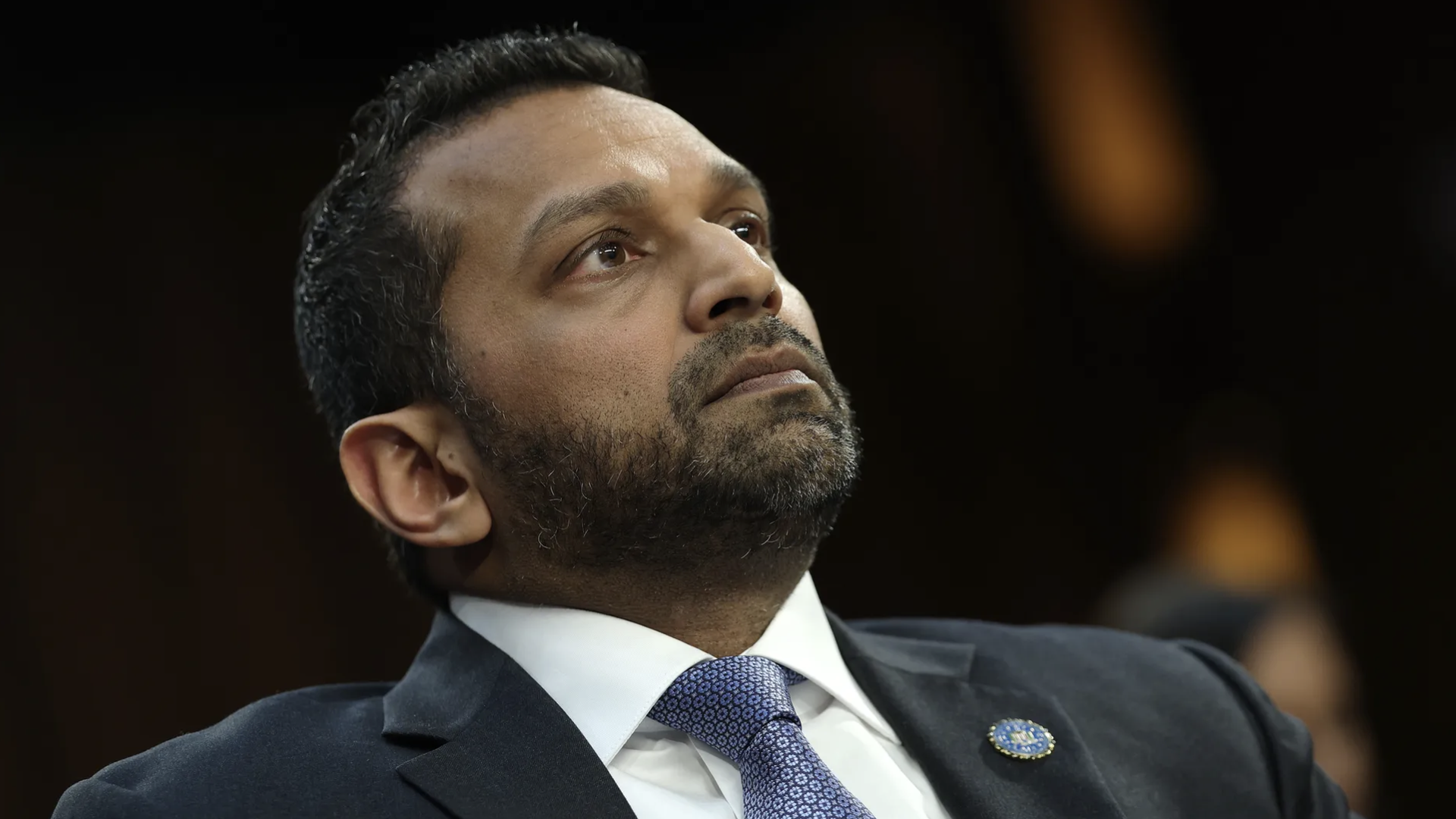
FBI director Kash Patel sued The Atlantic and one of its reporters yesterday, alleging they defamed him when the outlet published a story last week alleging he has an excessive drinking habit and a pattern of "erratic" behavior.
🤷 Why it matters: Legal experts don't think Patel has a strong case, but that may not matter.
- Sometimes, "the lawsuit is the punishment," said Foundation for Individual Rights and Expression senior attorney Adam Steinbaugh in a statement.
- SLAPP suits, he argued "are weaponized by the wealthy and well-connected to punish speakers with costly litigation, even if the suit is ultimately thrown out."
The big picture: The bar to prove "actual malice" when covering a public figure is extremely high, and courts have repeatedly upheld that standard throughout defamation lawsuits during the Trump administration.
Case in point: Of the 18 lawsuits tracked by Axios since 2023 between the media and the president, his administration or administration officials, and businesses:
- Two have been settled: ABC and CBS.
- Three suits filed by the president or his administration have been dropped or dismissed:
- Trump v. Simon & Schuster.
- TMTG v. Guardian News and Media.
- Trump v. WSJ/Murdoch.
- Corporation for Public Broadcasting v. Trump was dropped after the group dissolved.
- The administration lost two cases:
- NYT v. Department of Defense.
- VOA employees vs. the Trump administration.
- There are 10 ongoing cases, including:
- TMTG v. Washington Post.
- TMTG vs. multiple media outlets (including Axios).
- Trump v. BBC.
- NPR v. Trump.
5. 📺 Silicon Valley builds its own news-industrial complex

One of Silicon Valley's most powerful venture firms helped launch a 24/7 livestream on X yesterday, joining a wave of tech money piling into the news cycle as the internet's hottest new asset class.
Why it matters: "Monitoring the Situation" — the theme of Polymarket's pop-up D.C. bar, and now the name of a new show (MTS) funded by Andreessen Horowitz — has become one of the most viral and lucrative memes in tech.
- The phenomenon sprouted from Elon Musk's X, a platform now dominated by independent creators, amateur intel analysts and prediction markets that treat real-time news as a spectator sport.
- A permanent breaking-news cycle, including President Trump's second term, the Iran war and daily AI shocks, has made the news itself a product — something to trade, clip and monetize.
Zoom in: Backed by a roster of angel investors, MTS is being pitched as Silicon Valley's answer to cable news — a 24/7 livestream of elite X users reacting to real-time headlines, like Apple CEO Tim Cook's surprise exit.
- A16z co-founder Marc Andreessen, a prominent figure in MAGA's tech alliance, framed MTS as a tool for "sense-making" in an era he calls "incredibly complex and erratic."
- Skeptics were quick to mock the format as a well-funded livestream of venture partners switching tabs between X, prediction markets and Wikipedia.
The big picture: Legacy media is shedding jobs, audiences and relevance. An emboldened tech ecosystem, deep-pocketed and fast-growing, is racing to replace it.
- Kalshi and Polymarket now command valuations in the tens of billions, fueled by bettors trading record volume on everything from the Iran war to the best new AI model.
- OpenAI this month reportedly paid in the low hundreds of millions for TBPN, a buzzy livestreamed tech talk show now reporting to Sam Altman's top political operative, Chris Lehane.
The intrigue: A new Peter Thiel-backed startup called Objection.AI aims to go even further, letting users pay to challenge news stories and have them judged by a mix of human investigators and AI.
6. ⏸️ Local megamerger halted
A U.S. district judge on Friday issued a preliminary injunction requiring Nexstar and Tegna to remain separate, despite closing their $6.2 billion megamerger last month.
Why it matters: The ruling significantly dampens the consolidation outlook for the entire local broadcast industry.
🙅 Zoom in: In a lengthy decision, District Judge Troy Nunley said the court agrees with DirecTV that the merger would force national pay-TV providers like DirecTV to lift their prices on consumers, causing "irreparable harm."
- He also said the plaintiffs' argument that the deal will reduce competition in dozens of markets was likely to prevail in court. DirecTV filed a lawsuit against Nexstar alongside eight state attorneys general.
- Nexstar said it will appeal the ruling.
💰 By the numbers: Nexstar, the country's largest broadcast group, announced a deal to acquire Tegna for $6.2 billion last year.
- The combined company would span more than 259 stations and would have more than 80% reach into U.S. households.
📡 The big picture: To approve the merger, the FCC waived a rule that caps local broadcast station ownership to reaching no more than 39% of U.S. households.
- There's been a fierce debate over whether the FCC had the authority to unilaterally lift the cap. Opponents of the deal say Congress passed a law setting that threshold, and thus only Congress could unwind it.
What's next: The injunction goes into effect at 5pm PT tonight, when the previous temporary restraining order expires.
- While in place, the injunction prohibits Nexstar and Tegna from any action to consolidate their stations.
- Nexstar must also permit Tegna to continue operating as a separate and distinct, independently managed business unit from Nexstar.
Sign up for Axios Media Trends