
Axios Markets

July 21, 2023
🎉 Friday! We made it. Today's newsletter is 902 words, a 3½-minute read.
1 big thing: Extreme heat is becoming an urgent labor issue
Photo illustration: Aïda Amer/Axios. Photos: Mark Felix/AFP, Frederic J. Brown/AFP via Getty Images.
Extreme heat is becoming a rallying issue for workers around the country, Emily writes.
Why it matters: The stakes couldn't be higher — July is on track to be the globe's hottest month on record. Those who work outside or without air conditioning are at heightened risk of developing a heat-related illness, which can be fatal, reports Axios' Jessica Boehm.
- There were at least 436 work-related deaths caused by environmental heat exposure from 2011-2021, per the U.S. Bureau of Labor Statistics. That number likely underestimates the scope of the problem.
State of play: From farms to warehouses to fast-food kitchens, workers are laboring in dangerously hot conditions — and employers are subject to few legal requirements to keep them safe.
- Workers are speaking up. "We've definitely seen an increase in the number of workers who are organizing around heat," Anastasia Christman, senior policy analyst at the National Employment Law Project, told Emily.
- UPS agreed in June to air-condition delivery trucks after drivers complained for years about intolerable heat.
- Workers at a Voodoo Doughnuts in Portland went on strike during a 2021 heat wave to protest conditions. So did Detroit McDonald's workers.
Zoom in: Farmworker advocates gathered in Miami this week to mourn 30-year-old Efraín López García, who died this month after experiencing heat stress.
- His was the second heat-related farmworker death in Florida this year, Axios' Martin Vassolo reports.
- Proposals for regulation around working conditions in the heat aren't getting traction, said Neza Xiuhtecutli, general coordinator at the Farmworker Association of Florida.
- Farmworkers avoid taking breaks in the heat for fear of falling behind in their work because they're often paid according to how much they harvest, he said.
- Many are undocumented immigrants, afraid to complain. "People don't feel like they can speak up about any kind of labor violation for fear of being targeted," said Xiuhtecutli.
Be smart: The workers most at risk are often those with the least leverage to protest; disproportionately workers of color.
- About 38.7 million workers are employed in industries that put them at risk from climate dangers, including heat and other extreme weather, according to an analysis Christman wrote in March.
- Just 22% of white workers are in such jobs; compared to 25.5% of Black workers and 36% of Latino workers.
Zoom out: There is no federal law protecting workers specifically from extreme heat.
- The Occupational Safety and Health Administration (OSHA) prescribes a "general duty" for employers to keep their workers safe. But it's a broad provision that would likely be up to court interpretation, employment law professor Michael Selmi told Axios Phoenix.
- The penalty for violating the law is often a modest civil fine, Selmi said.
- For example: A labor contractor was fined just $15,625 after a Florida farmworker he hired died last year from heat illness.
Only seven states — including California, Maryland, and Oregon — have laws guaranteeing workers access to water, rest and shade, Washington Post reports.
What to watch: The Biden Administration announced it would add heat safety rules to OSHA in 2021. But the rulemaking process is nowhere close to complete.
Go deeper .... Amid historic U.S. heat wave, workers have few protections
2. Catch up quick
3. Old houses now cost as much as new houses
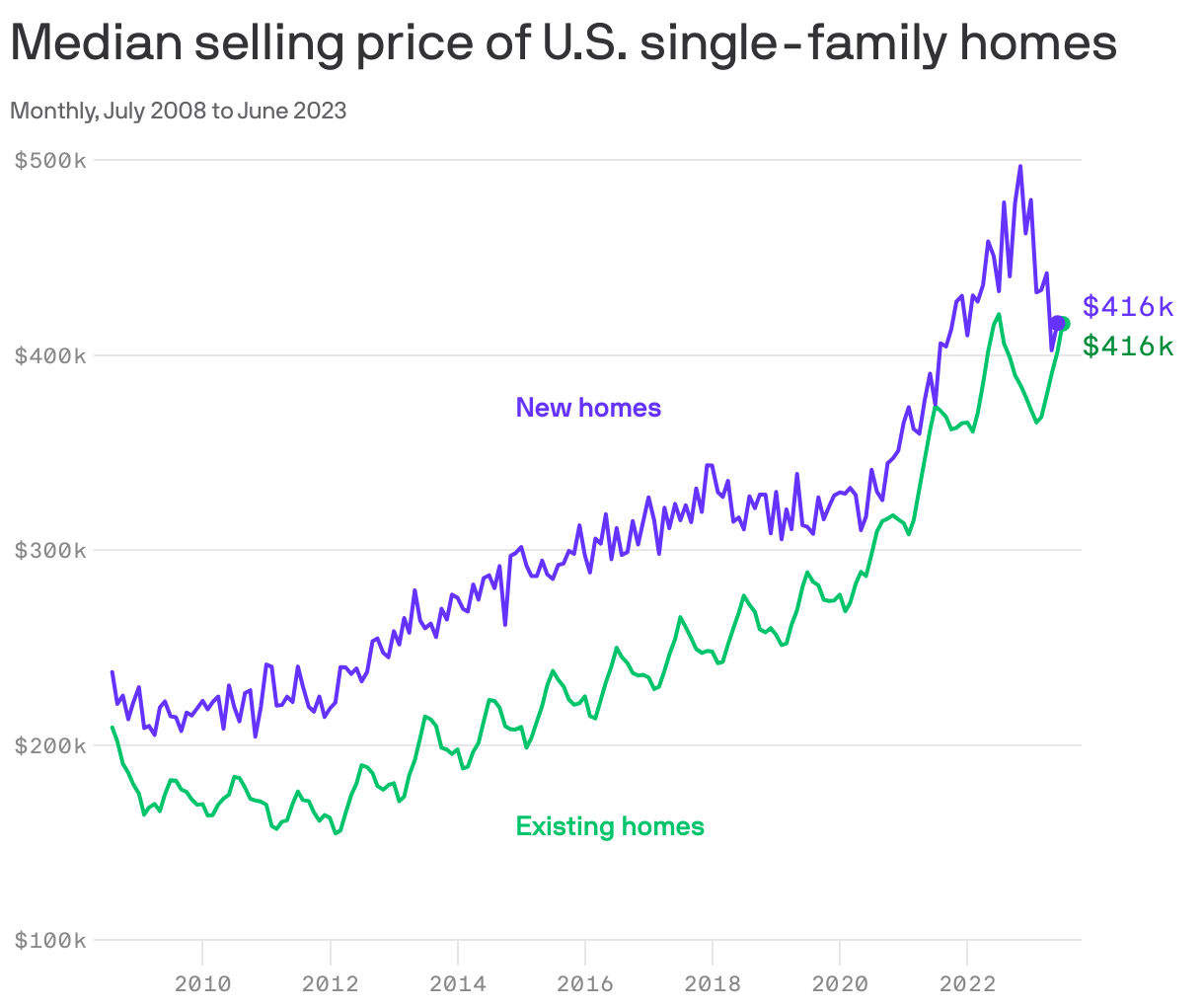
Here's a remarkable tidbit on the state of U.S. home prices, Matt writes.
- New data shows the median price for an existing single-family home — as opposed to a newly built one — stood at $416,000 in June.
- That's basically the same price that a newly built house was selling for in May, the last month we have data for. (June numbers are out next week.)
Yes, but: It's true, we're kind of comparing apples to oranges, since we don't have the new home sale price for June yet. But the sharp decline of the premium for new homes this year is pretty remarkable, nonetheless.
Context: For the last 10 years, prices for new single-family homes have been on average about $60,000 more than existing home sales. In May, that differential was less than $15,000.
The bottom line: The surge of mortgage rates over the last year — they're hovering just below 7% — continues to upend the housing market in surprising ways.
- The rate "lock-in" effect has resulted in a dwindling supply of existing homes on the market, helping to keep those prices elevated.
- Meanwhile, home builders are offering smaller, more affordable houses to tap into demand from first-time buyers facing low inventories of existing homes.
- As a result, the price points between this old house, and that new one, are starting to converge.
4. 🏠 D.R. Horton explains
"To adjust to changing market conditions and higher mortgage rates over the past year, we increased our use of incentives and reduced the sizes of our homes to provide better affordability to homebuyers."— Michael J. Murray, co-chief operating officer at homebuilder D.R. Horton, on an earnings call yesterday.
5. No sign of relief


The 30-year mortgage rate continues to hang under 7%, according to the latest weekly numbers from U.S. housing giant Freddie Mac.
- That's a tad lower than the average U.S. rate last week, 6.96%.
The bottom line: There's still little sign of meaningful relief on housing costs, either from home prices, or financing costs for would-be buyers.
Was this email forwarded to you? Subscribe here.
Today's Axios Markets was edited by Kate Marino and copy edited by Carolyn DiPaolo.
Sign up for Axios Markets

Stay on top of the latest market trends and economic insights
