Axios Markets

January 09, 2023
Morning! Another big week in the markets awaits, with Thursday morning's inflation report the likely main event.
- Missed that upbeat jobs report on Friday? We've got you here.
Today's newsletter is 934 words, 4 minutes. Let's go.
1 big thing: Mortgage buydowns, explained

Illustration: Trent Joaquin/Axios
The hot new thing in the moribund housing market is called a mortgage buydown — it's one of the concessions home sellers are increasingly offering buyers to seal a deal, Emily writes.
Why it matters: Though they've been around a while, buydowns seem a tailor-made solution for the current real estate market's biggest problem: high mortgage rates hovering around 6% have turned off buyers.
How it works: Sellers, homebuilders or even lenders pay cash to lower the buyer's mortgage rate by typically one to three points.
- Where does that cash go? It sits in an escrow account with the buyer's lender and is used to pay part of the monthly mortgage payment, for anywhere between one and three years.
- For example: A 2/1 buydown effectively sets your mortgage rate at 2 percentage points lower than your permanent rate (i.e. the current market rate) in the first year, 1 point lower in the second year, and then reverts to the permanent rate in year three.
The impact: The short-term benefit for buyers — in the form of a lower monthly payment — is bigger than it would be if the sale price were simply reduced by the same amount (see the table below).
- That's because the benefit of cutting the sale price would be spread over the life of a 30-year loan instead of concentrated in the first couple of years.
State of play: These deals were less likely to happen back when the 30-year mortgage rate was around 3% and demand for homes was high, said Van Welborn, a real estate agent with Redfin in Phoenix.
- Mortgage companies have also started more aggressively promoting buydowns. Rocket Mortgage is offering a one-year buydown that it's dubbed "Inflation Buster."
What they're saying: Homebuilders have used buydowns "forever," says Dan Hanson, executive director at LoanDepot. "They have a construction loan that's ticking away and they need to move the inventory."
- But now buydowns are "creeping into the resale market," adds Hanson, whose company is currently doing seminars for agents on the product.
- "It helps cushion the shock of the higher mortgage rate," says Van Welborn.
- His office has probably done about seven in the last month, compared to none at the same time a year ago.
Flashback: Buydowns were more common in the late 1970s when inflation was high. They were last seen in the run-up to the financial crisis, part of a whole menu of shady mortgage products lent to people who couldn't afford the payments. But today's buydowns are different.
- Borrowers still must qualify for the loan at the permanent, higher rate, to ensure they can make their payments.
Yes, but: Even if homeowners can technically afford the payments at a higher rate, they are likely in for some price shock when their rate adjusts higher down the road — and it's far from certain that they'll be able to refinance into a lower rate when that happens.
4. Bond market sees soft landing
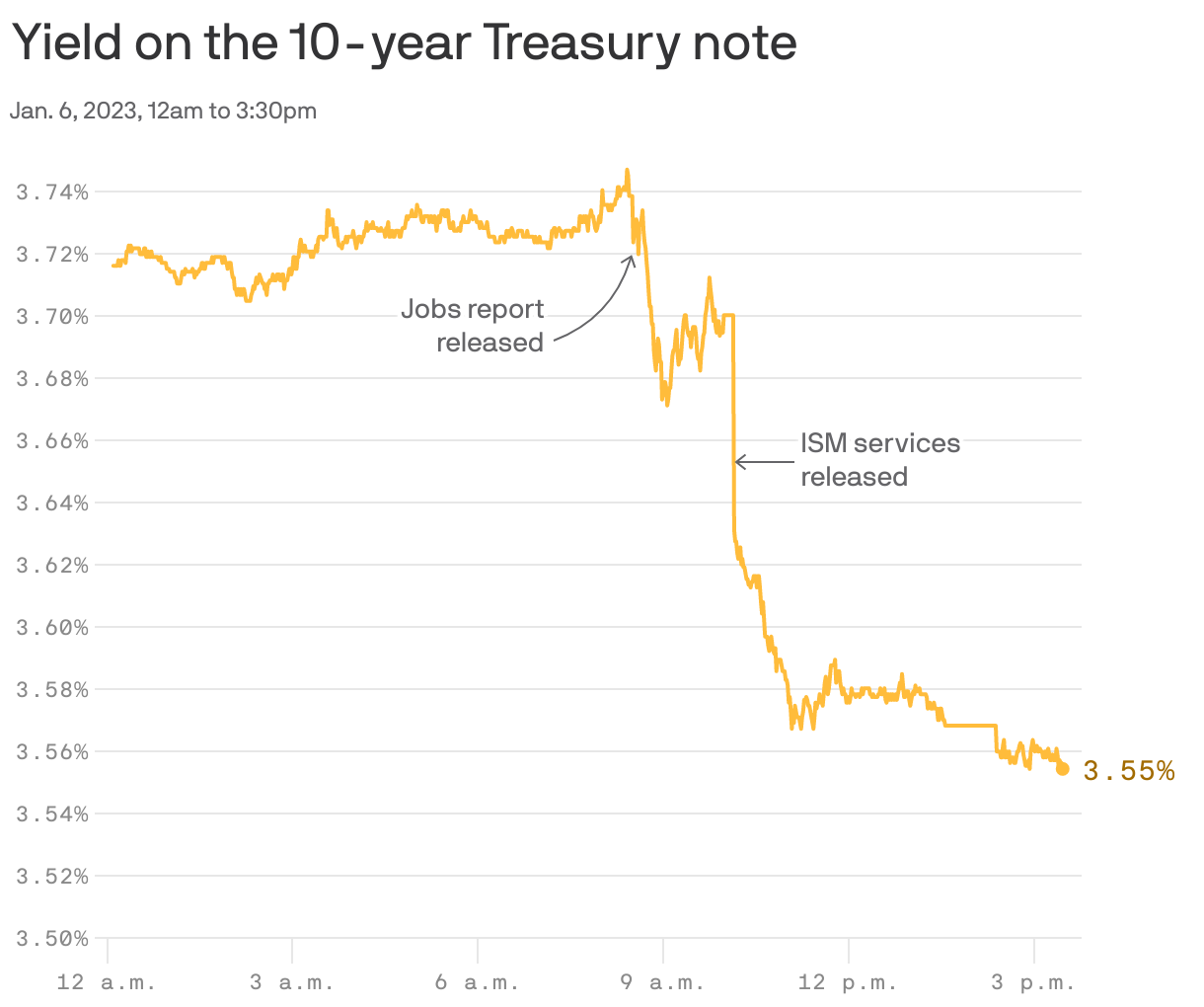
Yields on government bonds plunged on Friday as reports suggested that the sought-after soft landing for the economy may be a possibility, Matt writes.
Why it matters: A soft landing — meaning inflation eases, without the economy falling into a recession — would allow the Fed to ease up on the interest rate hikes that crushed the stock and bond markets last year.
State of play: Yields on the 10-year Treasury note plunged after a near-ideal jobs report Friday morning was followed by a closely watched ISM survey release on the services sector that showed a surprise slowdown.
- Context: Until recently, persistent strength in the services sector was seen by analysts as a reason that the Fed might have to keep hiking interest rates sharply.
- Falling yields, in turn, perked up the stock market which notched its best day so far this year. The S&P 500 rose 2.3%, driving the index to a tidy gain of 1.5% for the week.
What we're watching: The big inflation update that arrives on Thursday in the form of the Consumer Price Index. If that shows a third straight slowdown, Wall Street will be a happier place.
5. See how much tech companies are paying workers

Illustration: Shoshana Gordon/Axios
The guy behind layoffs.fyi, a popular website that tracks job cuts at tech companies, just started a new website that tracks tech salaries, called Comprehensive.io, Emily writes.
Why it matters: Even as the tech industry is going through a turbulent period of downsizing, employers are still advertising some eye-popping pay scales.
- Some of the top-paying companies listed on the site from Roger Lee include Tesla, StubHub and Asana.
- The average salary ranges for some popular job titles are $147,000 - $210,000 for a senior software engineer and between $178,000 - $242,000 for an enterprise account executive.
Backstory: Earlier this month, California started requiring employers to post salary ranges for open positions. A similar law in New York City went into effect last year. Lee's website relies on postings from those markets to compile its data.
- The intrigue: Employers often post such wide ranges that it's hard to gauge the usefulness of these numbers. A job posting at Netflix advertises a range of between $50,000 and $600,000.
What to watch: The numbers. If layoffs continue, might these salaries shrink? Also, will the averages fall as more companies start to comply with the new laws?
- Right now only 40% of employers in California have complied with the transparency law in the state compared to 63% in New York City, according to the website's tracking.
Was this email forwarded to you? Sign up here to get Axios Markets in your inbox.
Today's newsletter was edited by Kate Marino and copy edited by Mickey Meece.
Sign up for Axios Markets

Stay on top of the latest market trends and economic insights