Axios Login

February 02, 2022

Tomorrow at 12:30pm ET, Axios CEO Jim VandeHei will host a virtual event previewing Axios HQ — our AI-powered software platform that lets any leader or manager bring the Smart Brevity™ style of communication to their organization.
- The event includes real-world users, from CEOs to a school system.
- Register here ... Get a demo.
Today's newsletter is 1,159 words, a 4-minute read.
1 big thing: Computer chips are key to Biden's Russia strategy
Illustration: Shoshana Gordon/Axios
Biden administration officials say they will cut Russia off from its vital supply of semiconductors if it invades Ukraine — a broad sanction without precedent, Axios' Margaret Harding McGill reports.
Why it matters: Stemming the flow of computer chips to Russia would be a blow to the country's economy, but the novel move could have long-term repercussions for U.S. companies.
How it works: As part of Biden's strategy to inflict economic pain on Russia, the administration is threatening to use government regulations to restrict not only chips made by U.S. companies, but chips made by foreign companies that rely on U.S. equipment, tools, software or designs.
- Because of the ubiquitous presence of U.S. technology in the chip-making supply chain, the blow to Russia could be staggering.
"Semiconductors are the new weapon," Ed Mills, Washington policy analyst for Raymond James told Axios.
- "If you can link arms and deny a country access to semiconductors, their ability to function as a modern economy is eliminated."
The big picture: The semiconductor threat is one that would pose long-term economic damage, not stop tanks in the field.
- The Biden administration says planned financial sanctions would have an immediate impact, while the export controls, which limit products going into Russia, would make its economy more brittle over time.
Between the lines: It's not yet clear how broad the semiconductor sanction could be, but a person familiar with the White House's approach told Axios on Tuesday chip restrictions could be aimed at Russia nationwide or targeted more narrowly at specific industries.
- A senior administration official told reporters last week the export controls focus on areas that Russian President Vladimir Putin has said are strategically important to the country, including artificial intelligence and quantum computing.
Yes, but: The novel plan from the Biden administration has unnerved some industry officials, who fear it will lead to foreign companies accelerating plans to design out U.S. technology or seek alternatives from non-U.S. companies.
- Robert Atkinson, president of think tank the Information Technology and Innovation Foundation, told Axios an Italian company that relies on U.S. chips for its machines is considering substituting out American chips.
What they're saying: "This is certainly a big stick that we can deploy to make Putin think twice," Atkinson said. "The problem with deploying the stick is the more you use it, the more it degrades."
- "Even bringing it up sends a very clear message to a lot of countries and companies that they don’t want to be dependent on U.S. whims."
Flashback: The Trump administration made a similar move against Huawei in 2020, when it restricted the company's access to semiconductors that use U.S. technology and software.
- "One of the concerns from industry has been this is really opening up Pandora's box, in a manner of speaking, of the use of extraterritorial controls as a policy means," an industry source told Axios of the threatened sanctions.
The intrigue: Whether China would comply with the U.S. regulations, and not sell chips made with U.S. tech, is an open question.
2. FBI warns of cyber threats at Beijing Olympics
The FBI is warning people and businesses to remain vigilant against malicious actors who could interfere with the Beijing Olympic Games through a "broad range" of cyber activities, including theft of sensitive data, Axios' Shawna Chen reports.
Why it matters: High-profile events like the Olympics give cyber actors the opportunity to "make money, sow confusion, increase their notoriety, discredit adversaries, and advance ideological goals," the FBI said in a statement Tuesday.
Details: Possible disruptions include ransomware, malware, data theft or leaks, phishing campaigns, disinformation campaigns and "insider threats" that can interfere with the digital infrastructure supporting the Olympics, according to the FBI.
- Cyber actors could target networks of hotels, mass transit providers, ticketing services and event security, among others.
- "The FBI to date is not aware of any specific cyber threat against the Olympics, but encourages partners to remain vigilant and maintain best practices in their network and digital environments," the agency said.
- Olympic participants and travelers should use temporary phones in order to decrease the risk of threats associated with apps.
My thought bubble: The Olympics are always a prime target for cyberattacks, though the Tokyo Games were relatively calm on that front compared to the rest of 2021.
But, but, but: The Tokyo Olympics and Paralympics experienced over 450 million attempted cyber-related incidents, according to NTT Corporation, which provided telecoms and network security services for the events.
- None were successful due to existing measures, but popular attack methods included email spoofing, malware and the use of fake websites and streaming services designed to imitate official Olympic providers, per the FBI.
3. Charted: The most common letters in Wordle
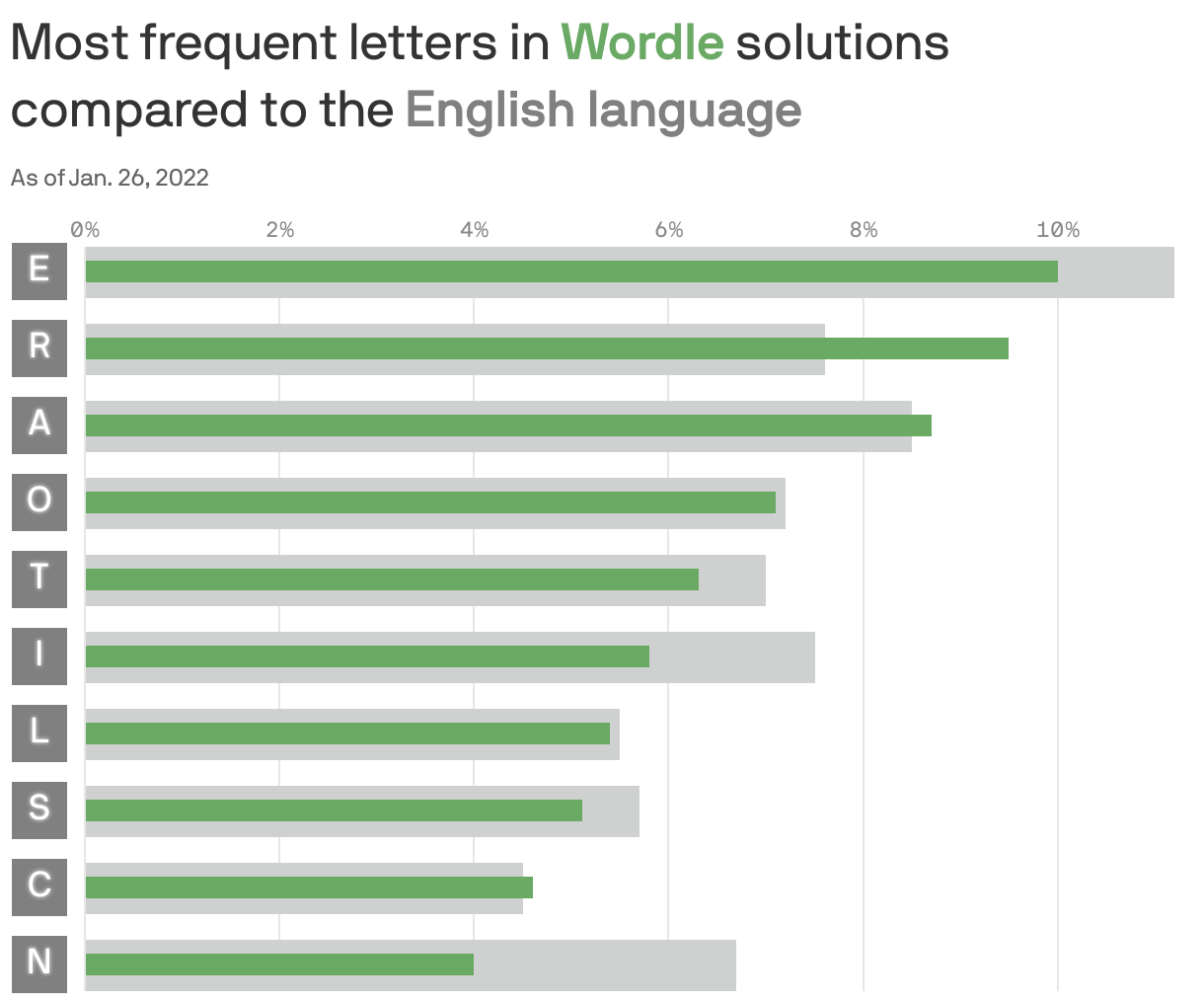
Ta-da! My Axios colleague Emily Peck brings you this ranking of the most common letters used in Wordle. They are E R A O T, according to an analysis of 221 games from Christopher Ingraham, a former Washington Post reporter.
Context: Invented by Josh Wardle, a software engineer in Brooklyn, to amuse his friends and partner, Wordle has become a daily obsession for many (🙋). The New York Times just paid in the "low-seven figures" to acquire the game.
The intrigue: The letter N is much less common in Wordle than real life.
- Orate could be a good starter word.
4. Quick takes: Alphabet revenue tops $200B
1. Quarterly earnings at Alphabet topped expectations as Google's parent company took in more than $200 billion in annual revenue for the first time. Sales of the Pixel phone also hit a new high.
- The big picture: Google and other tech giants keep on chugging amid the pandemic.
2. The confirmation process for Gigi Sohn to the FCC and Alvaro Bedoya to the FTC have hit another road bump. With Sen. Ben Ray Luján (D-N.M.) recovering from a stroke, their committee confirmation vote has been postponed, as Democrats can no longer count on enough votes for passage.
- Why it matters: The FCC and FTC remain evenly split, with two Democrats and two Republicans on each commission, until the pair are confirmed.
3. Virtual reality is causing lots of real-world injuries as early adopters find their digital and analog worlds literally colliding, the Wall Street Journal reports.
- My thought bubble: While there are many hurdles to VR going mainstream, not to be underestimated is that many people don't have enough living space to fully (and safely) enjoy the technology. It's the biggest limiting factor for me.
5. Take note
On Tap
- Today's earnings reports include Facebook parent company Meta, along with Qualcomm and Spotify.
ICYMI
- The Washington Post has a jaw-dropping read, citing a whistleblower report, that surveillance firm NSO offered "bags of cash" to gain access to U.S. cellular networks. (Washington Post)
- Cruise, GM's autonomous car unit, announced it is opening a public wait list for a late-night robotaxi service in San Francisco. At the same time, it said it has raised an additional $1.3 billion from SoftBank's Vision Fund. (TechCrunch)
6. After you Login
Continuing on the wintry theme from yesterday, this person waited for the perfect time to pull out their collection of wooden penguins. Impressive artistry and patience.