Axios Login

October 14, 2022
I have good news. It's Friday.
Also, today's Login is 1,275 words, a 5-minute read.
1 big thing: How Democrats' plans for Big Tech shrunk to tiny steps
Illustration: Aïda Amer/Axios
Democrats talked a big game about reining in Big Tech, but after nearly two years of controlling the agenda in Washington, they've got little to show for it, Axios' Margaret Harding McGill reports.
Why it matters: Pledges to tackle data surveillance practices, harm to children's mental health and tech giants' power over wide swaths of the economy haven't yet translated into passing new laws, and the clock is running out.
State of play: The remaining days for legislative action are winding down for this Congress as midterm elections approach, with lawmakers already planning a packed schedule for the lame-duck session to fund the government and consider proposals on marriage equality and election reform.
- That leaves little time for tech policy bills, even those with some bipartisan support, such as antitrust and privacy measures.
What happened: High-profile bills that would heap new regulations on the tech industry have advanced, but they've yet to cross the finish line into law. Here's where Congress stands on some of the major issues in the sector.
1. Antitrust: The House Judiciary Committee passed a package of bills that would alter how Amazon, Apple, Google and Meta operate after a marathon markup in June 2021, and the Senate Judiciary Committee passed some similar measures earlier this year.
- But despite a pressure campaign from supporters for a Senate floor vote before the summer recess, the most ambitious antitrust proposals have stalled.
- Meanwhile, the House passed a bill in September that will raise filing fees for large mergers, using the proceeds to fund antitrust enforcement efforts.
2. Privacy: Democratic and Republican leaders of the House Energy & Commerce Committee authored a federal privacy bill that passed out of their committee by a bipartisan vote in July.
- The American Data and Privacy Protection Act would require companies to minimize the amount of personal information they collect from consumers, among other requirements.
- But House Speaker Nancy Pelosi (D-Calif.) voiced reservations about the bill's potential to limit her home state's privacy law.
3. Children's online safety: Revelations from Facebook whistleblower Frances Haugen about social media's negative effects on children spurred congressional hearings as well as legislation aimed at forcing companies to better protect the interests of children online.
- The Kids Online Safety Act from Sens. Richard Blumenthal (D-Conn.) and Marsha Blackburn (R-Tenn.) would require platforms to prevent and mitigate specific harms, including the promotion of self harm, suicide, eating disorders and substance abuse.
- The bill advanced from the Senate Commerce Committee in July, as did a children's privacy bill, but neither have companion legislation in the House.
Between the lines: Even bipartisan support in a 50-50 Senate wasn't enough to speed these bills to passage.
- That's in part because the bills need to clear a 60-vote filibuster threshold to become law, exacerbating tensions between Democrats who favor stricter rules and Republicans who have more pro-business philosophies.
Yes, but: Democrats and Republicans did come together to pass new laws with major implications for the tech sector.
- President Biden signed into law a $280 billion package meant to boost the domestic chip-making industry and scientific research.
- In fall 2021, Congress passed the Infrastructure Investment and Jobs Act, which included $65 billion to improve high-speed internet access and affordability.
What they're saying: Rep. David Cicilline (D-R.I.), chairman of the House Judiciary antitrust subcommittee, said antitrust bills meant to regulate app stores and ban companies like Amazon from favoring their own products in an anticompetitive way are "wildly popular with voters."
- "There has been no tech competition legislation passed since the dawn of the internet because gatekeeper platforms will stop at nothing to maintain their market power," Sen. Amy Klobuchar (D-Minn.), lead sponsor of the American Innovation and Choice Online Act, told Axios in a statement.
The bottom line: Tech regulation lost out to COVID, the economy and a massive climate, health and tax spending package for much of this Congress.
2. Meta files to dismiss FTC deal-blocking suit
Illustration: Shoshana Gordon/Axios
Meta filed court papers Thursday seeking to dismiss the Federal Trade Commission's attempt to block its acquisition of virtual reality fitness startup Within, Axios' Ashley Gold reports.
Why it matters: If Meta is successful in its request, it would be free to acquire Within and the agency would have to pursue unwinding the merger after it has already happened.
Driving the news: Meta's filing asks the federal district court in Northern California to waive the FTC's request for a preliminary injunction, which would block the company from closing on its acquisition.
What they're saying: "There is vibrant competition in the fitness space and across VR, and our acquisition of Within will be good for people, developers, and the VR space. For these reasons, the complaint should be dismissed," a Meta spokesperson said in a statement.
Flashback: The FTC first filed to block Meta's acquisition in July, arguing that Meta is "already a key player at each level of the virtual reality sector," per a release.
- The FTC, in an unusual move, amended its original complaint to drop its claim that the acquisition would reduce competition in the market for virtual reality fitness apps.
- The FTC is now mostly arguing that Meta's acquisition of Within would "substantially lessen competition or tend to create a monopoly" in the market for virtual reality "exercise" apps — a narrower market than "fitness" apps, per Reuters.
Between the lines: Critics previously told Axios this was an unusual case for the FTC to take on and would be tough to win, while supporters applauded the agency for using the case to send a message to Big Tech about the buying up smaller companies in emerging fields.
3. Netflix with ads is coming Nov. 3

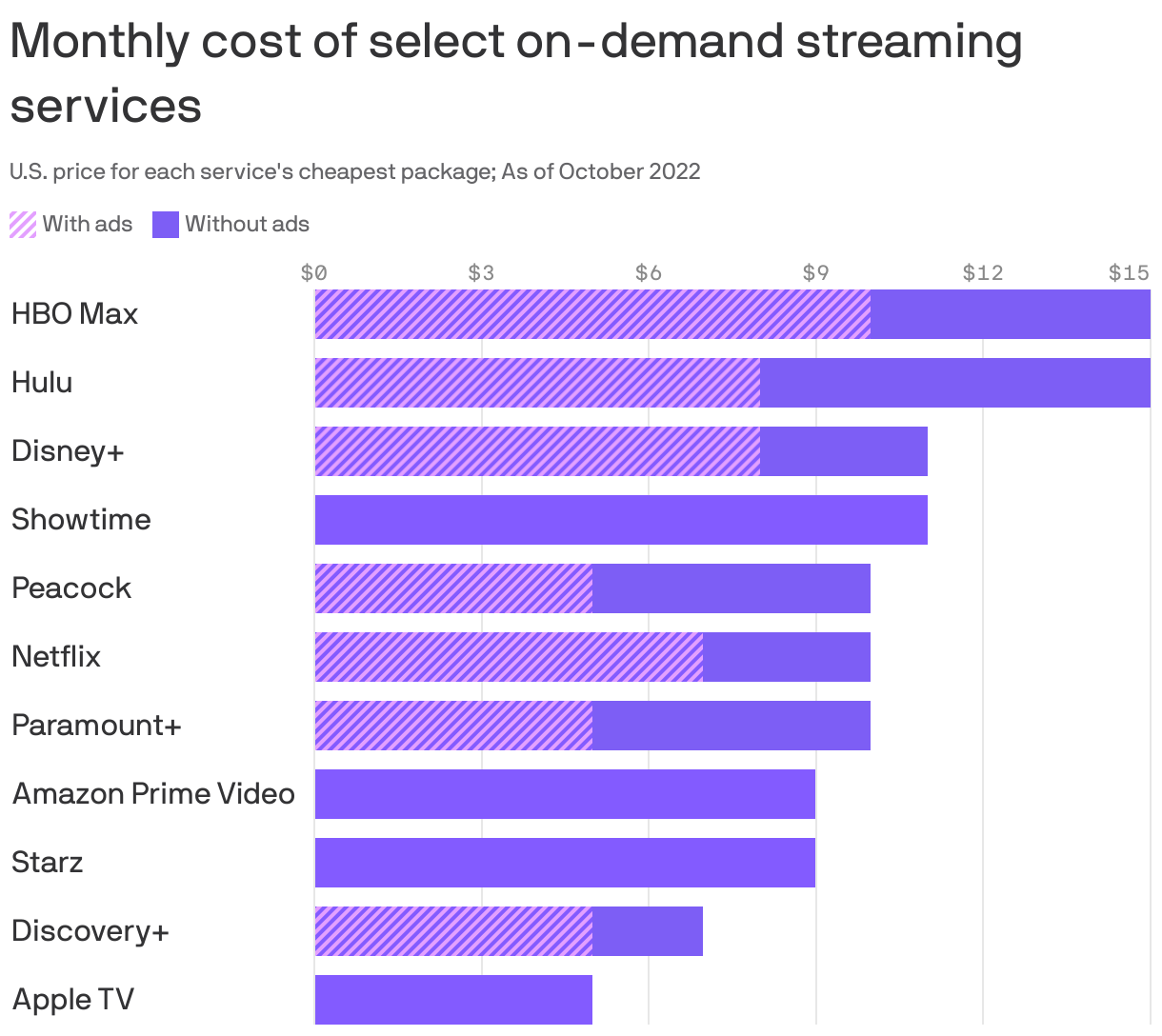
After years of avoiding putting ads on its service, Netflix on Thursday said it finally plans to debut an ad-supported tier on Nov. 3 in 12 countries, including the U.S, for $6.99 a month, Axios' Tim Baysinger and Sara Fischer report.
Why it matters: The rollout comes as Disney continues to challenge Netflix's dominance globally. Netflix is launching its ad-supported tier roughly a month ahead of Disney's ad-supported tier, and for $1 less per month.
Details: Netflix's ad-supported tier will offer nearly all of the same shows and movies as Netflix's current ad-free services, and will be available on nearly all of the same devices that a consumer today can use to watch Netflix.
Yes, but: A very small fraction of content — "in the 5–10% range" — won't be available on the service at its debut due to licensing restrictions, Netflix's Chief Operating Officer Greg Peters said.
How it works: Existing Netflix subscribers will remain in their current plan at the same price, unless they choose to switch to the new ad-supported plan, Peters said.
4. Take note
On Tap
- Lesbians Who Tech Summit wraps up in San Francisco, while Microsoft's Ignite conference concludes in Seattle.
Trading Places
- Add two more Amazon executives to the list of those who have departed under new CEO Andy Jassy. According to Business Insider, Kindle inventor Gregg Zehr and Tom Taylor, senior vice president of Alexa, both announced in August they would be leaving the company.
ICYMI
- Soldiers are reportedly not loving their experience with Microsoft's HoloLens, with many reporting nausea. (Bloomberg)
- Meta used motion capture animations in its announcement that it had added legs to its avatars. (Engadget)
- The Republican National Committee has yet to join a Gmail pilot program that would keep campaign emails out of spam folders. (The Verge)
5. After you Login
A lot happened yesterday at Lesbians who Tech. There were all sorts of important talks, but I'm talking about what happened on the basketball court. First, I finished third in the horse tournament. Then I got to hang with trans WNBA icon Layshia Clarendon. But then Charlotte Clymer dunked. So, I'm still processing.
Thanks to Scott Rosenberg and Peter Allen Clark for editing and Bryan McBournie for copy editing this newsletter.
Sign up for Axios Login

Taking you inside the AI revolution, and delivering scoops and insights on the technologies reshaping our lives.