Axios Login

May 02, 2023

Please give a warm welcome to Ryan Heath, our new global technology correspondent and Login co-author, whose debut story is below. Today's Login is 1,287 words, a 5-minute read.
1 big thing: AI insiders push red emergency button

Illustration: Shoshana Gordon/Axios
A key founder of the field of modern artificial intelligence has quit Google to join a growing chorus of specialists warning that today's rush to deploy advanced generative AI is headed for disaster, Axios' Ryan Heath reports.
Why it matters: When some of the smartest people building a technology warn it could turn on humans and shred our institutions, it's worth listening.
Driving the news: Geoffrey Hinton, the machine-learning pioneer sometimes called "the godfather of AI," says he left Google so he could speak freely about the dangers of rushing AI products.
- "It is hard to see how you can prevent the bad actors from using it for bad things," Hinton told the New York Times.
- AI's capabilities are on path to outstrip those of humans, Hinton told MIT Technology Review, and will be harnessed for "winning wars or manipulating electorates."
- His warning comes on the heels of an open letter — signed by thousands in tech, most famously Elon Musk — that called on companies to take a six-month break from work on the most advanced AI so humanity can take stock of the risk.
The big picture: AI can help address our blind spots and save time. But humans have a miserable record of turning technology against one another.
- Axios asked AI experts — developers inside companies, researchers outside and regulators weighing action — to share their most plausible disaster fears.
- Their concerns focus on immediate harms — rather than the far more remote "runaway superintelligence will drive the human race extinct" scenario that keeps some critics awake.
1. Cyberattacks explode. The right prompts can now generate working malicious code, meaning more, bigger and increasingly diverse cyberattacks.
- Dario Amodei, CEO at Anthropic, which offers a rival to ChatGPT, told Axios CEO Jim VandeHei that a massive expansion of such attacks is his biggest near-term worry.
2. Scams sharpen. Forget clumsy emails: Using social media posts and other personal information, the new AI-assisted phishing and fraud schemes will take the form of real-sounding pleas for help in the faked voices of your friends and relatives. (The "bad actors" are already at it.)
3. Disinformation detonates. Propaganda and partisan assault will be optimized by algorithms and given mass distribution by tech giants.
- Multimodal AI — text, speech, video — could make it impossible for the public to separate fact and fiction. (This one's already happening too.)
- Displaced workers could turn to violent protests or isolationist politics.
4. Surveillance locks in. America's 70 million CCTV cameras and unregulated personal data already enable authorities to match people to footage. Israel uses facial recognition technology to monitor Palestinians, while China uses AI tools to target its Uyghur minority.
- AI can supercharge this kind of tracking for both corporations and governments, enabling behavior prediction on a mass scale but with personalized precision.
- That creates opportunities for "incentivizing conformity, and penalizing dissent," Elizabeth Kerley of the International Forum for Democratic Studies told Axios.
5. Strongmen crack down. Mass digital data collection can give would-be autocrats a means to anticipate and defuse social anger that bypasses democratic debate — "with no need to tolerate the messiness of free speech, free assembly, or competitive politics," per Kerley.
- MIT's Daron Acemoglu, author of "Why Nations Fail" and "Redesigning AI," told Axios he worries "democracy cannot survive" such a concentration of power without guardrails.
What's next: Democracies have a limited time window to act by, for instance, imposing legal constraints on AI providers, but the tech industry's AI product race shows no sign of slowing.
The bottom line: Those setting the AI pace are "trying to move fast to pretend that they're not breaking things," Marietje Schaake — the former EU official who is now international policy advisor at Stanford's Institute for Human-Centered AI — told Axios.
2. Exclusive: Mozilla buys fake-review spotter
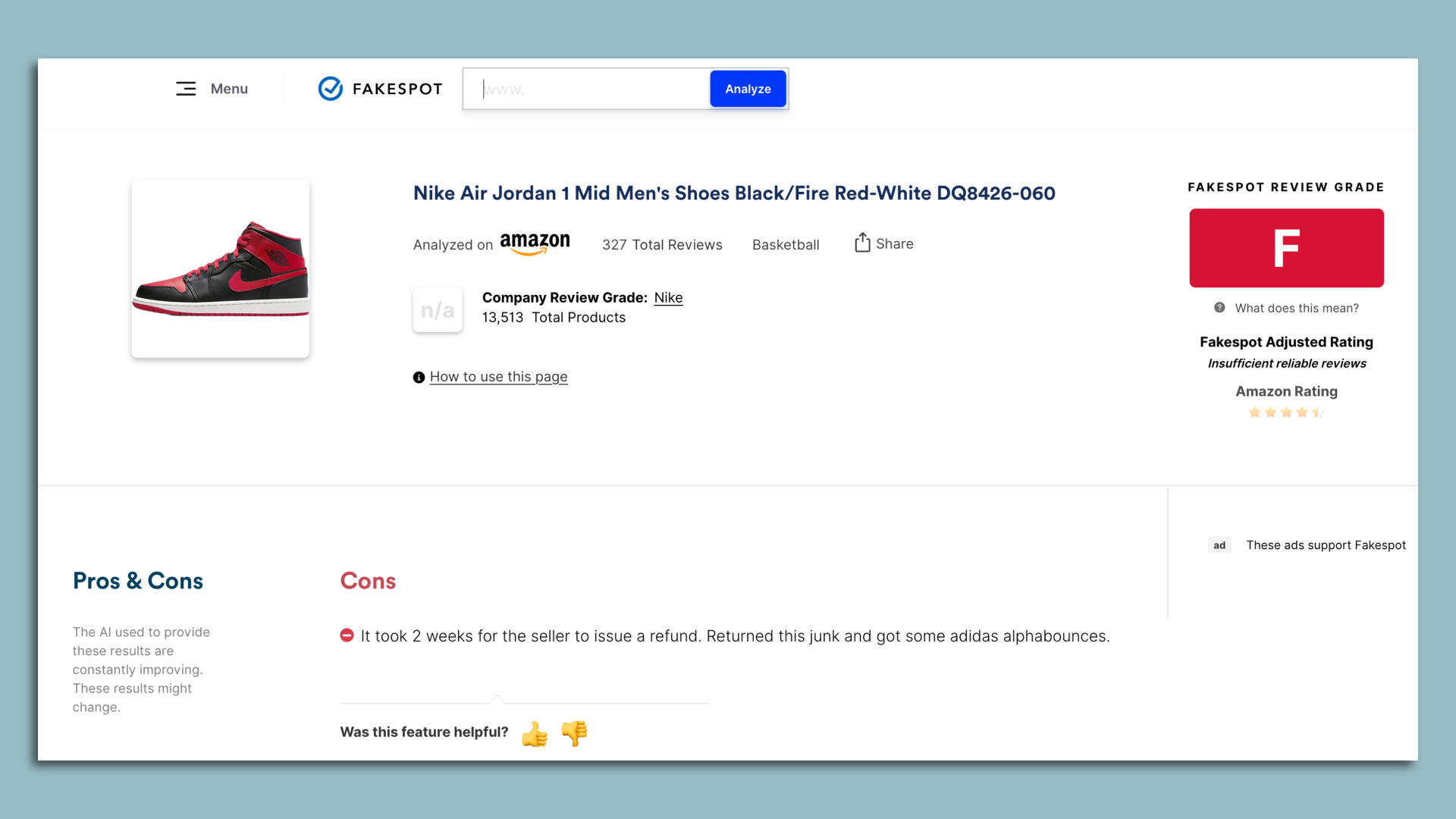
Image: Fakespot
Mozilla has acquired Fakespot, a small startup whose website and browser plug-in help users identify bogus product reviews on e-commerce sites.
Why it matters: Fake reviews, both man made and machine generated, are a huge problem for consumers and businesses alike.
Details: Fakespot grades product reviews on sites such as Amazon, Walmart and eBay using an A-to-F scale.
- Mozilla won't say how much it paid for Fakespot, but tells Axios it has kept its existing staff of 13 and plans to expand the team over time.
- It also plans to keep supporting Fakespot's website and Chrome browser plug-in even as it works to more tightly integrate the technology into its own Firefox browser.
Between the lines: Earlier AI technologies were already being used to crank out fake product reviews. But the new generation of generative tools, such as ChatGPT, threatens to make the task of identifying AI-generated comments much harder.
- Some early attempts to use generative AI have been spotted because the fake reviewers have neglected to remove identifying language, like ChatGPT's famous "As a large language model" self-introduction. But future efforts are unlikely to be so careless.
What they're saying: Trustworthy reviews are essential to keeping the e-commerce ecosystem healthy, Fakespot founder Saoud Khalifah told Axios. "You can't touch the product," he said. "You really need the reviews."
Flashback: Khalifah started Fakespot in 2016 after being duped by the seller of a supplement on Amazon who'd rigged positive reviews.
3. Code.org leads "TeachAI" push

Image: TeachAI
A coalition of technology and educational organizations are teaming up to support TeachAI, a Code.org-led effort to help educators both use artificial intelligence in the classroom and explain to their students how the technology works.
Why it matters: Adoption of AI is exploding, creating a huge need for people to understand the technology's power and limits. At the same time, educators are struggling with the tools' disruptive impact.
Details: Code.org is providing the seed capital for TeachAI, but aims to find outside funding from other sources, including companies and foundations.
- The goal is to get school districts and ministries of education representing millions of students around the world to join the effort and use the resulting curriculum.
- In addition to Code.org, supporters include Khan Academy, the World Economic Forum, Educational Testing Service and the International Society for Technology in Education, a global education group.
Between the lines: Some educators have embraced ChatGPT as the equivalent of a calculator, while others have rushed to ban the technology.
What they're saying: "Education needs to evolve," Code.org's Hadi Partovi told Axios. "Part of what is exciting is that, until now, educators and technologists have not been engaging in real dialogue."
The big picture: Khan Academy, which is a backer of TeachAI, has been an early user of GPT-4, incorporating OpenAI's engine into its Khanmigo tutor.
- Coursera, meanwhile, has also added generative AI features to its online learning platform and new courses on AI technology specifically.
Yes, but: AI also threatens to upend some education businesses. Shares of Chegg fell by a third Monday after the company issued a dour forecast, citing the impact of AI.
4. Take note
On Tap
- AMD reports earnings after the markets close.
- The Wall Street Journal's Future of Everything Festival runs today through Thursday in New York and online, while the Milken Institute Global Conference continues through Wednesday in Beverly Hills.
Trading Places
- Accountable Tech is beefing up its team with former Democratic staffers to combat what they call an undermining of the information ecosystem and democracy ahead of next year's elections, Axios' Maria Curi reported Monday.
ICYMI
- IBM has paused hiring for some back-office jobs it expects to be able to replaced by AI within five years. (Fortune)
- Mastodon is aiming to make it easier for people who want to join the Twitter alternative. (The Verge)
- Box is adding AI-powered tools for users to search and summarize their stored files. (Axios)
5. After you Login
And this is what happens if you ask AI to reimagine the mascots of all 32 NFL teams.
Thanks to Scott Rosenberg for editing and Bryan McBournie for copy editing this newsletter.