Axios Login

January 05, 2023

Sorry if Login is a little damp. It's pretty wet here. Today's Login is 1,265 words, a 5-minute read.
1 big thing: Tech giants' alternate universes
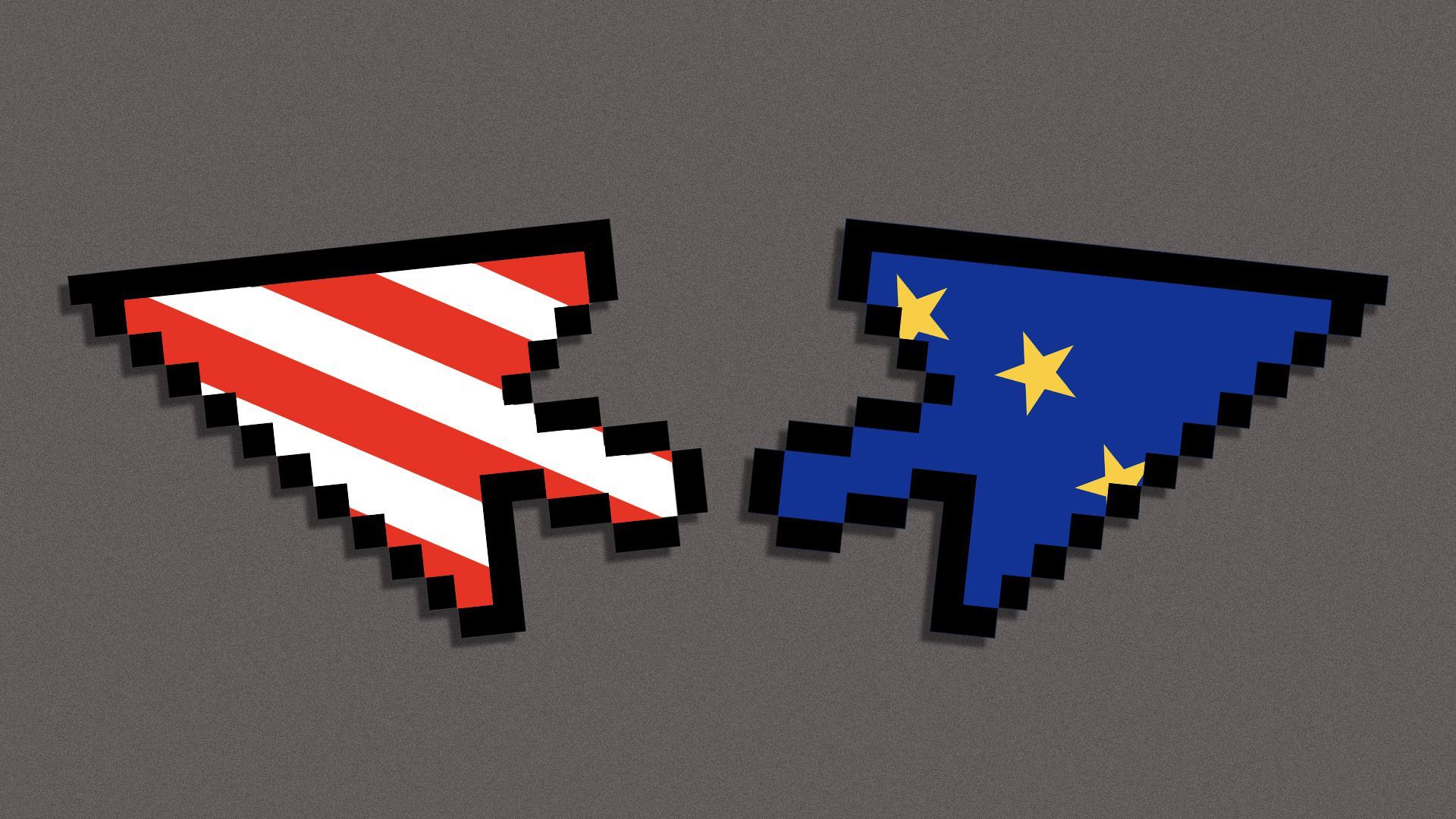
Illustration: Natalie Peeples/Axios
New fines levied by European regulators against Meta and Apple are the latest reminder that Big Tech companies must now maneuver between two wildly different regimes in the U.S. and the EU, Axios' Ashley Gold reports.
Why it matters: These firms must navigate conflicting laws, mounting fines and a growing wariness of their business models on both sides of the Atlantic.
The big picture: Companies are fighting off attempts to change the rule book in the U.S. while figuring out how to toe the harder lines in Europe and the U.K., which is also developing its own rules.
Driving the news: Companies have racked up billions in fines over the past 10 years, and there's no sign that will slow down.
- On Wednesday, Ireland's Data Protection Commission fined Meta $414 million for violating General Data Protection Regulation (GDPR) rules in how it obtains users' consent to ad personalization. Meta said it plans to appeal the decision.
- "It would be highly unusual for a social media service not to be tailored to the individual user," Meta said. "We strongly believe our approach respects GDPR, and we're therefore disappointed by these decisions and intend to appeal both the substance of the rulings and the fines."
- Also on Wednesday, France fined Apple $8.5 million over the use of personalized advertising on iPhones, saying the firm's practices violated the French Data Protection Act.
What they're saying: European officials say if the companies want to do business in the EU, they must keep up with the laws.
- "We have European legislation that says, as a platform providing services you need to set up a system so that you can actually implement our national rules on your platform," Margrethe Vestager, Europe's competition commissioner, said at an event in Washington last December.
How it works: Although tech's big five companies — Apple, Amazon, Google, Meta and Microsoft — are all U.S.-based, they're motivated to operate globally to reach as many customers and advertisers as possible.
- But the rules in Europe and elsewhere are much stricter than those in the U.S., despite increasingly aggressive efforts by some regulators and states to sharpen American laws.
Details: GDPR was Europe's first major tech policy package, and as companies have tried to comply with its privacy requirements, they've run into hefty fines. Last year the EU added two new sweeping competition and content rules, the Digital Markets Act and the Digital Services Act.
- The DMA lays out obligations and punishments for digital service "gatekeepers" who break the law's rules for promoting competition. The DSA puts more responsibility on large platforms to police and take down illegal content, with fines if they fail to comply.
The intrigue: In some cases, U.S. companies have had to make changes to business models or product design to comply with European law, resulting in significant differences between the products or services deployed on either side of the Atlantic.
- For example, Amazon last December agreed to change some business practices around the way merchants can advertise their products on the Amazon website.
- Congress last year failed to pass a bill that would have required Amazon to adopt similar practices in the U.S.
In other cases, differing rules in the U.S. and the EU mean that an online platform's policies might be merely controversial in one region but outright illegal in the other.
- Some experts have flagged Twitter's push to relax content rules under Elon Musk as likely to run afoul of EU regulators, who have reminded Musk that "the bird will fly by our rules" in Europe.
The other side: In the U.S., many regulators and lawmakers have sought to heighten pressure on tech giants..
- But partisan divides, a more business-friendly culture and costly lobbying efforts by affected companies have so far limited those efforts here.
- Meanwhile, the EU has woven a blanket of complex laws that tech firms must scramble to comply with — or keep paying out big penalties.
Yes, but: The EU bureaucracy moves slowly, and each enforcement process can take years.
- Meta's new $414 million fine stems from a proceeding that began in 2018.
2. Amazon cuts add to tech's mounting layoffs

Illustration: Allie Carl/Axios
Several more well-known tech companies announced plans to cut jobs or scale back their products as the industry battens down to weather what is expected to be a more challenging economy.
Why it matters: The cuts — including 18,000 at Amazon — are the latest sign that companies expect further deterioration in corporate and consumer spending.
Driving the news: Amazon notified employees on Wednesday it plans to eliminate 18,000 jobs. That figure includes both previously announced cuts, which focused largely on the company's devices and books business, as well as newly announced reductions that involve other units, including Amazon's people and technology team.
- Amazon's cuts are the largest layoff at any tech company in recent months — bigger (by number, not percentage) than workforce reductions at Meta, Snap and Twitter.
Meanwhile, Salesforce told workers early Wednesday that it plans to cut 10% of staff. That's on top of several hundred job cuts made late last year.
- Vimeo is cutting 11% of jobs, which follow a 6% workforce reduction last July.
- Swedish telecom firm Ericsson, meanwhile, announced it will exit certain product categories and business deals in its cloud services and software unit as it looks to maximize profits rather than gain market share.
The big picture: The latest cuts are in addition to prior moves made by Meta, Twitter, Snap and others, who also announced widespread cuts last year.
3. CES showcases the weird

Withings U-Scan is a toilet computer that scans people's urine and offers up health metrics. Image: Withings
One of my favorite parts of CES is the showcase it offers for wacky hardware ideas — and this year in Las Vegas is no exception.
What's new: Many of this year's wildest ideas are making use of artificial intelligence in novel ways, such as a Samsung oven that aims to alert people if dinner is getting burned.
Here are a few of the other products that have caught my eye from afar (I'm covering the event remotely this year):
- Withings showed off U-Scan, a $500 bathroom computer that sits in the toilet bowl to scan people's urine and offer up a range of health metrics.
- Acer debuted the eKinekt BD3, a combination desk/exercise bike that can be used to recharge a phone, tablet or even a laptop using three built-in USB ports. The high-tech desk is set to go on sale in June for $999.
- There were also all the fun dual-purpose devices, such as this Asus ChromeOS desktop computer that can also act as a wireless charger, or this $60 Samsung phone charger that is also a smart home hub.
Yes, but: Many products shown at CES either never see the light of day or quickly fade.
Go deeper: We're rounding up the biggest news from this year's CES here.
4. Take note
On Tap
- CES officially gets under way, although many of the big companies have already made their announcements. Today's keynote speakers include the chairman of BMW and the CEO of John Deere.
ICYMI
- The governing body for New York City public schools is blocking access to ChatGPT from district owned-devices and networks, citing potential cheating concerns. (Chalkbeat)
- A judge overseeing Celsius Network's bankruptcy ruled on Wednesday that some crypto assets belong to the company's estate rather than the individual account owners. (Axios)
- Dell is reportedly looking to phase out Chinese-made chips by 2024. (Nikkei)
- Sony unveiled Project Leonardo, a PlayStation 5 controller kit that aims to help people with disabilities play games. (Engadget)
5. After you Login
This board game, where you use your own books to find passages that answer various prompts, sounds pretty cool.
Thanks to Scott Rosenberg and Peter Allen Clark for editing and Bryan McBournie for copy editing this newsletter.