Axios Login

March 04, 2022

Join Axios virtually at our inaugural What's Next Summit on April 5.
- Register here to attend livestream sessions with discussions on trends that will revolutionize our future.
Situational awareness: Overnight, Google announced that it was suspending all ad sales in Russia, and Airbnb said it is suspending all operations in Russia and Belarus.
Today's newsletter is 1,178 words, a 4-minute read.
1 big thing: Hot seat for crypto lobbyists
Illustration: Shoshana Gordon/Axios
Russia's invasion of Ukraine is highlighting the dark side of crypto, right as the industry's lobby ramps up efforts in D.C. to protect it from regulation, Axios' Peter Allen Clark reports.
Why it matters: The crisis provoked a sharp and nearly united response globally from the very institutions — governments and banks — that cryptocurrencies seek to sideline. It's also amplifying the perception that crypto helps bad actors escape penalties or detection.
- At the same time, the war's pressures are pushing even more people to begin using crypto.
What's happening: Sanctions speedily imposed by governments and traditional banking systems after Russia's Ukraine invasion helped tank Russia's economy.
- Immediately, concerns arose that both the Russian government and targeted individuals might sidestep sanctions by funneling money into decentralized, unregulated cryptocurrencies.
- A group of four senators, including Sen. Elizabeth Warren (D-Mass.), wrote to the Treasury Department Wednesday asking whether "criminals, rogue states, and other actors may use digital assets and alternative payment platforms as a new means to hide cross-border transactions for nefarious purposes."
- Additionally, the Biden administration asked leading crypto exchanges to monitor accounts that might be tied to sanctions targets.
- Crypto platforms have balked at calls to ban Russian addresses from using their services.
The intrigue: The crisis unfolded just as crypto lobbyists in D.C. were cranking up a campaign to dissuade lawmakers from enacting new restrictions.
- "Congress blindsided the industry last summer with tax provisions in the infrastructure bill, and advocacy ramped up exponentially and immediately," Niki Christoff, a Beltway consultant who advises companies in the crypto payments space, told Axios.
By the numbers: A cryptohead.io study, released last month, showed that the industry's lobbying expenditures increased by 116% in 2021, rising to $4,925,000.
- A Tech Transparency Project report released at the end of last year revealed at least "235 officials from Congress, the White House, federal agencies, the Federal Reserve, and national political campaigns" have "moved to or from dozens of crypto companies, exchanges or trade associations."
- Membership in the Blockchain Association lobby group has ballooned in recent months to 80 members, including Crypto.com and Foundry Digital.
The big picture: Cryptocurrencies and blockchain-based tech aim to build alternatives to existing financial systems that can transcend national boundaries and operate beyond government reach.
- That vision has increasingly conflicted with real-world institutions and laws.
- The dramatic rise in ransomware attacks, often coupled with demands for payment in crypto, has added to regulators' fears.
- "In reality, the crypto industry has the worst of both worlds: dependence on institutions without any of their protections," crypto critics Rebecca Ackermann and Poppy Alexander wrote in an LA Times op-ed on Monday. "No wonder terrorists increasingly rely on crypto for financing, criminals seek to hide their funds with it, and fraudsters take advantage of the gullible, with crypto 'love scams' particularly on the rise."
Yes, but: Crypto has proven a fast and effective way to send funds to the war zone. The Washington Post reported on Thursday that the Ukrainian government has already raised over $42 million in crypto.
Inside the industry, many, like Christoff, say that concerns crypto might help Russia evade sanctions are a "red herring."
- "People can't spend crypto without off-ramps into fiat banking," Christoff said.
- And some have pointed out that the magnitude of the sanctions, paired with the transparency of public blockchain receipts, would make it difficult for Russia to use crypto as a financial back door.
Between the lines: Dave Grimaldi, executive vice president and head of government relations at the Blockchain Association, understands how quickly the tide can turn against a new, technologically complex industry.
- "You're always one crisis away from good will eroding within minutes," he said.
2. Senators advance Biden picks for FCC and FTC
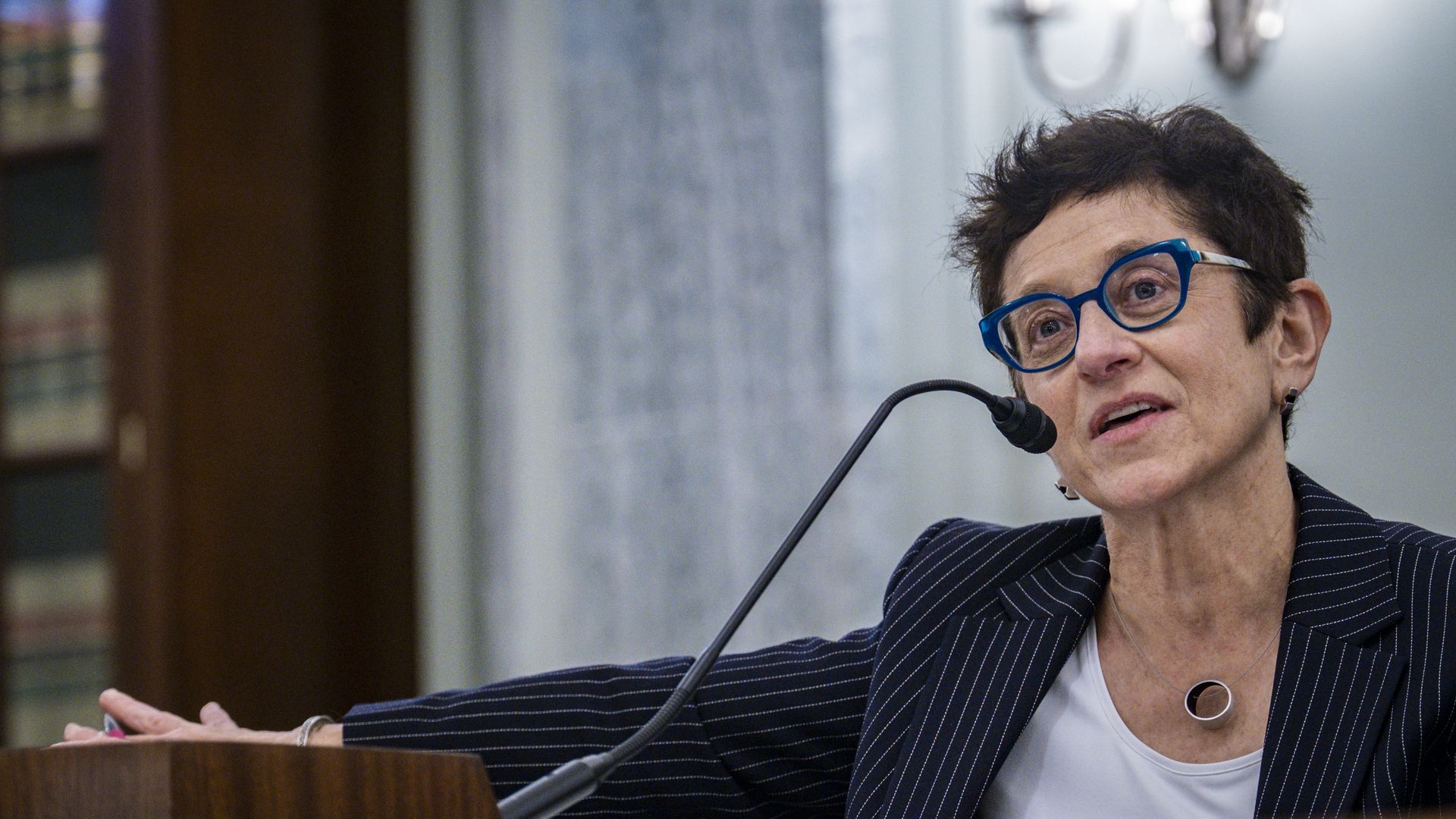
Photo: Pete Marovich-Pool/Getty Images
The Senate Commerce Committee voted 14-14 along party lines Thursday to move President Biden's nominees for the Federal Communications Commission and Federal Trade Commission to the Senate floor, Axios' Margaret Harding McGill reports.
Why it matters: Both the FCC and FTC lack the Democratic majorities necessary to overcome Republican opposition to more partisan agenda items.
What they're saying: Sen. Roger Wicker (R-Miss.), ranking member of the Senate Commerce Committee, said he could not support FCC nominee Gigi Sohn or FTC nominee Alvaro Bedoya for their posts.
- Wicker said he was troubled by Sohn's recusal related to broadcast issues, and he took issue with Bedoya's "divisive views."
Between the lines: Nominees that receive a tie vote in the committee are still able to receive a full vote on the Senate floor through an extra procedural step.
3. Witcher studio halts Russian game sales

Screenshot: CD Projekt RED
Polish studio CD Projekt RED will suspend selling its popular games in Russia and Belarus due to Russia's invasion of Ukraine, the company announced on Twitter this morning, Axios Gaming's Stephen Totilo reports.
Why it matters: CDPR is the biggest gaming company to pull business from those countries, following many other industries' similar withdrawals.
- CDPR developed 2015's The Witcher 3 and 2020's Cyberpunk 2077, two of the most popular games of the past decade. Both are slated for major updates this year.
What they're saying: "We know that players in Russia and Belarus, individuals who have nothing to do with the invasion of Ukraine, will be impacted by this decision, but with this action we wish to further galvanize the global community to speak about what is going on in the heart of Europe," CDPR representatives said in a tweet.
Of note: A Russian gaming blogger, who asked not to be identified out of concern for their safety, told Axios "the position of the Ukrainian people is understandable — they want us to overthrow a bloody tyrant."
- The problem was the country's feared internal security forces or "repression machine," they said. "People fear it more than [the] economic collapse that is heading our way. Though maybe it will push our people a little to open their eyes and do something."
4. Starlink users in Ukraine could draw fire
Ukraine asked Elon Musk for terminals they could use to keep the country connected to the internet via his Starlink satellite network. Musk sent them.
Yes, but: The gifts turn out to have a significant downside — their signals can expose users as targets.
In a series of tweets Thursday, Musk provided an "important warning" that "Starlink is the only non-Russian communications system still working in some parts of Ukraine, so probability of being targeted is high. Please use with caution."
- "Turn on Starlink only when needed and place antenna away as far away from people as possible."
- "Place light camouflage over antenna to avoid visual detection."
5. Take note
On Tap
- Apple's annual shareholder meeting today will vote on a number of resolutions, including whether to limit CEO Tim Cook's pay and whether the company should conduct a third-party civil rights audit.
Trading Places
- Marian Lee is joining Netflix as chief marketing officer, as current CMO Bozoma St. John departs.
ICYMI
- ICANN, the internet domain authority, rejected Ukraine's request that it cut Russia off from the global internet. (CNN)
- Tech workers at the New York Times have voted to unionize. (Axios)
6. After you Login
Pixel art is the art primitif of the digital age, and here's a delightful gallery that takes it to almost pure abstraction. (Courtesy Jason Kottke)