Axios Login

November 03, 2020

It's going to be a long day. Be sure to breathe. Stay hydrated! And for more tips on staying well informed, but not fooled by misinformation, see item No. 3.
If you do want to keep tabs on the election news, Axios has you covered with two easy ways to follow the hours ahead:
- The Axios app: All of our reporting, graphics and results — neatly packaged. (App Store, Google Play Store)
- Our "Axios Today" and "Axios Re:Cap" podcasts will team up with a burst of special five-minute episodes today and tomorrow.
Today's Login is 1,468 words, a 6-minute read.
1 big thing: Tech ran from politics, but couldn't hide

Illustration: Aïda Amer/Axios
Tech companies that entered the 2020 election season hoping to stay out of politics find themselves more embroiled in partisan conflict than ever on Election Day, Axios' Sara Fischer, Ashley Gold and Kyle Daly report.
Driving the news: Twitter and Facebook have scrambled to make late changes in complex misinformation policies — intended to dampen candidates' premature claims of victory — as they face a barrage of complaints and censorship charges from President Trump and his camp.
The big picture: Companies know their platforms are where misinformation and rumor are likely to spread on election night, and they're bracing for impact.
- Twitter on Monday named seven outlets it will lean on to help it determine whether a race is officially called, and Facebook hours later revealed some details of its own slate of sources for election results.
- Both platforms say they will hide or label posts from candidates or anyone else claiming or reporting victory that don't rely on calls made from those authoritative sources.
- As Axios has reported, President Trump is expected to claim victory if his camp feels he has a wide margin in enough states, even if mail-in ballots are still being counted.
Where it stands: In prior elections, tech companies were happy to represent themselves as tools for both parties, offering their services, helping get out the vote and assisting with targeted advertising.
- That attempt at cordial civic engagement got scrambled after 2016, as it became clear that online platforms had been exploited to influence that year's election.
- That angered Democrats. But then the companies' efforts to prevent a repetition made them a target for Republicans, who said their crackdowns on misinformation and inauthentic activity were just anti-conservative censorship in disguise.
This year, many tech companies sought to distance themselves from politics.
- Twitter, LinkedIn, Pinterest, Spotify and others banned political ads altogether, while Google limited their targeting capabilities.
- Facebook, Twitter, Google, Microsoft and other firms throttled back their presence at the 2020 political conventions compared to prior years.
- TikTok, whose enviable algorithm keeps tight control over what videos get served up, has tried to keep contentious political battles from reaching its users.
Yes, but: None of those moves have kept politics at bay.
- Each party ended up charging tech companies with being pawns for the other side: Republicans denounced ad bans and limits as censorship, while Democrats decried the spread of conspiracy theories and disinformation online.
- TikTok's attempt to become a politics-free entertainment zone has bumped up against widely reported efforts by political operatives and others to bring partisan conversations to the platform. And the company's new election resources could drag it into future political battles, particularly if there's a contested outcome.
The ad market is what made tech a political lightning rod. Even with some platforms banning political advertising, candidates have funneled more political ad dollars into online advertising this election than ever before.
By the numbers: More than $1.4 billion has been spent on political and issue ads on Google and Facebook so far this election, per Advertising Analytics, nearly a fifth of the roughly $7.7 billion spent on all 2020 political advertising.
- Donald Trump's campaign has spent more than $260 million on Google and Facebook ads this year. Joe Biden's has spent more than $180 million.
2. Platforms' last-minute rule changes raise risks
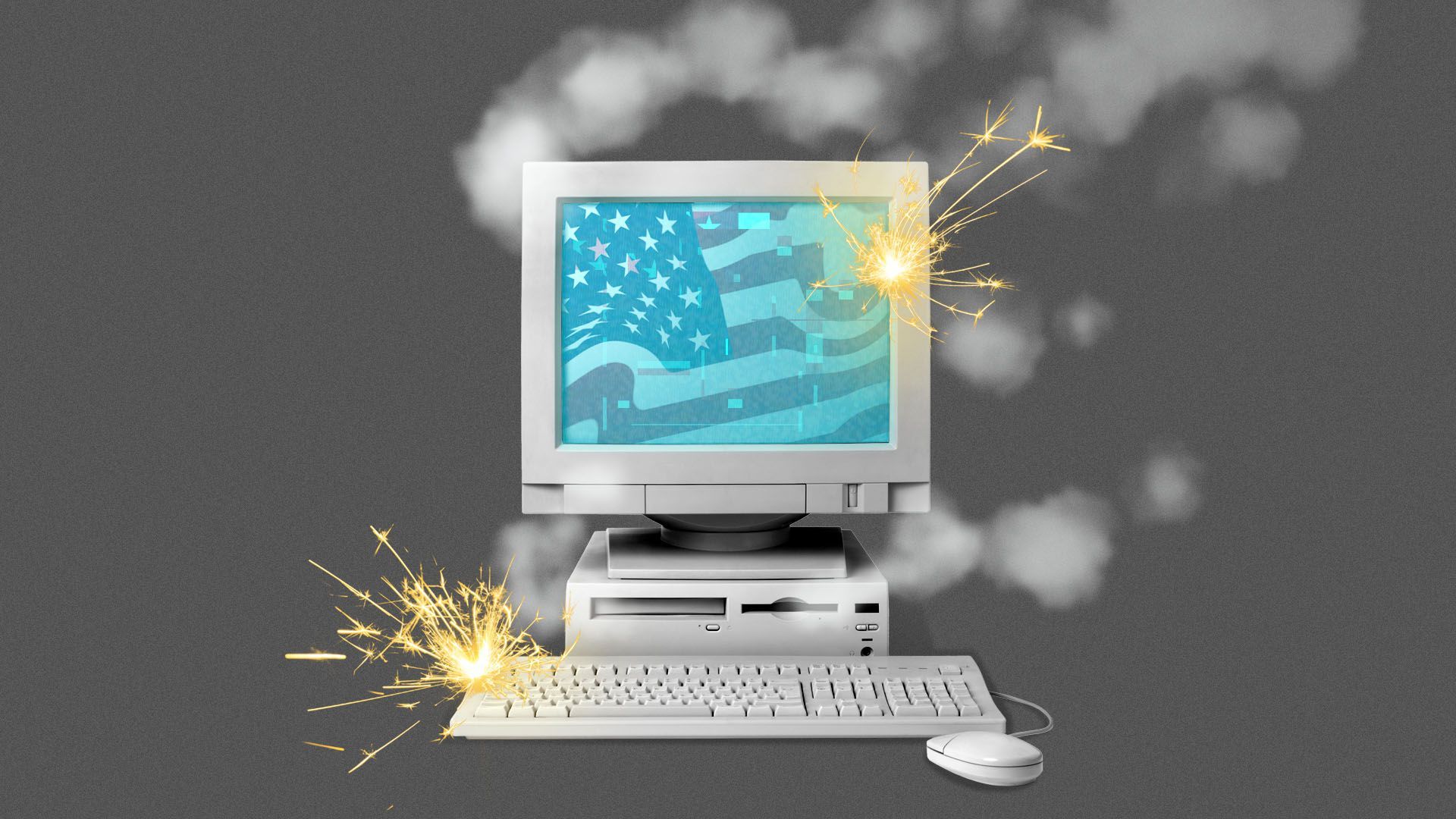
Illustration: Sarah Grillo/Axios
Election-related policy changes introduced by tech companies at the last minute will put their efforts to control misinformation in the spotlight over the next few days as the U.S. readies for election results, Ashley and Sara report.
Why it matters: Most of the new policies haven't been tested in real time yet, and the platforms have a record of confusion, inconsistency and self-reversal as their rules land on the information battlefield.
What's new: Facebook and Twitter elaborated on Monday their plans to rely on selected news outlets to call races, which will the govern how they apply labels to posts that prematurely claim victory.
- Twitter said it's relying on calls from ABC News, AP, CNN, CBS News, Decision Desk HQ, Fox News and NBC News to determine winners.
- Facebook said Monday it would be relying on consensus results from the National Election Pool/Edison via Reuters, the Associated Press, NBC, ABC, CBS and Fox.
- Last week YouTube announced that it will add to all election-related search results and videos about the election an information panel noting that "election results may not be final" and linking to Google’s election counts.
Be smart: Tech companies have a record of rolling out new policies, sometimes right before major events, that go awry in their implementation.
- Facebook said last week that a mix of "technical problems" and confusion among advertisers around its new political ad ban rules held some ads back that should have been displayed, causing uproar from Democrats and Republicans.
- Twitter did an about-face on its hacked materials policy after the New York Post published a controversial article about materials allegedly found on Hunter Biden's laptop, first limiting the spread of the article, including locking the Post out of its Twitter account, then backtracking completely.
- Earlier this year, when Facebook faced criticism for failing to take down a Wisconsin militia page that may have been connected to an incident of violence against protesters, CEO Mark Zuckerberg said it had made an "operational mistake." The policy governing militia groups' postings had only been put in place a week before.
The big picture: Big tech is sure to be under scrutiny no matter how well it enforces its own policies today. Misinformation will slip through; candidates, journalists and voters will have their content flagged and be confused about it; and the platforms will be blamed for whatever mess transpires on the internet.
- The difference between now and 2016: Tech firms are well aware of these potential calamities and are trying to prevent them.
3. How to avoid Election Day misinformation
Today will be hard enough for many of us to get through without also falling for misinformation that may enrage, depress and deceive. Here are a few tips from team Axios and experts designed to relieve at least a little of the Election Day stress.
Why it matters: The intentional spread of false information aims not just to mislead, but also to keep voters from the polls and to undermine public faith in institutions.
The big picture: The antidote to misinformation is a mix of media literacy and healthy skepticism.
Here are a few tips from me:
- Check the source before you tweet — even if your friend tweeted it.
- Try to read the article before hitting retweet (something Twitter has been encouraging more broadly).
- Step away from the computer when you start to feel overwhelmed. Take a breath, a bath or a walk, or build a Lego set —whatever helps you clear your head.
Laura Rosenberger, director of the Alliance for Securing Democracy, agreed with those, adding:
- Be patient.
- Identify credible sources in advance (like your secretary of state, or state/local election officials, and the CISA rumor control website).
- Use in-platform resources to look for credible info and report suspicious materials.
- Be very cautious about reports of fraud or hacks or interference — the goal of bad actors is to make us lose faith in the process, and these claims could be part of that. Wait for verified information.
Snopes, which has been debunking internet myths for years, encourages people to check its existing (and still-being-updated) list of election misinformation.
- "First: Remember that many of the rumors spreading on Election Day are likely to be things we've covered before — gaffes, mischaracterizations, cheap fakes, pics stripped of context, and more," Snopes said in a tweet.
Go deeper: BuzzFeed’s Jane Lytvynenko has some more specific tips and tools for evaluating manipulated media and other misinformation yourself in this Twitter thread.
4. Charted: Election conspiracy theories


Conspiracy theories around the Biden family and voter fraud have picked up steam ahead of the election, according to data from social intelligence company Zignal.
Why it matters: Researchers have expressed concern that the information ecosystem today is ripe for an unprecedented level of exploitation by bad actors, particularly hyper-partisan media and personalities on the right, Axios' Sara Fischer reports.
5. Take Note
On Tap
- It's the day you have all be waiting for ... National Sandwich Day. Just a reminder, this isn't like other national sandwich days. You can take a bite but we still may not know the overall verdict on the sandwich for days to come.
Trading Places
- Adobe named Mark Adams its new chief security officer. Adams previously served in the same capacity at game maker Blizzard Entertainment.
- Jack Dorsey gets to keep his job as CEO of Twitter, following a board committee review brought on on by a push from outside shareholders. (Technically, this would be a Not Trading Places.)
ICYMI
- YouTube will stop selling full-day ads that take over the main spot on its home page. The move comes as President Trump bought that spot for several days leading up to the election. (CNBC)
- Apple announced a Nov. 10 "One more thing" press event, where the company is expected to introduce the first Macs using processors made by Apple, rather than Intel. (Axios)
- PayPal reported better-than-expected earnings, but its profit outlook for the current quarter was lower than some analysts had hoped for. (Reuters)
- Twitter and Facebook late Monday labeled as misleading a post from President Trump suggesting that counting all Pennsylvania ballots amounts to cheating. (Axios)
6. After you Login
I thought I'd end on a hopeful note. Specifically, speakers at last week's GeekWire Summit were asked what gives them hope. Here's what Bill Gates and I (and a bunch of other folks) had to say.