Axios Login

May 17, 2023

Hey there, it's Ina today. As a reminder, if you hit reply, it goes straight to both Ryan and me, so feel free to drop us a note whenever. (If you just want me, it's still [email protected], and Ryan is [email protected]).
Today's Login is 1,186 words, a 4-minute read.
1 big thing: Please regulate us, AI leaders tell senators
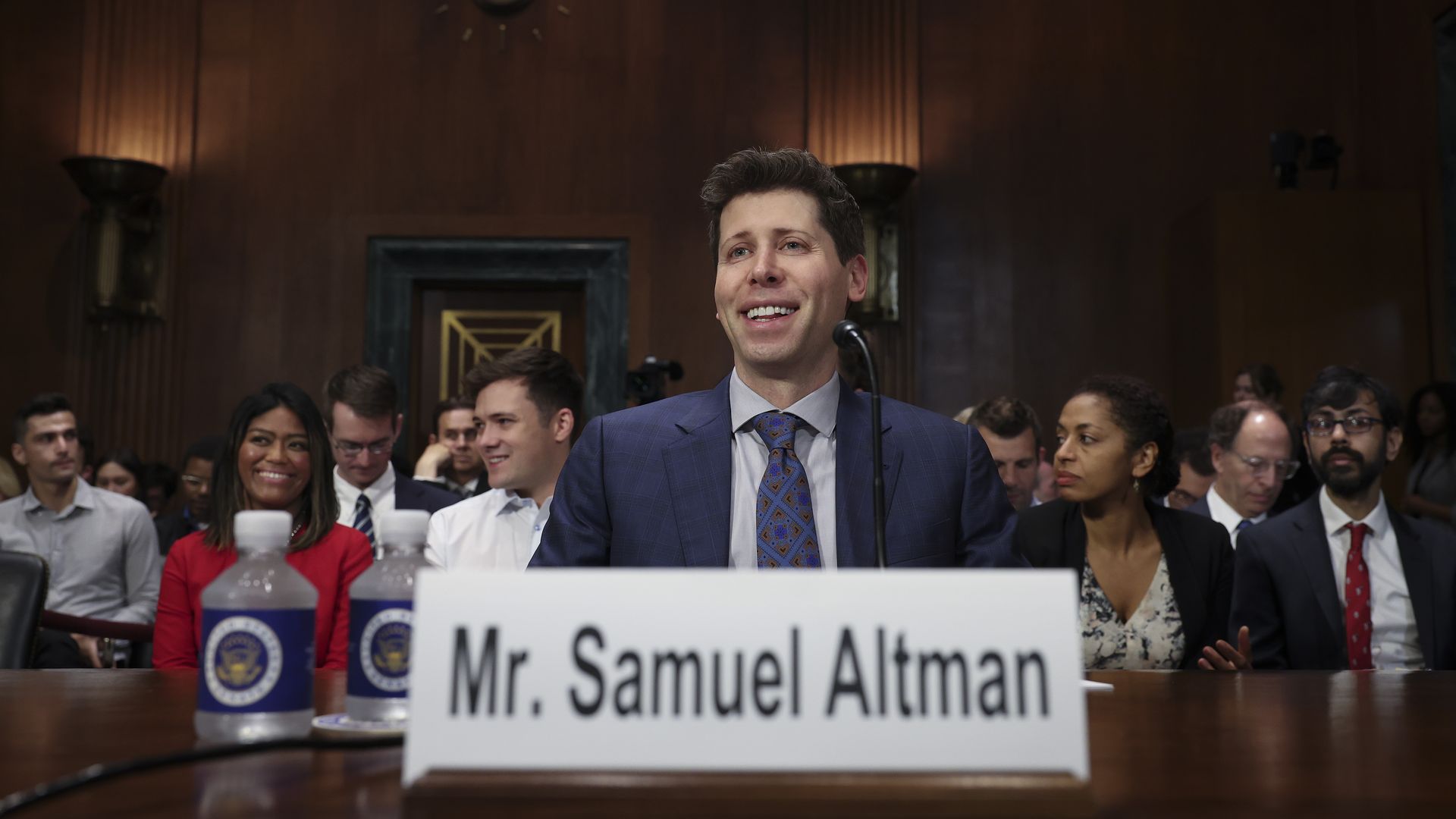
OpenAI CEO Sam Altman at Tuesday's Senate hearing. Photo: Win McNamee/Getty Images
For what might be the first time ever, industry leaders of a new technological revolution are practically begging the government to regulate them — and they still might not get what they want, Axios' Ryan Heath and Ashley Gold report.
Driving the news: A discussion Tuesday between lawmakers and tech executives about the potential misuse of generative AI featured OpenAI CEO Sam Altman urging Congress to enact rules to limit the technology's dangers.
- Altman's regulatory wish list: "a new agency that licenses any effort above a certain threshold of capabilities," testing of potentially dangerous AI models before deployment, and independent audits.
- Altman appeared before a Senate Judiciary subcommittee, along with IBM chief privacy and trust officer Christina Montgomery and NYU professor Gary Marcus.
What they're saying: "This is your chance, folks, to tell us how to get this right. Please use it," said Sen. John Kennedy (R-La.). "Talk in plain English and tell us what rules to implement."
- "This cannot be the era of 'move fast and break things,'" Montgomery said. Her priority: "define the highest risk uses of AI," with existing agencies taking action, rather than wait to commission a new AI-focused regulator.
- Marcus argued for safety testing in the style of clinical trials for prescription drugs.
- All three witnesses agreed on the need for international bodies to help set standards and monitor AI. Altman offered the International Atomic Energy Agency as a model.
Reality check: AI is still more likely to cause a range of near-term harms than Congress is to regulate to prevent those harms.
- In recent years the legislature has passed even the most naturally bipartisan bills on tech policy only with enormous effort.
- The failure to enact a national privacy law — which even many in the industry support in principle — shows how tough a road AI legislation likely faces.
Between the lines: In the past tech companies have asked to be regulated in some areas — like privacy — after their products have become controversial or raised a public outcry. The difference with AI is how early in the adoption cycle some companies are calling on government to make rules.
The other side: Some in the industry fear that effective AI regulations today would lock in the AI race's current leaders — including the OpenAI/Microsoft alliance and Google.
- Meanwhile, critics outside the industry argue that Congress needs to consult much more widely beyond the ranks of the industry it aims to regulate.
Flashback: Congress failed to take early action to set rules for social media — a mistake senators said they're determined not to repeat with AI.
What's next: More AI hearings are on tap, with Sen. Chris Coons (D-Del.) previewing one in July that will look specifically at copyright and patents.
- Meanwhile, Altman's next stop on a capitals-of-the-world tour of AI diplomacy is Brazil.
2. Ransomware gangs target U.S. cities and towns

Illustration: Rebecca Zisser/Axios
A recent resurgence in ransomware attacks targeting local governments is spurring local IT leaders into action to lock down their systems, Axios Codebook author Sam Sabin reports.
Driving the news: Leaders in Dallas are preparing to spend months recovering from a recent attack that hindered the city's 911 emergency services, court systems and more
- Oakland, California, continues to struggle with the long tail of a ransomware attack that started in February.
- Over the weekend, a ransomware gang published sensitive data stolen from the city of Lowell, Massachusetts, during a recent breach.
The big picture: After a reported dip in ransomware costs last year, experts say that ransomware attacks against governments are back up to previous levels — and could even be worse.
- Ransomware gangs spent the last year writing new malware to infect companies and evade detections, Mark Manglicmot, senior vice president of security services at Arctic Wolf, told Axios..
- Malicious attackers have also recognized that local governments have a trove of sensitive data about their residents, Rita Reynolds, chief information officer at the National Association of Counties, told Axios.
- Nearly 7 in 10 IT leaders at local and state governments said in a Sophos report last week that they faced ransomware in the last year. Most of those attacks started either through unpatched systems or stolen passwords.
The intrigue: Governments are increasingly turning to third-party service providers and cloud products to fill the gaps in their security stacks, Reynolds told Axios.
- However, if these tools aren't configured properly or aren't patched when new vulnerabilities are discovered, they can provide new entry points for ransomware criminals, Reynolds said.
3. Telly's free TV: new take on ad-supported gear

Photo: Telly
Ads have supported free TV content for a long time, but one startup is betting they can even subsidize the cost of the television itself.
How it works: Telly, which was started by Pluto TV co-founder Ilya Pozin, is giving away half a million 55-inch 4K televisions — with the condition that recipients also install a separate second display underneath that is constantly showing ads and other information.
- Telly also comes with a soundbar, voice assistant and integrated camera, with the company promising music, video chat, games and fitness services. TV content can come via any traditional cable or satellite TV provider or through a streaming device, such as Fire TV Stick or Roku.
- The required second display sits below the main screen and sound bar and can display stock quotes and sports scores in addition to the mandatory ads. The company uses an obligatory survey done at signup to deliver the targeted advertising — so you are giving at least some data in addition to your attention.
- The company promises to begin shipping the units this summer.
The big picture: The notion of using ads to subsidize tech gear is not a new one. The approach has been tried with cell phones, web-surfing devices and even computers, though more often than not the gadgets have been discounted rather than provided wholly for free.
Between the lines: There's a lot of fine print, and the company also warns its terms of service could change at any time. If you ever decide the deal isn't for you, you have to return the TVs.
4. Take note
On Tap
- Cisco reports earnings after the markets close, as does gamemaker Take Two Interactive.
Trading Places
- Ring founder Jamie Siminoff, who stepped down as head of that Amazon-owned business in March, has sold his latest stealth startup to smart lock maker Latch and will become that firm's CEO.
- Life360 named former GoDaddy and Microsoft executive Lauren Antonoff as its new chief operating officer. As previously announced, company president C.J. Prober is leaving after a transition period.
- Docusign announced former Amazon finance executive Blake Grayson as its next CFO.
ICYMI
- Public housing developments are seeing a sharp rise in the use of cameras and other technology to surveil and often punish residents, according to a Washington Post investigation. (Washington Post)
- The Department of Justice announced five criminal cases against people it accuses of stealing or illegally transferring U.S. technology to businesses and governments in China, Russia and Iran. (Axios)
5. After you Login
Check out this video of a chess player at a New York park vastly underestimating the skills of a woman who happened to be a grandmaster. (Hat tip to Stefan Jon Silverman for the link.)
Thanks to Scott Rosenberg and Peter Allen Clark for editing and Bryan McBournie for copy editing this newsletter.