Axios Login

April 04, 2023
My Axios colleagues and I are hosting a reception on April 26 at the RSA Conference in San Francisco, California, spotlighting whatβs next for cybersecurity policy and tech platform accountability amidst mounting cybersecurity threats, attacks and sophisticated hacking techniques. Interested in attending? Request an invite here.
Today's Login is 1,169 words, a 4-minute read.
π Situational awareness: U.K. regulators have fined TikTok Β£12.7 million, alleging that the platform allowed up to 1 million children under 13 to use the app and tracked their data, the BBC reports.
1 big thing: After layoffs, tech stocks boom


Tech layoffs are way up β and so are tech stocks. Two charts tell this story, Axios' Scott Rosenberg writes.
The big picture: The tech industry's layoffs began last year and have kept up a relentless stream of bleak announcements β in some companies' cases, like Meta's, coming in multiple waves.
- The industry, which had overhired during the pandemic, started trimming its workforce last year, just as the Federal Reserve started raising interest rates to cool the inflation-rattled U.S. economy.
Between the lines: Layoffs are often understood as an indicator of incipient recession, and stock prices typically fall in step with both of those trends.
- That's exactly what happened in 2022 β the worst year for tech stocks since the great dotcom bust more than 20 years ago.
Yes, but: The new year brought a turnaround to tech stock prices, as this second chart lays out (courtesy of Axios Markets' Matt Phillips).


What's happening: Tech stocks have always been volatile, and it's never a good bet to blame their fluctuations on any single cause. Here are some possible explanations for the resurgence, more than one of which might apply:
- Wall Street is rewarding tech for all those layoffs. Investors applaud "discipline," and thinner payrolls could mean more profits to come.
- No, it's the wave of enthusiasm in the industry for ChatGPT and generative AI is driving the market up. Many observers are framing the new generation of AI as the biggest leap forward in tech since the iPhone's 2007 debut.
- Or maybe the market just oversold tech in 2022 and it's correcting course now.
- Some of these companies are also spending some of their cash hoards buying back shares, which can help lift share prices.
- Alternately, this resurgence is an illusory "dead cat bounce." It will fizzle out as the pain of higher interest rates continues.
However you interpret the numbers, the tech-stock rebound has raised spirits in Silicon Valley and provided some hope that the industry's toughest sledding may be behind it.
The bottom line: Some discouraging reports continue β including sagging ad growth and unsold Teslas β but tech's leaders are beginning to see a turnaround. We'll know they're really feeling good when they start hiring in droves again.
2. A convincing deepfake that tells on itself
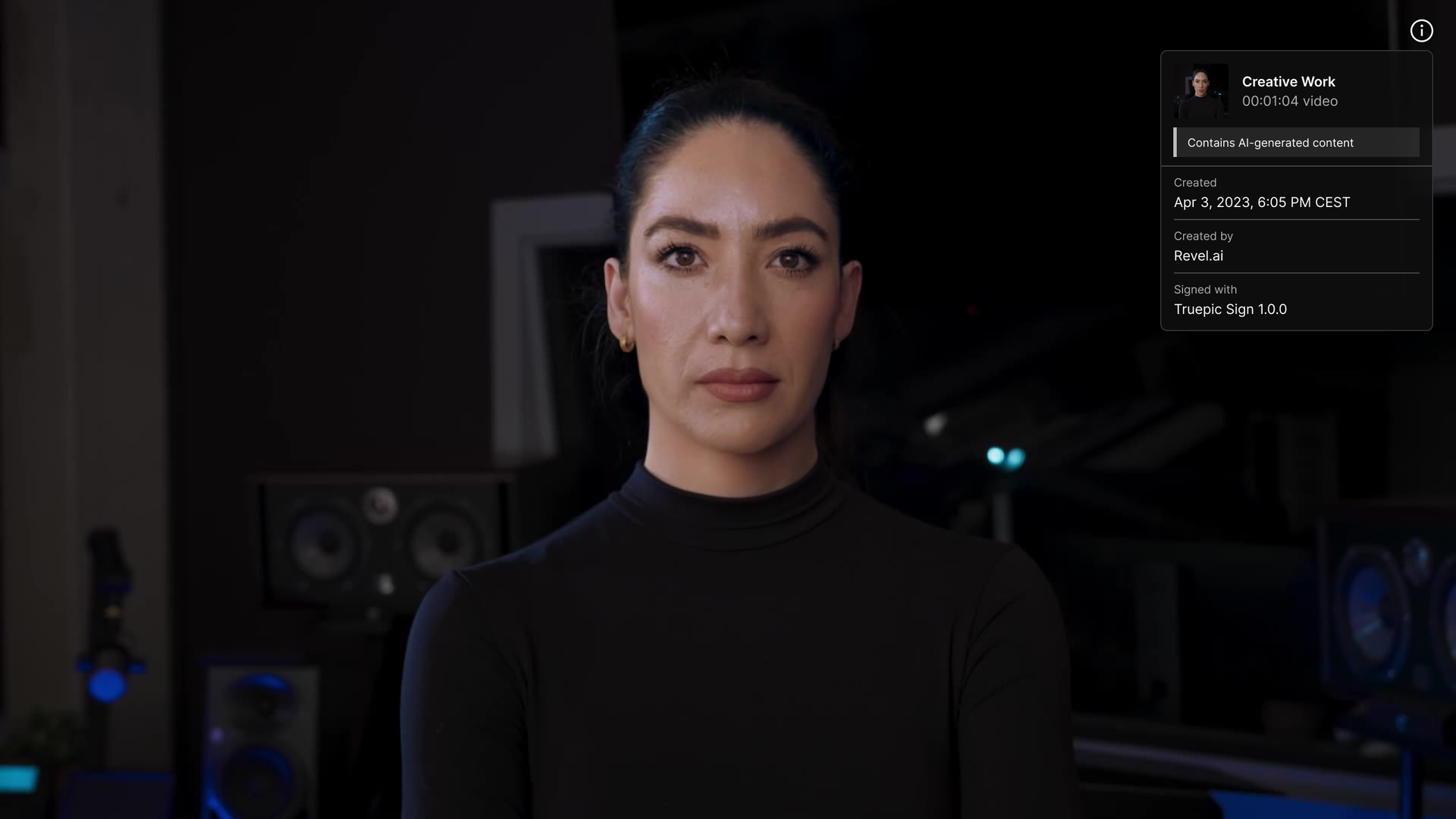
Image: Truepic
Several leaders in AI have teamed up to create what they are calling the first transparent deepfake β a video that looks convincingly real, but is both synthetically created and makes use of an emerging standard to label itself as such.
Why it matters: Many in the field say concerns over synthetic media are no longer hypothetical and that now is the time to start clearly labeling how content was created or altered.
Driving the news: A new synthetic video from Revel.ai features a convincing fake of AI author Nina Schick β with her permission.
- The video is labeled using commercially available technology from Truepic to identify itself as being synthetically generated and having come from Revel.ai.
- The labeling is based on the latest version of a standard from the Content Authenticity Initiative led by Adobe and others designed to show how images and video were produced. Adobe is also using similar tools to identify content created using its new Firefly generative AI tools.
What they're saying: Truepic CEO Jeffrey McGregor told Axios that momentum is building around the need to label synthetic content, with fear of regulation among the motivations.
- Last week's letter calling for a pause in some AI development also underscored the urgent need for a system of content verification as existing AI tools are widely adopted.
- "I think the conversation has changed even in the past two weeks," McGregor said. "People are starting to look at this as a best practice for implementing responsible AI."
Yes, but: Labeling content that is synthetically created doesn't help if most legitimately captured video is not labeled.
- More than anything, you want to know that real content is real, rather than just have some portion of fakes admit that they are fakes.
McGregor said labeling synthetic content can help educate consumers and incentivize other good actors, but acknowledges that the bulk of all content really needs to be transparently labeled in order to minimize the impact of deepfakes.
- Truepic already has a business helping create secure pipelines that media organizations and others can use to prove their images and video were legitimately captured, along with any editing that has taken place.
- McGregor says the company is working with more than 170 organizations, including a pilot with Microsoft to authenticate images coming out of Ukraine.
The bottom line: The era of deepfakes is already here, and people should be suspicious of any video that can't prove where it came from. "You should not trust digital video at this point," McGregor said. "You really shouldn't."
3. AWS debuts generative AI accelerator

Illustration: Tiffany Herring/Axios
Amazon Web Services is debuting a new 10-week accelerator program focused on generative AI startups, Axios' Kia Kokalitcheva reports.
Why it matters: The current AI boom is a boon to cloud computing providers, as their services are essential for the development and operation of this technology.
Details: As part of the program, participating startups will get up to $300,000 in AWS credits, technical and business mentorship, and access to networking within Amazon's business.
- They'll spend the first and last week in person in California, with the last one culminating in a day of presentations to investors.
What they're saying: "[W]e think weβre in a seminal moment in the generative AI journey," Howard Wright, AWS global head of startups, tells Axios.
Between the lines: As with its other startup accelerator programs, AWS aims to hook a new generation of companies on its cloud services.
- The company boasts that high-profile tech businesses like Airbnb and Uber have become its customers over the years.
- "It's good and paramount to our business to stay close to those that are disruptive," adds Wright.
The intrigue: Amazon wouldn't say much about the costs of computing power for generative AI and large language models, but it's known to be a large expense for AI companies.
- The company tells Axios that continuing to lower those costs β including for startups β remains a top priority, pointing out that "frugality" is one of Amazon's core principles.
The bottom line: Expect big cloud tech providers to play a major role in the current AI boom, both with user-facing apps and behind the scenes, as they power the next tech revolution's infrastructure.
Go deeper: Stretching the AI startup boom
4. Take note
On Tap
- Deputy Attorney General Lisa Monaco will meet with tech company representatives today to discuss how to combat the illegal sale of drugs on social media platforms, Axios Pro's Maria Curi reports.
- Also today, President Biden is meeting with his advisory committee on science and technology, known as PCAST, to talk about the risks and opportunities associated with AI.
ICYMI
- Google is cutting back on office spending, including laptop replacements, as well as supplies such as staplers and tape, to pare costs. (CNBC)
5. After you Login
Yes, we've been getting a lot of snow in Northern California this year.
Thanks to Scott Rosenberg and Peter Allen Clark for editing and Bryan McBournie for copy editing this newsletter.
Sign up for Axios Login

Taking you inside the AI revolution, and delivering scoops and insights on the technologies reshaping our lives.

