Axios Generate

January 18, 2024

☕ Good morning! Today's newsletter has a Smart Brevity count of 1,225 words, 4.5 minutes.
🎶 Exactly 25 years ago, Brandy was No. 1 on the Billboard Hot 100 with today's beautiful intro tune...
1 big thing: Greenland is losing even more ice mass
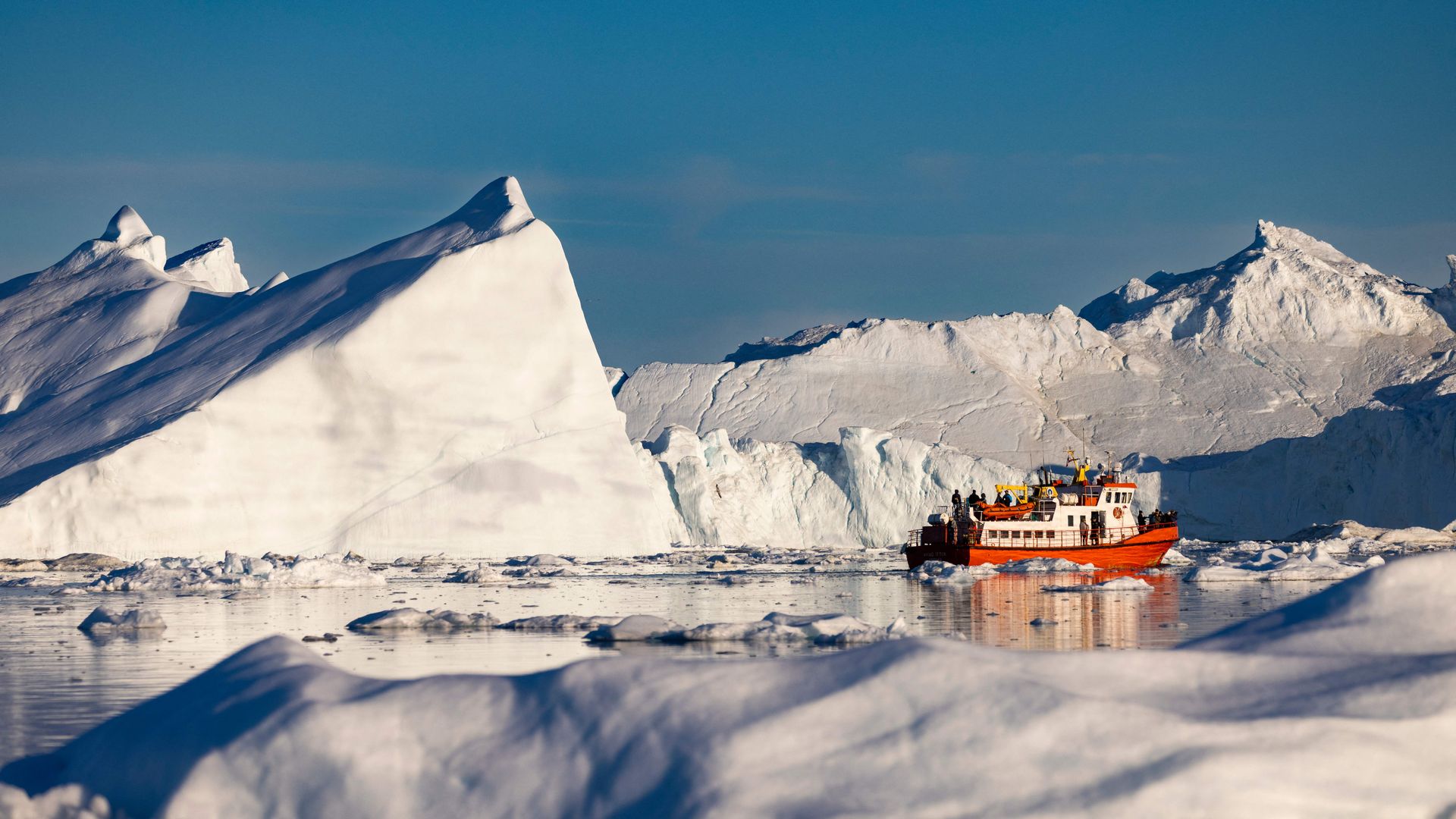
A boat carrying tourists moves among icebergs from Jakobshavn Glacier in Disko Bay, Ilulissat, Greenland, in June 2022. Photo: Odd Andersen/AFP via Getty Images
Scientists may have underestimated the amount of Greenland Ice Sheet melting since 1985 by as much as 20%, a new study found, Andrew writes.
Why it matters: Such an undercount of Greenland ice mass loss indicates a heightened risk of shifts in ocean currents, sea level rise and global weather patterns.
Zoom in: The study focuses on glacier calving retreat, which means ice lost at the edges where glaciers meet the sea.
- According to the new research, published in the journal Nature, since 1985, the Greenland Ice Sheet has lost about 5,091 square kilometers (1,965 square miles) of area due to its retreating calving front, which amounts to about 1,034 gigatons of ice that has slid into the sea.
- The study combines 236,328 manual and AI-generated observations of glacier terminus, or end, positions with a model to capture ice flow. The researchers used this to provide insights into the monthly aerial extents of the entire ice sheet between 1985 and 2022.
What they found: Every region of the ice sheet shows area and mass losses during the period.
- The two glaciers that have lost the most mass — Jakobshavn Isbrae near Ilulissat on the west coast and Zachariae Isstrom in northeastern Greenland — vary greatly throughout the seasons, influenced by ocean currents and temperatures.
- Scientists found that how glaciers vary in mass during the seasons is the best predictor of long-term mass loss.
The intrigue: The researchers claim they capture more than 1,000 gigatons of ice loss that has not been included in previous ice mass loss studies, in part because it can't be detected by satellites and other measuring technologies.
Between the lines: With more freshwater going into the North Atlantic Ocean than previously known, it could explain some of the observed weakening in the Atlantic Meridional Overturning Circulation (AMOC), part of which includes the Gulf Stream.
- "There is some concern that any small source of freshwater may serve as a 'tipping point' that could trigger a full-scale collapse of the AMOC," the study warns, with widespread impacts on weather patterns and marine species.
What they're saying: Ruth Mottram, a climate scientist at the Danish Meteorological Institute who did not contribute to the new research, said the machine learning used in the study is novel.
- "There is a huge amount of machine-learning based insights coming into glaciology, and Earth science in general, and I think this is a nice demonstration of how we can use statistics on big, high-quality datasets to really learn something about the world," she told Axios.
2. The fight to control the oil demand narrative

Illustration: Annelise Capossela/Axios
To paraphrase Yoda: Begun, the latest oil demand wars have, Ben writes.
Driving the news: OPEC boss Haitham Al Ghais released a statement bashing estimates that peak demand looms this decade.
- He pushes OPEC's analysis that global consumption will rise to 116 million barrels per day in 2045, up from 102-ish now.
Yes, but: That collides with the International Energy Agency's latest projection.
- It sees a peak around 2030 slightly above today's levels, but followed by a very slow decline absent stronger climate policies.
Why it matters: Who gains the upper hand in these analytical and PR fights could have real-world consequences.
It depends on a tricky question: whether outlooks from IEA, OPEC and others simply reflect on-the-ground trends — or actually influence investment decisions.
The intrigue: Al Ghais' leans toward the latter.
- He says OPEC's view "underscores the need for stakeholders to recognize the need for continued investment into the oil industry" for "many decades."
- This echoes Saudi views and those of some oil execs and analysts.
What they're saying: Ben Cahill of the Center for Strategic and International Studies says OPEC wants to encourage investment inside and outside its ranks.
- OPEC is "usually blamed for volatility and price spikes, so they want to send clear messages that the big producers can't do it alone," he said via email.
- Cahill adds: "[P]lenty of OPEC states allow private upstream investment and they want to retain those partners."
Quick take: Squabbles over future demand levels and investment needs aren't new (and analyses are all over the map). But they're intensifying.
- The late 2023 UN climate summit endorsed transitioning away from fossil fuels.
- And calls to stem oil investment got louder in 2021. IEA released a hypothetical road map to net-zero emissions that included no investment in new oilfields.
The bottom line: Getting back to Yoda, impossible to see, the future is.
3. The next charging scramble is over electric planes

Illustration: Aïda Amer/Axios
Joby Aviation, the Toyota-backed electric air taxi startup, is splitting from the rest of its industry over how to charge the innovative aircraft, Axios' Joann Muller reports.
Why it matters: It could launch another VHS vs. Betamax debate over charging standards, mirroring drama that played out recently in the automotive industry — until Tesla won.
Driving the news: Joby is collaborating with Atlantic Aviation, an airport services operator, to install its proprietary charging infrastructure at small airports in New York and Southern California.
- Outfitting general aviation airports with Joby's Global Electric Aviation Charging System (GEACS) will help enable launch of its air taxi service in New York City and Los Angeles as soon as next year, Joby said.
Yes, but: The rest of the industry isn't very interested in Joby's standard. Instead, most are adopting the Combined Charging Standard (CCS) widely used in EVs today.
But Joby no doubt hopes it can win over converts as Tesla did.
4. Court signals readiness to overturn Chevron deference

Illustration: Brendan Lynch/Axios
Conservative Supreme Court justices signaled Wednesday they are likely to curtail or overturn the authority government agencies have when interpreting congressional legislation for issuing regulations, Andrew writes.
Why it matters: The arguments involved the legal doctrine of Chevron deference. Depending on how far the ruling goes, this case could dramatically limit the authority of federal agencies to regulate environmental issues.
How it works: Legislation doesn't always foresee a future regulatory need, and for 40 years, agencies have interpreted the original legislation and applied it to new priorities, such as cutting greenhouse gas emissions.
- Courts have deferred to the agencies due to their specialized expertise on such topics.
Zoom in: During Wednesday's oral arguments, conservative justices expressed skepticism that Congress meant to delegate so much power to the executive branch.
- Liberal justices indicated a concern that weakening or striking this doctrine down would force courts to decide complex technical questions where justices may lack expertise.
- "Judges should know what they don't know," said Justice Elena Kagan.
What they're saying: Tina Van Bockern, an environmental litigation partner at Holland & Hart, said Justice Amy Coney Barrett's questions indicated a possible compromise.
- Justice Barrett expressed concern about a potential "flood of litigation" if Chevron deference were overturned.
Yes, but: "In all likelihood, based on the questions posed by the Justices today, Chevron deference will be a thing of the past," Van Bockern said.
5. Bonus policy notes: Charging, trade, solar
🚗 The Transportation Department this morning announced nearly $150 million in grants to repair and replace nearly 4,000 existing EV charging ports across 20 states.
🧳 Ambassador Sarah Bianchi, President Biden's deputy U.S. trade representative, is leaving the administration, Axios' Hans Nichols reports.
- Why it matters: Bianchi has a deep understanding of Biden's energy transition strategy.
- Catch up fast: She has been working with partners throughout Asia on how to import more critical minerals needed for EV batteries. Full story
☀️ Biden officials floated plans to open millions of acres in Western states to potential utility-scale solar development. Full document, Reuters coverage
📬 Did a friend send you this newsletter? Welcome, please sign up.
🙏 Thanks to Chris Speckhard and Chuck McCutcheon for edits to today's edition, along with the talented Axios Visuals team.