Axios Generate

April 15, 2024
š„ Good morning! We'll start the week with 1,198 words, a 4.5-minute read.
šØ Situational awareness: Tesla is laying off over 10% of its global workforce, per a company memo viewed by Bloomberg and Electrek.
š¶ This week marks 25 years since Tom Waits released the album "Mule Variations," which provides today's intro tune...
1 big thing: Oil markets play wait and see ā for now
Illustration: Natalie Peeples/Axios
Oil prices barely moved in the first trading since Iran launched drone and missile strikes against Israel over the weekend, but major geopolitical peril remains.
Why it matters: Market moves are an exercise in hive-mind risk analysis, Ben writes.
- Traders apparently don't expect immediate escalation after the largely deflected attack, which followed Israel's April 1 airstrike in Syria that killed a top Iranian general.
- And as Rystad Energy notes, oil prices last week already priced in expectations of an Iranian move.
What they're saying: "The muted price response reflects the fact that the supply of oil has been and remains unaffected," oil historian and analyst Ellen Wald tells Axios via email when trading began in Asia yesterday.
- She notes that Israel isn't an oil producer, and doesn't envision Iran closing the Straits of Hormuz to oil shipping because that would hurt their exports.
- And "Israel doesn't have the capability to take out Iran's oil infrastructure without assistance," said Wald.
State of play: Brent crude is floating in the mid-$89 per barrel range today, down less than 1% from where it ended last week.
The big picture: Analysts see powerful nations pressuring Israel and Iran to prevent further escalation.
- Axios' Barak Ravid reports the U.S. has told Israel it won't back a counterstrike.
- Eurasia Group analysts see China, which is heavily reliant on imports from the region, "actively" pressing Iran for restraint.
- The firm also notes Gulf Cooperation Council countries are looking to contain things to avoid risks to production and critical infrastructure.
Yes, but: Prices remain elevated, and analysts see the ongoing geopolitical risk as a major reason why.
What we're watching: What happens if things do escalate again, and send prices skyrocketing ā a political problem for President Biden.
- He's been willing to use the Strategic Petroleum Reserve, authorizing the largest sale ever in 2022 after Russia invaded Ukraine.
- However, that 180 million barrel release along with sales Congress mandated has left the stockpile far smaller, with only limited re-purchases since then.
- The current inventory is 362 million barrels, far below the peak of 727 million over a decade ago, per Energy Department data.
The bottom line: It's still a very dangerous situation.
2. La NiƱa on track to amplify Atlantic hurricane season
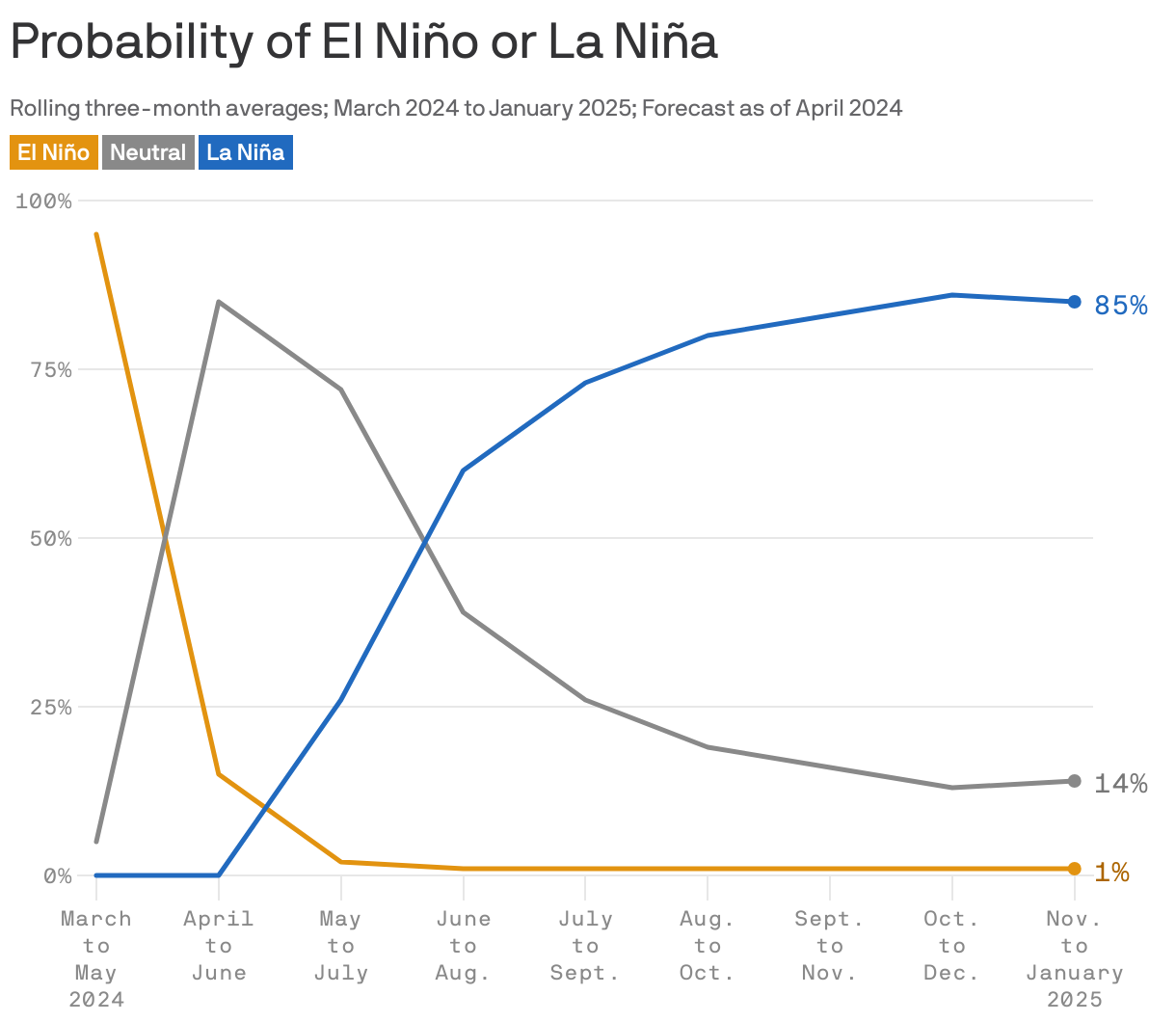
The tropical Pacific Ocean continues to trend toward a La NiƱa phase, coming out of one of the strongest El NiƱo events on record since 1950, Andrew writes.
Why it matters: The switch could bring favorable conditions for Atlantic hurricanes.
Driving the news: The latest federal outlook for the larger climate cycle, known as the El NiƱo-Southern Oscillation, calls for the currently fading El NiƱo to give way to neutral conditions this summer.
- NOAA experts give a 60% chance of a La NiƱa during the June through August timeframe, and the odds increase from there going into the fall.
How it works: While El NiƱo features unusually warm water temperatures in the equatorial tropical Pacific Ocean, La NiƱa is characterized by cool anomalies present in the same general region.
Threat level: For over a year, ocean surface temperatures in the North Atlantic have been at record highs, and water temperatures are currently nearing their typical July levels.
- This indicates that one key ingredient ā sufficiently warm waters ā will be present in spades this hurricane season.
- And this La NiƱa would be a climate wild card, given that it comes after a near-record string of 10-straight record-warm months worldwide.
3. Oil demand's state of play
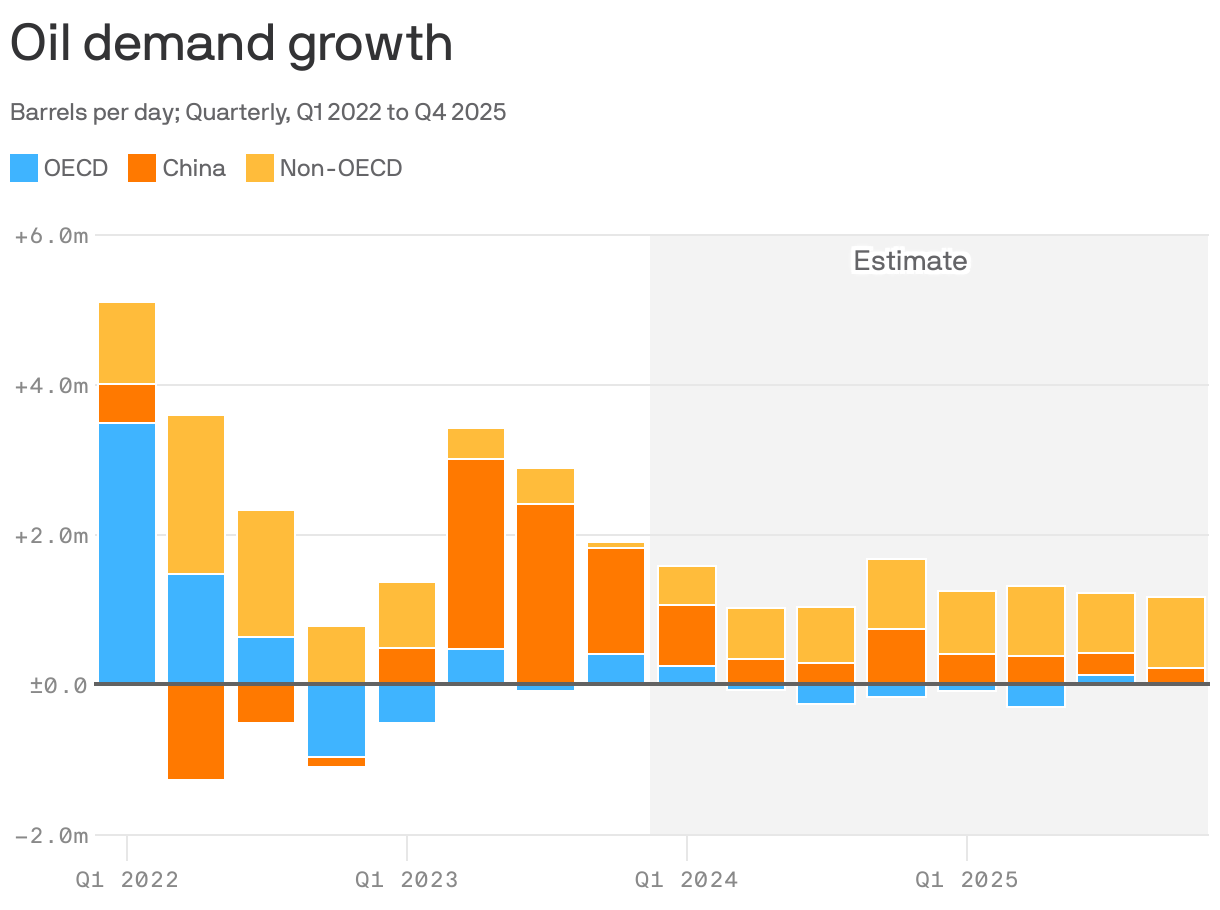
The International Energy Agency is offering fresh evidence for its estimate that global demand will peak this decade, Ben writes.
Why it matters: The future of oil carries huge stakes for producing economic growth, powering clean tech firms, and protecting the planet.
- And the agency's latest commentary comes as some Republicans and analysts say IEA underestimates the persistence of demand growth.
The big picture: Steep demand growth as nations emerged from COVID has run its course, IEA's Toril Bosoni and CiarƔn Healy write.
- They also see China's outsized role in boosting petro-thirst over the last decade easing.
- IEA projects slower economic growth there in 2024 and 2025, and fast Chinese uptake of electric vehicles and other tech that displaces demand.
- And IEA sees other "structural" reasons for slowing demand growth post-2025, such as Middle East countries using less oil for electricity.
Reality check: Absent stronger climate policies and investment, the post-peak decline will be very gradual, they write.
- And views about crude's trajectory are hardly uniform.
- For instance, a new report from analytics firm Enverus sees no peak or even plateau this decade but does project slowing growth after 2030.
4. šš½āāļø Catch up quick on policy
Illustration: Annelise Capossela/Axios
šµ The Interior Department raised royalties, fees and bonding requirements for onshore oil and gas development on federal lands, Ben writes.
- Why it matters: The changes ā the first onshore royalty increase in a century ā will cost companies an estimated $1.5 billion total through 2031.
- State of play: The rule also aims to avoid selling leases in areas with "sensitive cultural, wildlife, and recreation resources," officials said.
š House Republicans are expanding their probe of the White House pause on new LNG export licenses to major markets.
- What's next: An Oversight Committee panel will hold a hearing Thursday with Brad Crabtree, who heads DOE's fossil energy office.
- Friction point: Biden officials have "attempted to hide the influence leftist environmental groups have had over U.S. foreign policy," Rep. Pat Fallon, a senior committee member, alleged in announcing the hearing.
- The other side: The White House calls the pause appropriate to weigh the market and climate effects of surging exports, and notes shipments will keep rising regardless thanks to already approved projects.
ā” The Energy Department issued final efficiency standards for common residential and commercial lightbulbs.
- Why it matters: DOE estimates the rules will save $1.6 billion annually on household energy costs while helping to cut carbon dioxide emissions.
- What's next: They take effect in July 2028 for newly produced bulbs. The Hill has more.
5. One tech thing: cleaning up cement
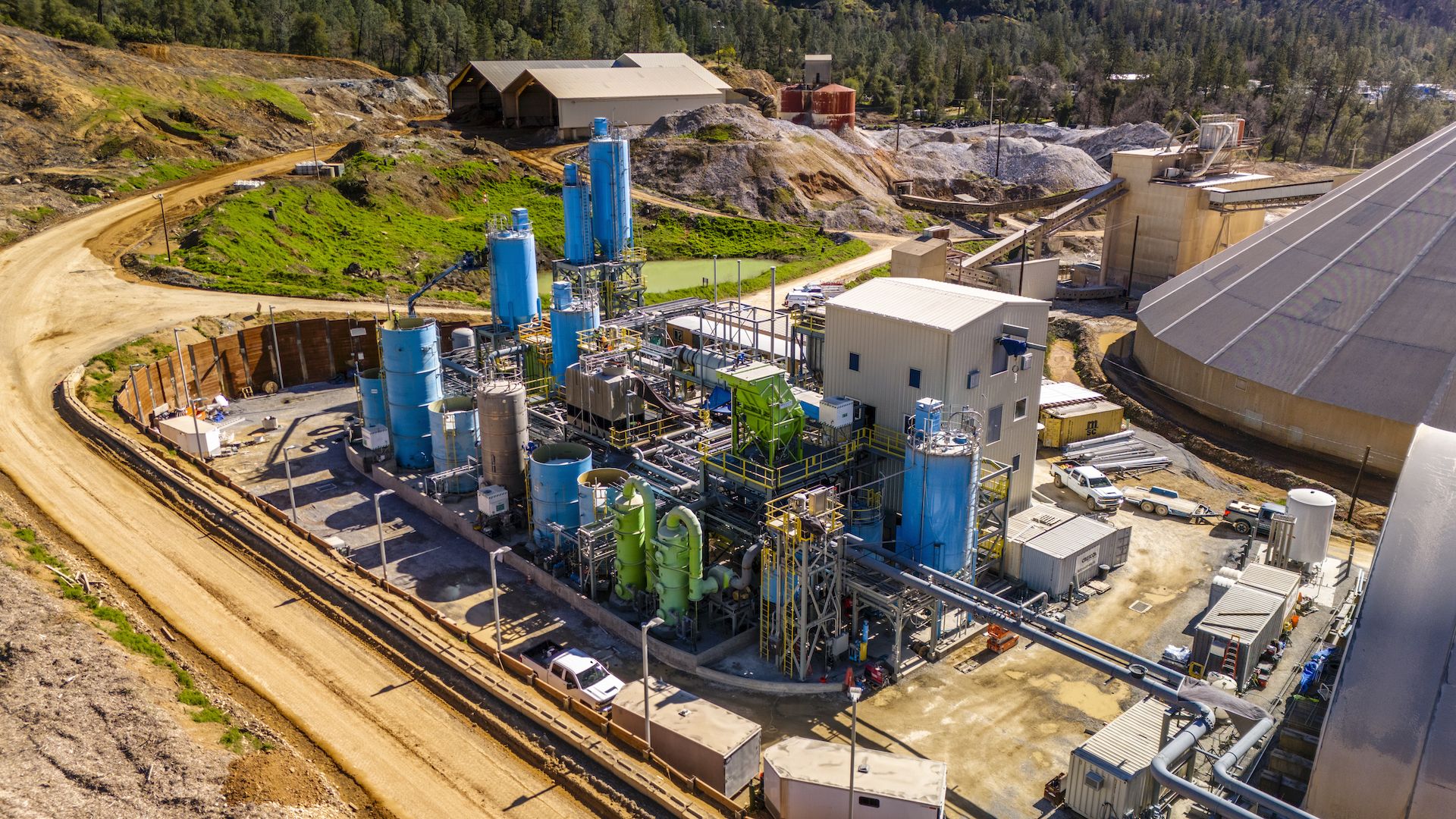
Photo courtesy of Fortera
Materials startup Fortera just opened its first "green cement" facility in Redding, California, Ben writes.
Why it matters: The cement sector accounts for roughly 6%-8% of global CO2 emissions.
- This is the "first industrial green cement and carbon mineralization facility in North America" and among the world's largest, Fortera said.
State of play: The new facility is adjacent to an existing CalPortland cement plant.
- Fortera's process captures CO2 from high-heat cement kilns and mineralizes it as a feedstock for its "ReAct" cement product. AP has more
The bottom line: With multiple companies in the market, "green" cement is getting bigger but remains in its nascent stages.
6. š Number of the day: 90%
Roughly 90% of buyers who qualify for federal EV tax credits are opting to receive them as an upfront benefit.
Why it matters: New Treasury Department data numbers provide a snapshot of a new program under the 2022 climate law, Ben writes.
- It allows credits to be claimed as an immediate reduction in vehicle cost, among other changes and expansions of the subsidy regime.
State of play: Treasury has sent over $580 million in "advance payments" to auto dealers since Jan. 1, the department said.
- The vast majority of new and used EV buyers are opting for the newly available upfront option. CNBC has more.
š Our Axios BFD summit returns to San Francisco on May 14, featuring Craft Ventures co-founder David Sacks, Google health chief Karen DeSalvo & many more. Request an invite.
š¬ Did a friend send you this newsletter? Welcome, please sign up.
š Thanks to Chris Speckhard and Javier E. David for edits to today's edition, along with the brilliant Axios Visuals team.
Sign up for Axios Generate

Untangle the energy industryās biggest news stories