Earth has its warmest March on record, beating 2023's milestone


Add Axios as your preferred source to
see more of our stories on Google.
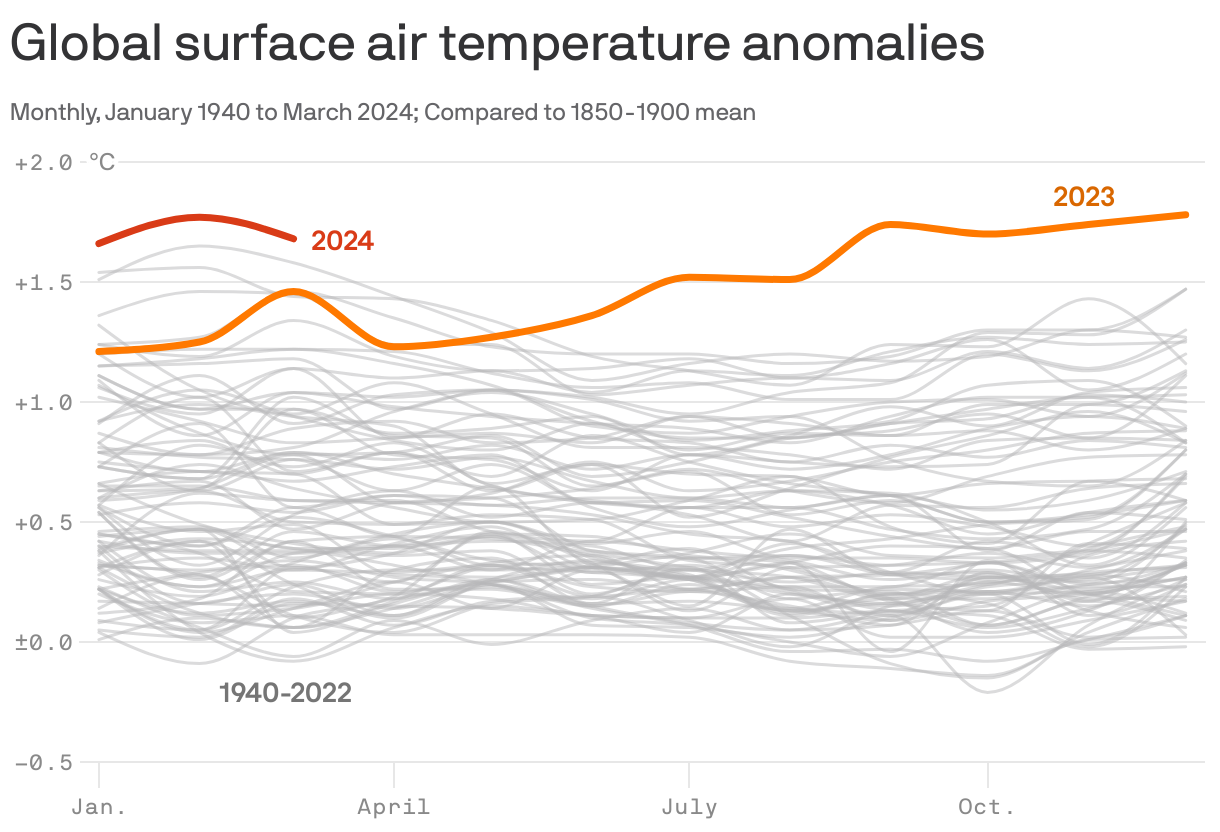
March marked the globe's 10th month in a row that set its warmest respective month on record.
Driving the news: This morning Europe's Copernicus Climate Change Service announced the milestone, making a recent preliminary finding official.
Why it matters: Copernicus is among the most closely-watched and respected sources of temperature data, and reports before the U.S.' climate agencies, NOAA and NASA.
- March marks just the latest in a string of troubling developments on the climate front.
- 2023 was the warmest year on record, and global conditions — including record warm oceans — are worrying scientists.
- Unusually warm waters in the tropical Atlantic led to the issuance this month of an extremely bullish forecast for the upcoming hurricane season.
State of play: Last month was 0.73°C (1.3°F) above the 1991-2020 average for March, and 1.68°C (3.0°F) above estimated preindustrial levels, which are calculated for the period from 1850-1900, Copernicus found.
Between the lines: Two other key records were also set during March: the hottest 12-month period, and the milestone for the hottest global average sea surface temperatures, Copernicus showed.
- Many regions of the globe were unusually warm during March, including large parts of Europe, eastern North America, Greenland, parts of South America, Africa, southern Australia and Antarctica.
- April has started out with record heat in multiple locations worldwide, particularly across Europe, southeast Asia and parts of Africa.
- In Europe, many locations have already seen temperatures soaring well into the 80s°F, exceeding records for the earliest such heat.
What they're saying: "Stopping further warming requires rapid reductions in greenhouse gas emissions," deputy director of the Copernicus Climate Service Samantha Burgess said in a statement.
What's next: As an intense El Niño event continues to weaken in the tropical Pacific, global air and ocean temperatures may begin to decline relative to other top 5 record years.
