Red Sea, Mid-East troubles raise specter of high energy prices

Add Axios as your preferred source to
see more of our stories on Google.
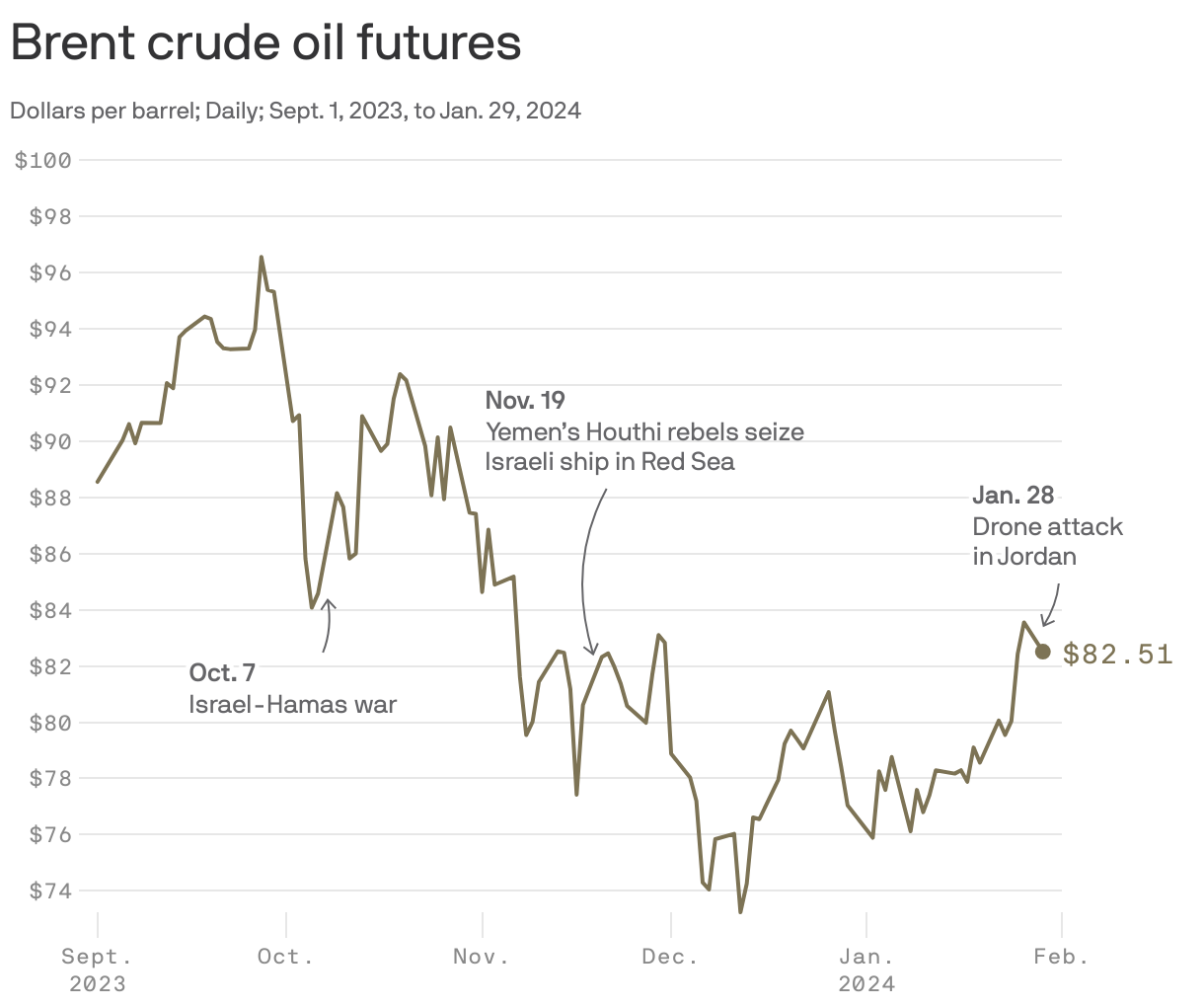
Ongoing geopolitical risks from the Red Sea conflict may cause a surge in energy prices, even as prices remain stable for the moment.
Driving the news: Fallout from the Israel-Hamas war, and worsening U.S.-Iran tensions, are endangering the stability of the global supply chain. In its 2024 outlook released earlier this month, the World Bank warned that "inflationary bottlenecks" were a real possibility.
- Amid "a setting of escalating conflicts, energy supplies could also be substantially disrupted, leading to a spike in energy prices," the bank added.
Why it matters: International tensions and supply chain imbalances have become major impediments to global trade since the pandemic.
- China, the world's biggest exporter, has intervened to de-escalate the Red Sea situation — and crude has remained remarkably stable in the face of mounting instability. But an escalation may put upward pressure on energy prices.
- The conflict comes at a time when more than a third of the Panama Canal has been struck by drought.
Catch-up quick: After recent attacks, shipping companies face increased costs and a one-week delay in delivery times. To compensate, they have shifted from the traditional Red Sea/Suez Canal route to the longer journey around the Cape of Good Hope.
- World Bank economists caution these delays may lead to inflationary bottlenecks, compounded by climate-related problems in the Panama Canal.
- Production cuts from OPEC+ and higher-than-anticipated demand pose additional upward price risks, according to the report.
- In early January this year, U.S. officials, said that the direct economic impacts on the U.S. were relatively limited.
Yes, but: Minor disruptions can contribute to the escalation of already volatile energy prices, which eventually impact fuel and food prices.
- But an increasingly unstable geopolitical outlook hasn't given a lasting boost to crude prices. After an attack in Jordan killed three U.S. service members over the weekend, crude briefly spiked, then fell by over a percent on Monday to settle below $83.
- A spluttering Chinese economy is contributing to demand fears that have kept prices subdued, while ample oil supplies are keeping markets fed, Axios' Matt Phillips reported recently.
By the numbers: About 15 percent of global seaborne trade goes through the Red Sea. This includes 8 percent of global grain trade, 12 percent of traded oil by sea, and 8 percent of the world's liquefied natural gas trade.
- The insurance costs are now adding $1 million each way for shippers who are forced to take the only alternative route.
Bottom line: In addition to energy, supply disruptions could spill over to other commodity prices, potentially dampening investment and weakening global growth.
- "An escalation of the conflict in the Middle East could exacerbate food insecurity across low-income countries as many of them are highly dependent on food and energy imports," the World Bank notes.
