
Axios Generate

June 26, 2023
🥞 Good morning! Today's newsletter has a Smart Brevity count of 1,366 words, 5 minutes.
🚨 Situational awareness: BlackRock chairman and CEO Larry Fink laments the politicization of ESG investing. Go deeper.
🎶 35 years ago this week: Public Enemy released the groundbreaking album "It Takes A Nation Of Millions To Hold Us Back," which has today's intro tune...
1 big thing: Paris summit yields tangible gains, but...
Illustration: Sarah Grillo/Axios
Last week's climate finance summit in Paris went a considerable way — but perhaps not far enough — to quell demands from developing nations for more funding to help offset the costs of climate change and the transition to clean energy, Andrew writes.
Why it matters: Global climate talks are riven by persistent issues of fairness and trust, with industrialized countries so far failing to deliver on promised climate funds.
- Progress could help lay the groundwork for a smoother U.N. climate summit in Dubai later this year.
Driving the news: The summit was organized by France and hosted jointly by the government of Barbados, whose prime minister has championed reforming the world’s multilateral banks.
- It was a precursor to more difficult, high-stakes finance meetings ahead of COP28.
Between the lines: One key demand from developing countries — access to $100 billion in “Special Drawing Rights” from the world’s biggest economies — was met, at least in principle.
The intrigue: The idea of a tax, with revenue devoted to clean energy transition and climate challenges developing countries face, gained traction at the summit.
Quick take: When it comes to global climate talks, never underestimate the power of a small island state, which is on the front lines of warming's effects sweeping the globe.
- At the Paris climate talks in 2015, the Marshall Islands’ top climate official, the late Tony deBrum, was a powerful moral voice who urged industrialized countries to push for an ambitious agreement that included a 1.5-degree climate change target.
- On climate finance, the leader to watch is Barbados’ Mia Mottley, who has taken a detailed set of proposed reforms — called the Bridgetown Initiative — and brought it to the forefront of the world’s richest nations.
What they’re saying: "Paris has shown that there is no shortage of creative ideas to make the financial system work better for people and the planet. But, as ever, it is about implementation. That requires broader leadership than that on display in Paris,” Rachel Kyte, dean of The Fletcher School of Law and Diplomacy at Tufts University, said in a statement.
2. Oil markets calm after Russia's wild weekend

Illustration: AĂŻda Amer/Axios
Oil prices rose modestly after the Wagner Group's aborted uprising in Russia — a massive oil exporter — offered the most serious challenge yet to Vladimir Putin's rule, Ben writes.
Why it matters: Geopolitical turmoil in petro-states usually sends prices sharply higher.
- But traders' chill response suggests the market hive-mind doesn't see huge changes afoot that jeopardize supplies — at least for now.
Where it stands: Brent crude is up less than 1% in the first day of trading since the mercenary group's brief advance toward Moscow.
The big picture: The Russian drama also comes amid headwinds, such as interest rate hikes by global central banks, the possibility of more from the Federal Reserve and China's weak economic recovery. Reuters has more.
Yes, but: "We do ... believe that the geopolitical risk amid internal instability in Russia has increased," Rystad Energy senior VP Jorge LeĂłn said in a note.
What we're watching: A note from ClearView Energy Partners tries gaming out what it all could mean for oil and gas markets.
- Potential bullish forces include Russian escalation in Ukraine that's met with tighter Western sanctions; and a succession crisis or civil war that affects state-owned companies' production and exports.
- Potential bearish forces include "a further fracturing of OPEC+ cohesion amid growing Russian instability"; and Washington loosening restrictions on Iranian barrels.
3. Charted: The state of EV sales


Electric vehicles' slice of the light-duty market inched to a new high last quarter, Ben writes.
Why it matters: The latest snapshot from the Alliance for Automotive Innovation shows steady growth but also signals market hurdles ahead.
Driving the news: Models with a plug — fully battery-powered or plug-in hybrids — were 8.6% of the U.S. light-duty market in Q1, up from 8.5% in Q4 of 2022 but well above the 5.9% a year prior.
The big picture: Consumer choice is growing. Ninety-seven EVs were available in Q1.
- California remains by far the biggest market, with EVs at 24% of sales in Q1. The next four: Washington, D.C. (20%), Washington state (17%), Oregon (16%) and Nevada (15%).
Threat level: "Installation of U.S. public chargers is not keeping up with current and projected EV sales," the group warns.
- Thirty-nine EVs were registered for every new public-charging port last quarter.
- The report also notes that while the U.S. is building a battery supply chain, it remains heavily reliant on global markets — notably China — for mineral extraction and processing.
4. Extreme precipitation risks currently underestimated


A database that infrastructure planners use to determine how best to design a bridge, building or new tunnel vastly understates the risk of extreme precipitation events, a report shows, Andrew writes.
The big picture: The current NOAA precipitation expectations, used to determine the risk of a "100-year" rainstorm and even rarer events, are not keeping pace with the warming climate, the First Street Foundation concludes in an analysis.
- The report uses a new, peer-reviewed flood model to examine how climate change already has shifted the odds of extreme precipitation events across the U.S.
- It compares the model's findings with what is contained in the NOAA database, known as Atlas 14.
- The climate change-related trends are projected to continue as warmer ocean and air temperatures provide more water vapor for storms to convert into heavy precipitation.
Between the lines: First Street's study shows that more than 51% of Americans live in an area now twice as likely to experience a 1-in-100-year flood event, compared with expectations from Atlas 14.
- The biggest corrections to NOAA's data came in the Northeast, Ohio Valley, and Texas and Louisiana coastlines.
NOAA is in the process of updating its database for Atlas 15, but this is not expected to begin rolling out until 2026.
- The government's outdated estimates may help set the design standards for the vast sums of infrastructure spending in the Biden administration's climate and infrastructure laws.
Yes, but: Besides First Street, a nonprofit, many climate startups exist to help prepare companies and communities for changing risks where existing data falls short.
5. Texas heat wave extends into Southwest, Miss. Valley
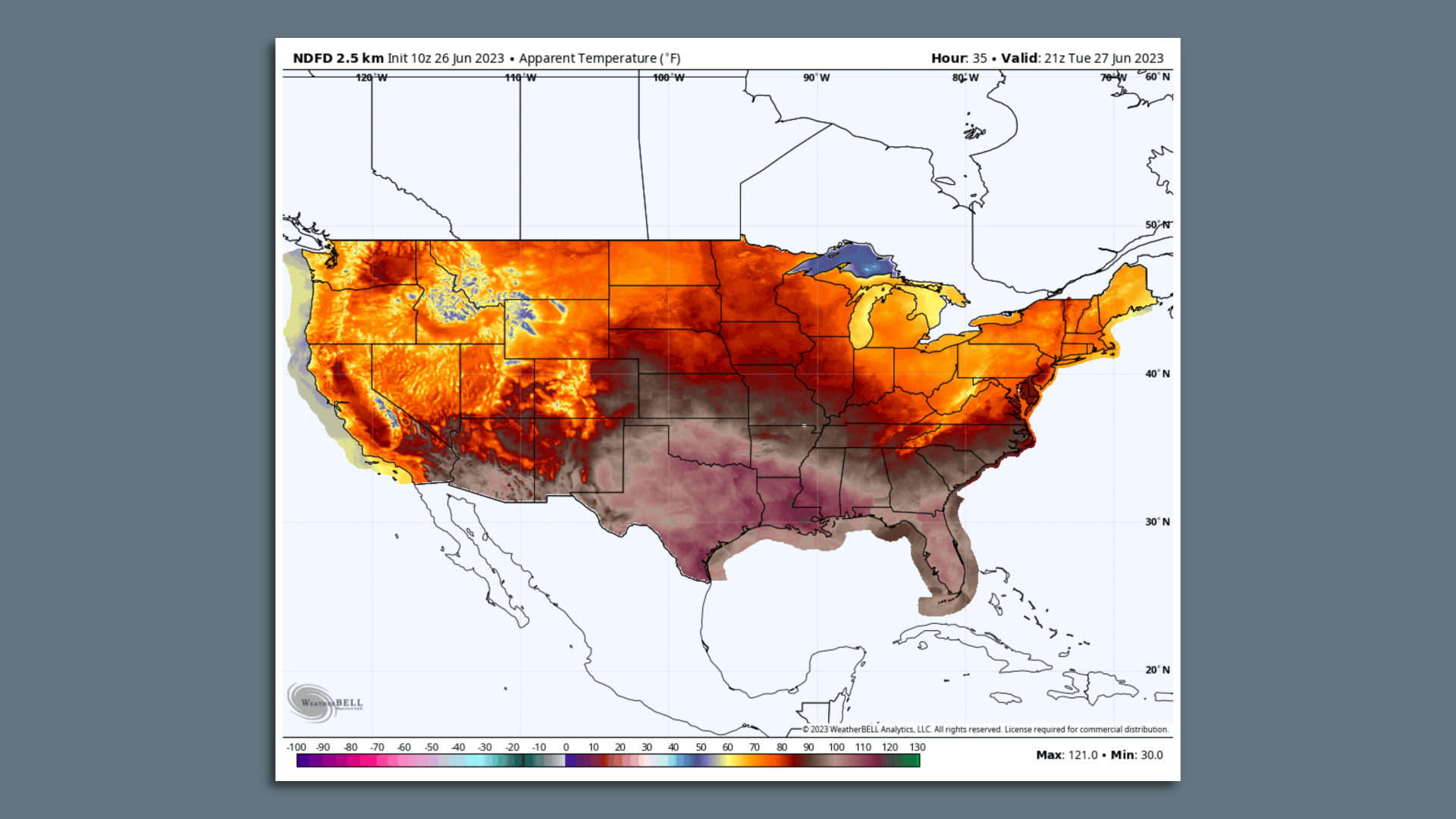
Map showing forecast "apparent temperatures" on June 27. Image: Weatherbell.com
More than 40 million people in seven states are under heat wave warnings and advisories on Monday, as Texas’ brutal heat wave expands, Andrew writes.
The big picture: The high-pressure area aloft, or heat dome, responsible for this event is moving out of Mexico, parking itself over Texas.
- This is causing the dangerously hot and humid conditions to spread from Arizona to the Mississippi Valley.
- Records are likely to be broken again in Texas, in particular, where daytime high temperatures will soar well into the triple digits.
Threat level: The prospect of Texas’ largest cities near or at record highs on consecutive days could mean an even bigger test of the state’s electrical grid than has occurred so far during this heat wave.
What they’re saying: “With oppressive heat across the Southern U.S. not going anywhere soon, it's CRUCIAL to practice heat safety no matter where you are," the NWS said Sunday afternoon.
6. Biden's Ford aid triggers union backlash
Illustration: Shoshana Gordon/Axios
The Energy Department's $9.2 billion loan to Ford's battery joint venture with South Korea's SK On is angering the powerful United Auto Workers, Ben writes.
Driving the news: UAW President Shawn Fain said the plants in Kentucky and Tennessee would create "low-road jobs with no consideration for wages, working conditions, union rights or retirement security."
- That's just one part of his broadside that slams the deal he says came with "no strings attached."
Why it matters: It's part of wider tensions with auto labor over the industry's shift to EVs, which require fewer workers to assemble.
Catch up fast: The fiery statements come weeks after the union said it's not endorsing President Biden's 2024 reelection bid — for the moment — after backing him in 2020.
- But the UAW isn't likely to support the GOP nominee — especially if it's Donald Trump, who Fain strongly opposes.
- Still, the recent events signal tensions between Biden-world and auto workers, even as the wider AFL-CIO backs the president.
The intrigue: The Detroit News notes the federal loan comes ahead of contract talks between Ford and the UAW.
- "Unionizing joint venture and battery plants, especially in the South where unions historically have struggled to organize workers, is a top priority for the union," the paper reports.
📬Did a friend send you this newsletter? Welcome, please sign up.
🙏Thanks to Gail Hughes and Javier David for edits to today's edition, along with the talented Axios Visuals team.
Sign up for Axios Generate

Untangle the energy industry’s biggest news stories


