Axios Generate

December 03, 2024


✅ Tuesday. There's a lot to talk about, but we'll keep the conversation short with just 1,271 words, 5 minutes.
🚨 Situational awareness: U.S. additions of clean power — wind, utility-scale solar, and batteries — had their largest Q3 on record. Go deeper.
🎶 In honor of HBO's yacht rock documentary that Ben enjoyed, the brilliant neo-yacht duo Young Gun Silver Fox has today's intro tune...
1 big thing: Why this climate court case is different
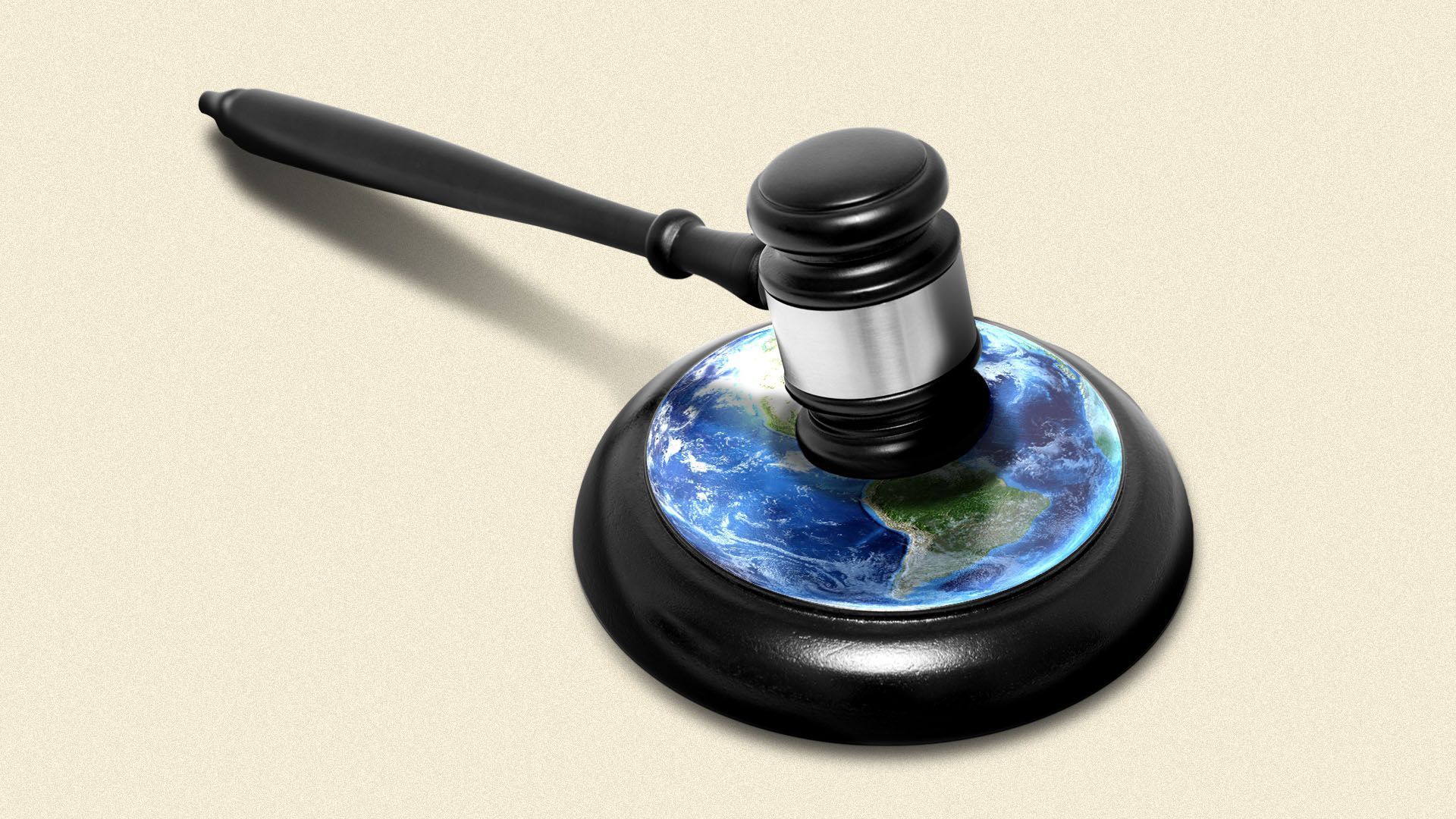
The first day of International Court of Justice hearings on countries' obligations to combat climate change revealed deep dissatisfaction with the climate finance agreement struck at COP29 last month.
Why it matters: The court's advisory opinion will be nonbinding. But vulnerable nations — led by Vanuatu — see it as a potential boost to efforts to hold big greenhouse gas emitters accountable, compared to the COP process.
The big picture: Representatives from Barbados expressed the prevailing, dim view of the UN climate summit process among many developing countries appearing yesterday before the 15-judge panel.
- "To say that we Barbadians are disappointed is to measure the distance between what has over the years been promised against what has in fact been delivered," said Robert Volterra, a co-representative of the country, before the ICJ.
- The outcome of COP29 was an agreement that calls for "at least" $300 billion a year for climate finance flowing from industrialized countries by 2035.
- That amount was agreed to even though studies have shown developing countries need at least $1 trillion per year to adapt to climate change impacts and decarbonize their energy systems.
Our thought bubble: Had the annual climate summits proven effective at cutting emissions and addressing developing countries' climate justice concerns, the ICJ case might not be necessary.
Zoom in: The case at the world court concerns countries' obligations under international law to take action on climate change, and what they have done to date.
- Arguments yesterday centered around the scope of a potential decision, as well as the plight of the world's most vulnerable nations.
- Some countries, like Saudi Arabia and Germany, argued that the climate agreements to date should form the basis of the advisory opinion, not broader human rights law.
- Vanuatu's representatives emphasized the inequities between the countries that have emitted the most greenhouse gases and the ones suffering its worst effects.
- "The conduct on trial is that of states, which have failed for over a century, despite increasingly dire warnings, to rein in the emissions from their territories," said Vanuatu climate envoy Ralph Regenvanu.
Meanwhile, the Bahamas called for countries to be held accountable for their planet-warming emissions from burning fossil fuels for energy.
- "We insist on liability, and we demand reparations," said Bahamas Attorney General Leo Pinder, emphasizing the country's extreme vulnerability to climate change-related sea level rise and more severe hurricanes.
What we're watching: How the next two weeks of hearings unfold, including U.S. contributions scheduled for tomorrow.
- The hearings may offer hints as to what the nonbinding ruling will say, along with any potential ramifications for countries rich and poor.
2. 🗞️ Exclusive: New methane monitoring AI tool unveiled
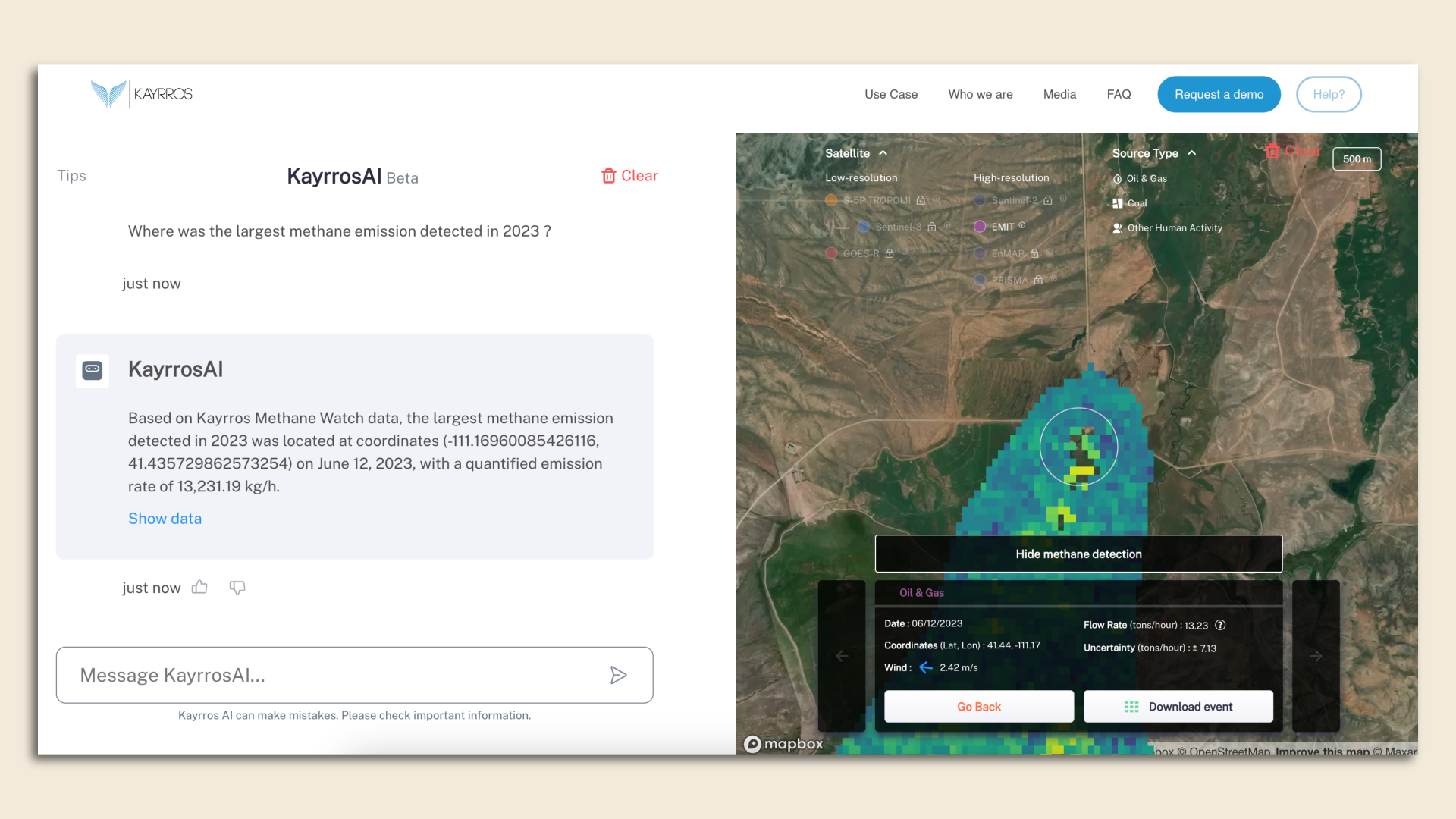
Environmental intelligence firm Kayrros is rolling out a large language model (LLM) to allow the public to pinpoint methane-emitting facilities, the company first told Axios.
Why it matters: The new "methane GPT" allows users to ask plain-language questions and get answers from the company's Methane Watch map for free.
- This may help publicize information about where the powerful global warming gas is coming from and ultimately hold polluters accountable.
Zoom in: According to Kayrros, which tracks global methane emissions, the map provides information for regions down to the facility level, including methane emissions from anywhere in the U.S.
- KayrrosAI is technically a retrieval-augmented generation LLM, able to decipher and generate human language text while accessing satellite data and in-house data insights from the company.
- While methane has a far shorter atmospheric lifetime than carbon dioxide, it's a more powerful warming agent. This makes reducing its emissions crucial to cutting near-term climate change.
Between the lines: Kayrros, aided by public and private satellites, has made tracking global methane emissions a more accurate and widely-accessible task during the past few years.
- The company's data showed how far off course signatories were from achieving the targets set in the Global Methane Pledge in 2021.
- Kayrros is part of a larger-scale proliferation of available data on greenhouse gas emissions with unprecedented precision.
The bottom line: "Public pressure can force governments and large organisations to do what is needed to prevent climate breakdown," Kayrros president Antoine Rostand said in a statement. "That starts with information."
3. 🚘 GM wants to stay nimble in rocky EV landscape


General Motors is selling its stake in a new Michigan battery plant that was built with government incentives.
Why it matters: This move gives GM both financial and technological flexibility as it tries to adjust to a changing EV landscape.
Catch up quick: GM partners with South Korean battery giant LG Energy Solution through a joint venture called Ultium Cells, which currently produces batteries at factories in Warren, Ohio, and Spring Hill, Tenn.
The automaker said yesterday it had reached a deal to sell its ownership stake in a recently built Ultium Cells factory in Lansing, Mich., to LG.
- The project received hundreds of millions of dollars in subsidies from the state of Michigan. The federal government awarded Ultium Cells a $2.5 billion loan to finance construction of its factories, including the Lansing site.
- The plant has not yet begun production.
The intrigue: GM also said yesterday it would expand its 14-year collaboration with LG to include the development of prismatic battery cells, which are flat and rectangular for what the company calls "space-efficient packaging."
Joann Muller contributed
4. 🔦 IEA to spotlight AI and power use
/2024/12/03/1733188342199.gif?w=3840)
The International Energy Agency is stepping up its work on artificial intelligence and the power sector with a two-day, high-level conference this week.
Why it matters: With its growing thirst for electricity, AI's expansion and development have the potential to result in increased greenhouse gas emissions, especially in the short term.
Yes, but: AI can also make the power sector more efficient and end up being a net gain.
Zoom in: One of the hottest topics in the energy world today is how the tech industry and countries more broadly will manage the spike in electricity demand from AI data centers, and do so in the cleanest way possible.
- David Sandalow of Columbia University's Center on Global Energy Policy, who will chair a session at the IEA conference, told Axios that he is bullish on AI turning out to be a net benefit for the power sector.
- This is despite a likely short-term uptick in greenhouse gas emissions as utilities scramble to get more electrons onto the grid to meet AI-related demand increases.
- Sandalow helped lead a hefty report on using AI for climate change mitigation, which was released last month.
The intrigue: "The use of AI is dramatically changing the way the power sector operates," he told Axios, citing advances being made in infrastructure monitoring for maintenance needs, satellite detection and AI-driven analysis of greenhouse gas emissions and other applications.
- "AI has enormous potential to contribute to efforts to reduce greenhouse gas emissions," he said.
- Sandalow cautioned this is not a fait accompli: "It requires sustained attention to make sure we realize that potential."
5. 📊 Shell deal highlights China's LNG thirst
 Open embedded content from datawrapper.dwcdn.net
A new deal between Shell and QatarEnergy signals confidence in China's long-term LNG demand even as its domestic gas production rises.
Why it matters: The contract for three million tons annually for delivery to China starting next year "highlights the continued growth of China's LNG market," QatarEnergy said yesterday.
- China is the world's largest LNG importer.
Go deeper: Reuters has more on the deal.
6. 🧮 Number of the day: $7.5 billion
That's the planned federal loan for a Stellantis-Samsung SDI joint venture to build two EV battery plants in Kokomo, Ind., the Energy Department announced.
Why it matters: DOE's loan office is looking to stake major climate tech projects as the clock ticks down on the Biden era.
- It follows last week's conditional $6.6B loan for EV startup Rivian's Georgia plant.
What we're watching: Whether they'll finalize these two deals by Jan. 20. AP has more on Stellantis-Samsung.
📨 Did a friend, colleague or even a frenemy send you this newsletter? Welcome, please sign up.
🙏 Thanks to Chris Speckhard and Chuck McCutcheon for edits to today's edition, along with the brilliant Axios Visuals team.
Sign up for Axios Generate