New studies paint troubling picture on methane emissions

Add Axios as your preferred source to
see more of our stories on Google.
Illustration: Rae Cook/Axios
Two new reports have bad news on methane emissions in the U.S. and worldwide.
Why it matters: Methane is a powerful planet-warming gas.
- Failure to slash emissions from agriculture, oil production and elsewhere will likely keep Paris Agreement temperature goals out of reach.
Driving the news: Big U.S. oil and gas fields are releasing four times more methane than EPA tallies that are based on industry data indicate, an Environmental Defense Fund analysis claims.
- The findings are based on high-tech aerial surveys in 2023 using a specially equipped airplane.
- It previews what's possible globally with the recently launched MethaneSAT satellite, EDF said.
Meanwhile, a paper in Frontiers in Science finds an "abrupt and rapid increase" in the growth rate of atmospheric methane in the early 2020s.
- It cites two main reasons: higher levels from fossil fuel production and wetlands releasing more in a warming climate.
- Methane, along with CO2, must "drop rapidly" to limit warming to 1.5°C-2°C above preindustrial levels, the paper notes.
- Costs of stemming the gas are low compared to harms from warming, but "legally binding regulations and methane pricing are needed to meet climate goals," it argues.
Zoom in: EDF finds oil and gas companies' methane "intensity" — the amount escaping per unit of energy produced — far exceeds industry goals.
- The aggregate "loss rate" in the 12 U.S. oil and gas basins EDF surveyed is 1.6%.
- EDF notes that's far above the target of 0.2% in 2030 adopted by the Oil & Gas Decarbonization Charter launched at last year's UN climate talks.
- An older industry group, the Oil and Gas Climate Initiative, adopted the same goal several years ago.
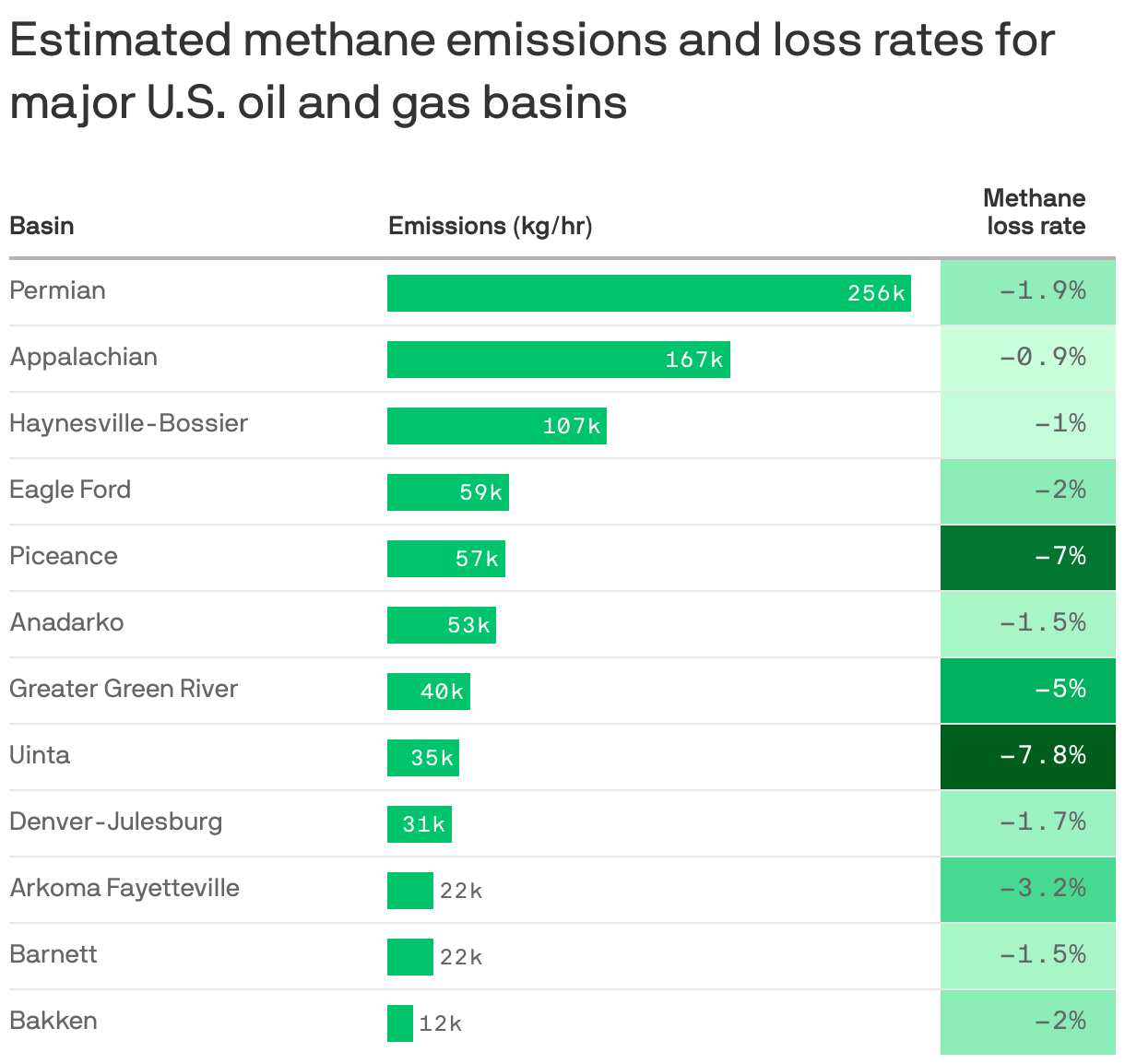
This chart ☝️ summarizes findings from the EDF analysis of major basins in the lower 48 states.
The Permian, by far the country's largest oilfield, has the highest absolute emissions.
Yes, but: Amounts escaping per unit of energy produced is a trickier story.
- "Gas-dominant" basins with high well-site productivity have comparatively low rates.
- Areas heavy on oil production are higher. This could stem from losses of "associated" gas, "possibly due to inefficient flaring and/or insufficient gas gathering or takeaway capacity."
Friction point: While measurements are improving, there are varying — and hotly debated — estimates of industry emissions.
- "We look forward to reviewing the [EDF] report," EPA told Axios.
- The American Petroleum Institute said its members are reducing emissions. It cited research showing substantial cuts from 2015-2022.
- "We can build on this progress through a sound EPA reporting framework, effective federal regulations and the deployment of advanced detection technologies," VP of upstream policy Holly Hopkins said in a statement.
What we're watching: The effectiveness of U.S. policy and global climate talks.
- EPA issued regulations in late 2023 to cut oil industry emissions, while the 2022 climate law also has methane provisions.
- The 2021 UN climate summit brought a multinational pledge to slash methane emissions by 30% by 2030.
