Developed countries agree at COP29 to pay at least $300 billion a year

Add Axios as your preferred source to
see more of our stories on Google.
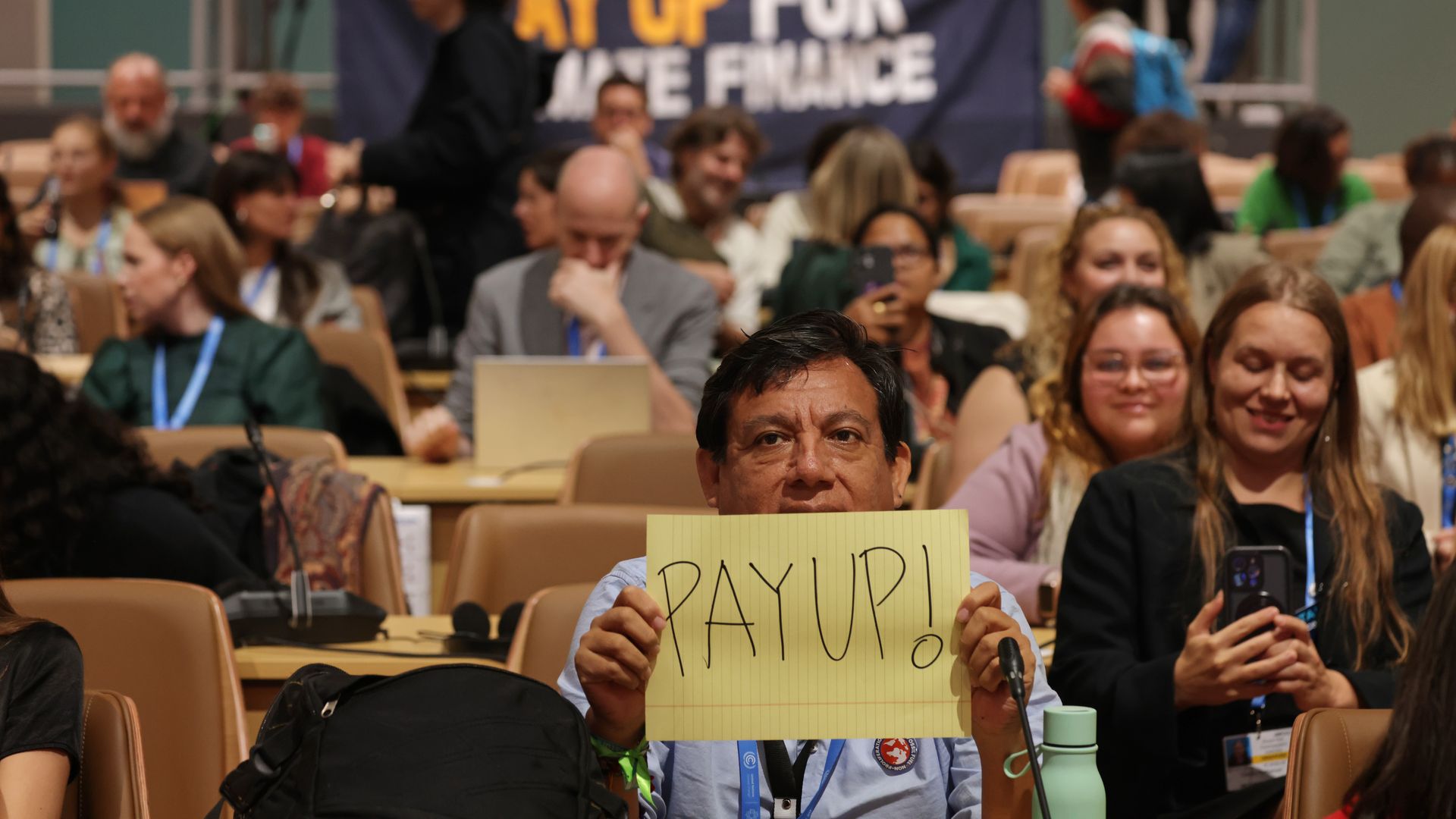
Activists, including one holding a piece of paper with "Pay Up!" written on it, attend the COP29 climate summit in Baku, Ajerbaijan. Photo: Sean Gallup/Getty Images
Nations agreed to a new deal Saturday that has developed countries "taking the lead" in providing up to $300 billion per year by 2035 to help vulnerable ones withstand climate change impacts and decarbonize.
Why it matters: The pact, struck at the COP29 climate summit in Baku, Azerbaijan, provides a boost from a prior goal of $100 billion per year by 2020, and allows for China and other developing nations to contribute.
- The deliberations — which produced an agreement deep into overtime — spotlighted deep divisions between many developing countries and the industrialized world.
Zoom in: The agreement's targets, which are voluntary, provide far less funding than what developing countries had been seeking, and what research shows will be needed for climate resilience and decarbonization.
- The agreement calls for climate finance to increase to a total of up to $1.3 trillion per year by 2035, with developed nations such as the U.S. and EU going first in raising at least $300 billion.
- Developed countries produced the most planet-warming greenhouse gases from a historical perspective.
- The $300 billion could include funds from a variety of sources, including multilateral development banks and private companies, rather than consisting exclusively of money from public coffers.
Importantly, the deal also "encourages" other nations to contribute — a nod to China's role as the largest current emitter of greenhouse gases along with its already stepped-up climate aid to other developing nations.
Between the lines: The impending pullout of the U.S. from the Paris Agreement under President-elect Trump complicated the process of agreeing to a new financial goal and may have limited the agreed-upon package.
- Yet it may have also lended some urgency to reaching the new goal while the U.S., under President Joe Biden, is still at the table.
- Also adding urgency: that this is virtually certain to be the world's hottest year on record.
Friction point: The types of climate finance to be included in the deal was a source of contention into the late hours of Saturday in Baku, as the summit — due to end on Friday — stretched more than a day into overtime.
- Many of these countries are already heavily burdened by debt from previous development assistance, and were seeking mainly grant-based money that would not have to be paid back.
- The talks were arduous, with blocs of least-developed countries and small island developing nations suspending participation at one point on Saturday morning out of frustration that their concerns weren't being heard and reflected in the text.
- These countries, such as the Marshall Islands, are on the front lines of climate change, and had sought a higher funding target and earmarking of a share of funds to their nations.
"I am not exaggerating when I say our islands are sinking! How can you expect us to go back to the women, men, and children of our countries with a poor deal which will surely plunge them into further peril?" said Alliance of Small Island States chair Cedric Schuster of Samoa in a statement.
The intrigue: The bloc of least developed countries and small island developing states secured language in the final text that establishes a process, known as the Baku to Belém Roadmap, to boost climate finance towards the $1.3 trillion target.
- This would prioritize grant-based or concessional funding, and would yield a report at COP30 in Brazil on scaling up climate finance.
- The final text also contains other references to the need to direct funds to the least developed countries and small island developing states.
- Another significant outcome, which may be overlooked by the finance fight, were the provisions needed to begin operationalizing new international carbon markets, which could raise billions in carbon credits.
Context: Like all final decisions at such climate confabs, the deal required unanimous support to be adopted.
- An initial text containing a target of $250 billion per year from industrialized nations was roundly rejected as insufficient, with developing nations seeking twice that amount as a minimum.
Flashback: The previous target of $100 billion per year was proposed in 2009 but not met until 2022, two years after the deadline, engendering deep mistrust among developing countries about climate finance.
What they're saying: Representatives of many developing countries criticized the new agreement as inadequate soon after it was passed.
- Some later characterized it as a compromise.
- "We are leaving with a small portion of the funding climate-vulnerable countries urgently need," said Tina Stege, Marshall Islands climate envoy. "It isn't nearly enough, but it's a start."
The bottom line: The COP process is ailing, but still ticking.
