Climate change is increasing hurricane wind speeds, study finds

Add Axios as your preferred source to
see more of our stories on Google.
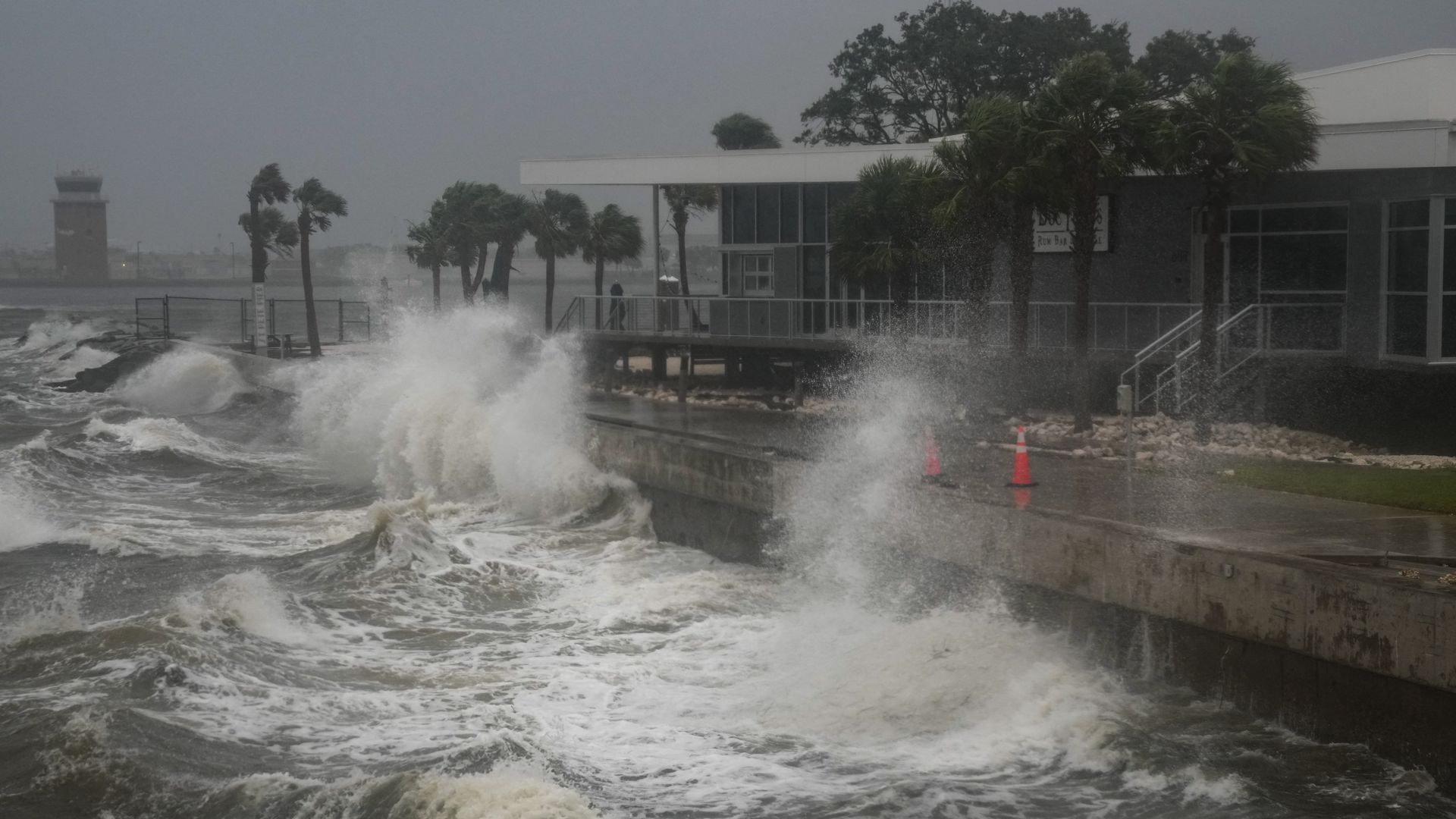
Waves crash along St. Pete Pier in St. Petersburg, Fla, as Hurricane Milton approached on Oct. 9. Photo: Bryan R. Smith/AFP via Getty Images)
Climate change strengthened the maximum wind speeds of Atlantic hurricanes by an average of 18 mph during the past five years, a new study published Wednesday shows.
Why it matters: The study is among the first to show a link between hotter ocean temperatures and stronger hurricane wind speeds. It ties climate change to a hurricane's destructive potential.
- Previous research mainly focused on how climate change is causing hurricanes to produce more precipitation and alter their movement in some areas.
Zoom in: A storm can cause far more damage with each successive category it achieves on the Saffir-Simpson Hurricane Wind Scale, as the scale isn't linear but rather logarithmic.
- The research, led by Daniel Gilford of the nonprofit research group Climate Central, found that 30 hurricanes in the study reached intensities that were about one category higher than they otherwise would have been.
- The study found three hurricanes that reached Category 5 intensity largely because of climate change: Hurricane Lorenzo in 2019, Ian in 2022 and Lee in 2023.
- According to the National Oceanic and Atmospheric Administration (NOAA), a storm's destructive power increases to the eighth power with each storm category increase.
For example, a hurricane that reaches high-end Category 2 intensity, with maximum sustained winds of 110 mph, would have a damage potential that is 21 times greater than that of a 75 mph Category 1 storm, according to NOAA.
The intrigue: In addition to the peer-reviewed study published in the journal, Environmental Letters: Climate, an accompanying analysis using the same methods found that climate change boosted the maximum sustained winds of the 11 hurricanes that formed this season, when compared to the preindustrial climate.
- The increase in maximum wind speed this season was between 9 and 28 mph.
- This included the devastating Hurricanes Helene and Milton, which saw an increase in their maximum intensities by 16 mph and 23 mph, respectively.
- The new research offers a framework, similar to a scientific blueprint, for similar future studies of individual hurricanes or hurricane seasons, to better communicate how global warming is raising risks.
What they're saying: "Every hurricane in 2024 was stronger than it would have been 100 years ago," Gilford said in a statement.
- Friederike Otto, a climate scientist at Imperial College in London, said during a media call Tuesday: "We've known for a long time that we will see more intense hurricanes if we continue to burn fossil fuels."
- "But now we can actually, we see it, and we can quantify it and we have confidence in the numbers," said Otto, who heads the World Weather Attribution project.
Between the lines: The study relies on attribution research that has shown how human emissions of greenhouse gases, such as carbon dioxide and methane, from using fossil fuels are increasing sea surface temperatures.
- It in turn ties the hotter ocean temperatures to a storm's maximum potential intensity, which is the peak strength for a hurricane in a particular location given various environmental factors.
- Using observations and computer modeling, the researchers calculated each storm's attributable intensity, which is how much of a storm's change in intensity is found to stem from increasing ocean temperatures.
- The study found that 84% of the hurricanes that formed during the five-year period studied had significantly higher intensities from ocean temperatures that increased since 1900.
Yes, but: Meteorologist Kerry Emanuel, who invented the metric of maximum potential intensity and has studied it intensively, told Axios he would be more hesitant to attribute so much of the temperature increase in the North Atlantic Basin to human-driven climate change.
- He noted, as the study does, that other factors at work on a regional level — such as declining air pollution from North America — may be partly or largely to blame for the trends found.
- In an email to Axios, he cautioned against pinning most of the explanation on increasing greenhouse gases, saying they "may have played a minor role."
The bottom line: As the climate continues to warm, hurricanes may continue to become stronger and more destructive.
