Axios Generate

January 24, 2025

🕺 Friday, we're in love with you. The last edition in a wild week is 1,296 words, 5 minutes.
🎸 This week in 1973 the genre-bending rockers Little Feat released the album "Dixie Chicken," which provides today's intro tune...
1 big thing: Making sense of January's wild weather
January's icy weather demonstrates the differences between regional weather and climate conditions.
Why it matters: The former is governed by disturbances in the jet stream and other factors, while the latter is more driven by influences such as human emissions of greenhouse gases.
Driving the news: January has been cold, if not downright frigid, across much of the Lower 48 states.
- A polar vortex-linked Arctic blast has engulfed much of the country, while a series of deadly extreme weather events have struck.
Zoom in: The most unusually cold air on the planet has been parked over the Lower 48 states this week, leading to a deadly, record snowstorm along the Gulf Coast.
- Ten to 12 inches of snow fell in southern Louisiana, while all-time record snowfall also occurred in Mobile, Ala., and Pensacola, Fla.
- The cold spilled so far south that the snow that fell in New Orleans' French Quarter was light and fluffy, and prone to drifting. In short, an alien phenomenon for that location.
- Typically during Arctic outbreaks, the Gulf Coast stays dry or receives a wintry mix. But this time, a storm formed along a frontal zone and tapped into unusually warm Gulf of Mexico waters.
- The comparatively warm and humid air was vaulted northward, where it overran the cold, dry and dense air, producing snow.
In other words, the same factor — unusually hot seas that helped lead to rapidly intensifying Gulf hurricanes last year — also helped produce record snows from Texas to the Carolinas.
The intrigue: January has also brought climate-linked disasters that have played out in the West, with the deadly LA-area wildfires.
- They began in early January amid abundant dry vegetation from what scientists refer to as hydroclimate whiplash, as two extremely wet winters were followed by record warmth and dry conditions last summer into this winter.
- Factors apart from climate — such as development patterns — have also played an important role in these blazes.
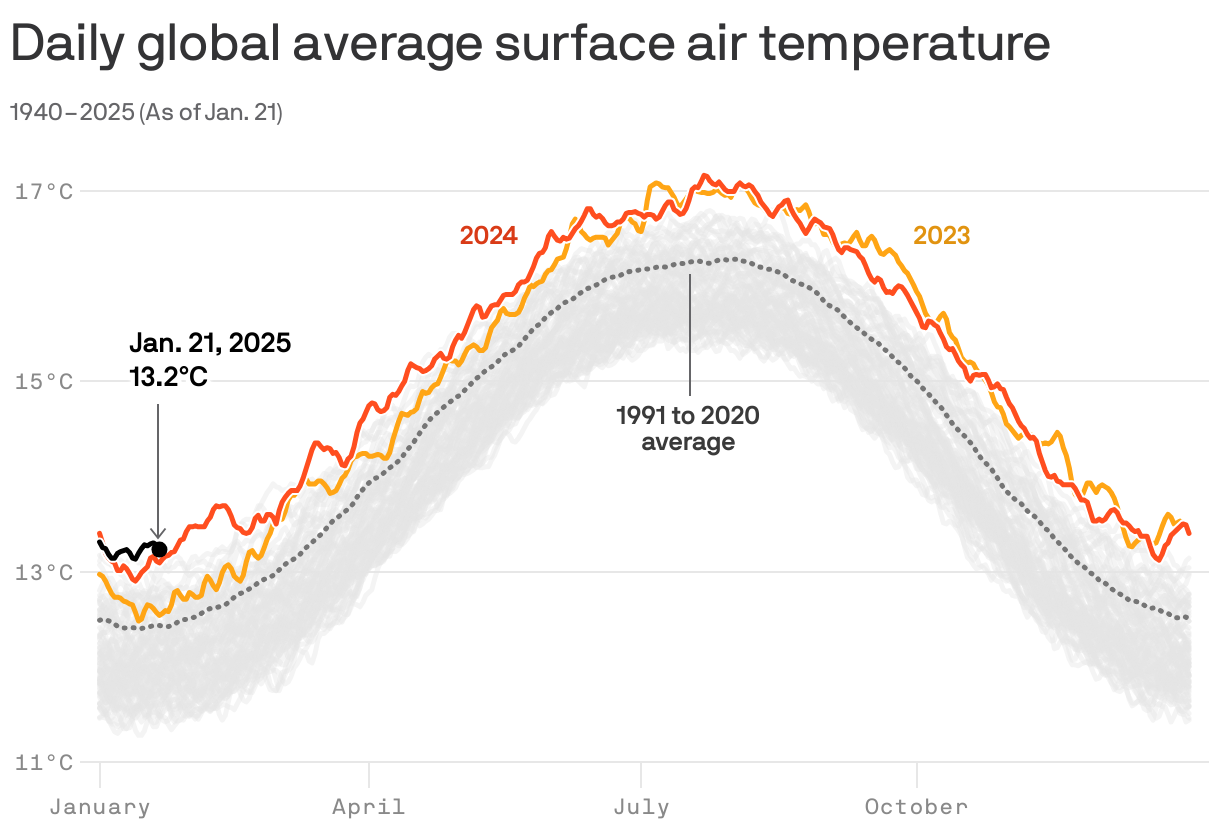
Zoom out: Following the hottest year on record in 2024, daily global average surface temperatures have been at or near record levels throughout the month.
- This is in keeping with the trend of record warmth seen during the period from 2023 onwards.
- What's unusual about the global warmth since late 2024 is that it's unfolding while the tropical Pacific Ocean has been exhibiting signs of a La Niña. (La Niña officially arrived on Jan. 9.)
- These natural climate events tend to damper global average surface temperatures, but this cooling effect may be becoming less effective over time as the planet warms more significantly and rapidly.
The bottom line: Just because it's freezing — and maybe even extremely snowy — where you are does not mean that it's unusually cold worldwide.
2. 🖥️ Trump looks to bypass grids on data center power
President Trump said his energy "emergency" can help build power plants that directly fuel AI data centers instead of connecting to regional grids.
Why it matters: His comments add detail to what remain vague "emergency" plans — and could boost a business line Exxon and Chevron are exploring.
📻 Driving the news: Trump said yesterday that data centers will "have their own electric generating facilities attached."
- "They don't have to worry about a utility, they don't have to worry about anything, and we're going to get very rapid approvals," he said in video remarks to the World Economic Forum in Davos.
"They can fuel it with anything they want. And they may have coal as a backup, good clean coal," Trump said of the most CO2-emitting fuel.
💬 What they're saying: Morgan Stanley analysts, in a note, predict Trump's separate order on "unleashing" U.S. energy is bullish for "behind the meter" gas and nuclear plants.
🏈 State of play: Tech firms are looking at various sources, including renewables and storage, gas, reviving large nuclear plants, and small modular reactors.
- Late last year Exxon said it's well into engineering and design of a gas plant — with CO2 capture potential — that could directly power data centers.
- Chevron is looking at building behind-the-meter gas for data centers, too.
- SMR startups including X-energy and Kairos Power have struck agreements with tech giants.
🔭 What we're watching: What Trump's comments mean on the ground for the burgeoning "bring your own power," or BYOP, push around AI infrastructure.
3. 🍰 Bonus Trump energy notes: Oil dissonance, wind, IRA
🛢️Trump's vow to Davos that he'll ask Saudi Arabia and OPEC to lower oil prices probably helped push crude lower in trading yesterday.
- Our thought bubble: The twin goals of lower energy prices and surging U.S. production are among the internal tensions in his policy.
- The intrigue: New analysis via Columbia University's energy think tank explores why tariffs on Canada could raise pump prices and electricity bills in some regions.
🔍 One fluid story we'll keep tracking is the amount of peril that Trump's anti-wind exec order creates for onshore projects.
- State of play: One view, spelled out in a BloombergNEF analysis, is very limited jeopardy because the vast majority of onshore projects aren't on federal lands.
- Yes, but: Heatmap explores how plans on non-federal lands could be threatened amid the need for FAA sign-offs, and other federal agency overlap.
- What we're watching: Capital Alpha Partners says another hurdle could be transmission that crosses federal lands. "[T]he impact of the federal pause on wind-related actions could be much wider than on federal lands only," they write.
👀 Conservative Climate Caucus leaders are pushing to save a handful of IRA tax credits from repeal, Axios Pro: Energy Policy's Daniel Moore reports.
- Why it matters: The House GOP majority is razor-thin, so any defections from plans to pare back the 2022 climate law are consequential.
- State of play: Leaders of the 81-member group want to keep subsidies for carbon storage, critical minerals production, tech-neutral power credits and more.
4. 🛡️The pushback against Trump's Paris U-turn
Bloomberg CEO and philanthropist Michael Bloomberg will help fund the UN's top climate office in the wake of the U.S. pullout from the Paris Agreement.
Why it matters: As the planet's second-biggest emitter, America's disengagement complicates the world's already faltering efforts to limit global warming to the Paris targets.
Zoom in: When President Trump announced the Paris pullout on Inauguration Day, he issued an executive order that went a few steps further.
- Trump also canceled the U.S. commitment to contribute millions in international aid to help other countries adapt to climate change and cut their emissions.
- In addition, he began the process of cutting off funds to the office that coordinates UN climate summits and houses the top UN climate official, Simon Stiell.
Flashback: Bloomberg Philanthropies took a similar step when Trump pulled out of Paris during his first term, spending about $21 million to support that office and other UN climate activities between 2017 and 2021.
Zoom out: Bloomberg is also involved with the "America Is All In" coalition, which seeks to work with states, cities and regional governments to cut emissions, regardless of what the federal government is doing.
What we're watching: How much such organizations can accomplish given the Trump administration's pro-fossil fuel policies.
5. 🛢️Saudi royals — they're just like us!
Texas Monthly has a smart, substantive profile of oil titan Scott Sheffield and the FTC's accusations of collusion with OPEC.
Oh, and this nugget is delightful, picking up with Sheffield's communication with Saudi oil minister Abdulaziz bin Salman ...
- On a couple of occasions, bin Salman exchanged direct messages with Sheffield. In December 2022, the Saudi minister saw an online headline referencing an interview Sheffield gave to the Financial Times in which Sheffield had pushed back on White House claims that oil operators were profiteering from high prices. "Can you send the article?" bin Salman asked, since it was behind a paywall. (This raises the question of why one of the wealthiest men in the world was apparently unwilling to pay for a newspaper subscription, which may not bode well for the future of journalism.)
📨 Did a friend, colleague or even a frenemy send you this newsletter? Welcome, please sign up.
🙏 Thanks to Chris Speckhard and Chuck McCutcheon for edits to today's edition, along with the brilliant Axios Visuals team.
Sign up for Axios Generate


/2025/01/23/1737663243817.gif?w=3840)