Why scientists say hottest recorded year shouldn't be ignored

Add Axios as your preferred source to
see more of our stories on Google.
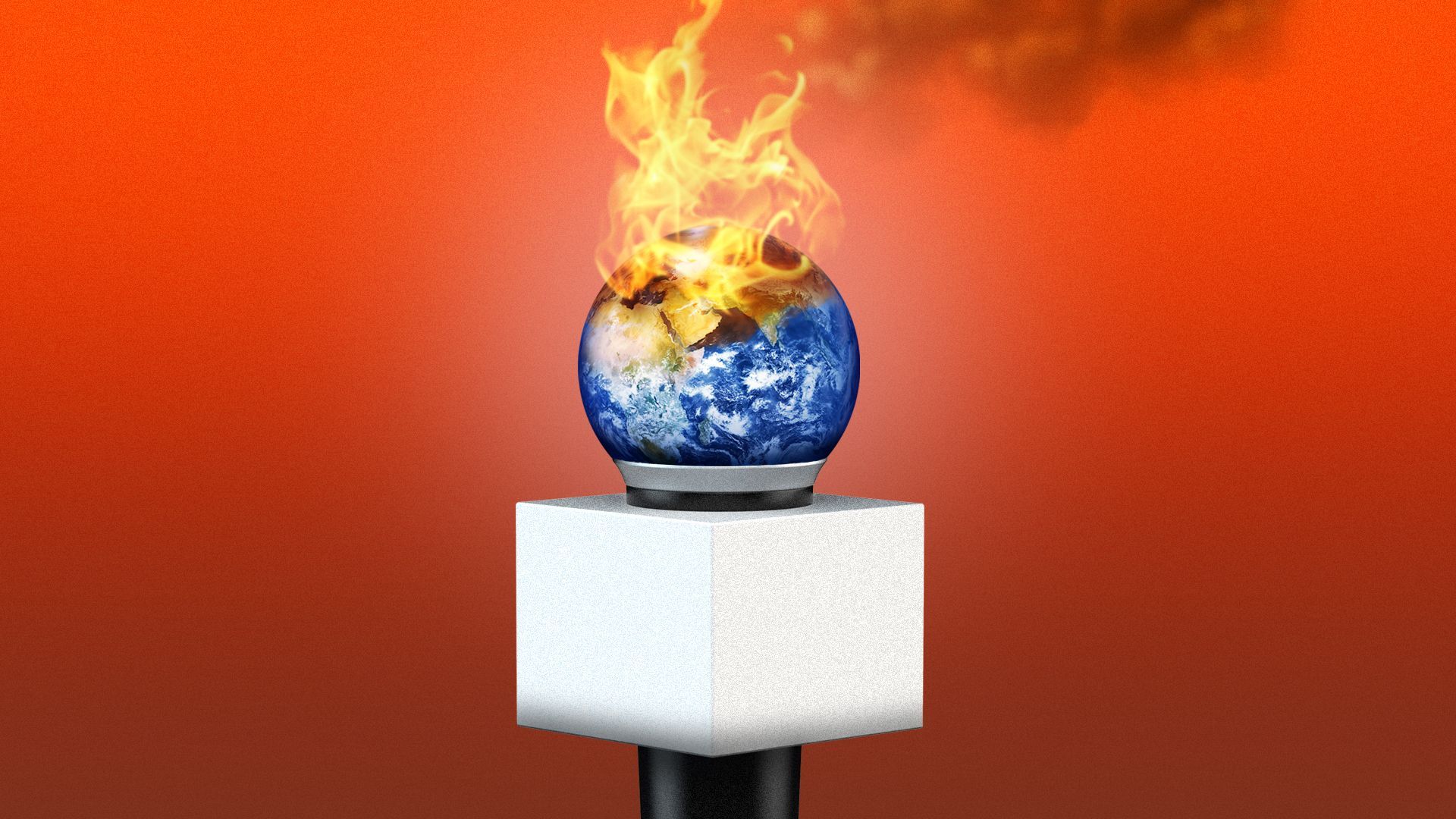
Illustration: Sarah Grillo/Axios
Official word will arrive later this week that Earth recorded the hottest calendar year in recorded history. And for the fifth time this decade, journalists will try to convey the significance of a milestone that's become routine and predictable.
Why it matters: This year's record stands out from the pack in that it wasn't expected. That's prompted climate scientists to launch multiple studies investigating what led to the record heat.
- Still, one hottest year after the next is a climate communications conundrum.
- To put it simply: It's about as far from a "stop the presses" moment as one can get in climate news.
Zoom in: Don't take my word for it. Andrew Dessler, a climate researcher at Texas A&M University, has a form email that he replies to reporters with when he gets inquiries for comment on a hottest annual temperature record.
- "Thank you for emailing me asking for a comment about 20__ being one of the hottest years in the record," it states. "No, this is not surprising — it is exactly in line with predictions."
- The email goes on to note: "Every year for the rest of your life will be one of the hottest in the record."
Between the lines: Dessler elaborated in an email to Axios, and his point is backed up by peer-reviewed research on how people process a rapidly shifting temperature baseline.
- "People have no real understanding of how hot it's gotten because people's memories of weather are very short-term," he said. "I firmly believe that if you took someone from the 1970s and beamed them forward in time to today, they would be shocked at how hot it is."
Yes, but: Zeke Hausfather, climate research lead at Stripe, said 2024's record-breaking temperatures raise the question of "whether the era of rapid global warming that started in the 1970s is now speeding up."
- Some prominent climate researchers think the answer is yes.
- In addition, he said 2024 will be a less routine global record announcement because the majority of temperature datasets will likely show for the first time that the planet exceeded 1.5°C compared to preindustrial levels.
- "While a single year above 1.5°C does not mean that the world has passed that target," he told Axios via email, "it is certainly a sign that we are getting worryingly close."
The intrigue: The speed of climate change is critical for determining the impacts to human society and natural systems alike.
- Right now, the climate is warming at rates never before experienced in human history, and long before that.
- Paleoclimate records from tree rings, ice cores and other sources show the potential for climate change tripwires to be crossed that would further speed up warming and potentially cause catastrophic impacts, such as the collapse of the West Antarctic Ice Sheet.
What they're saying: The prospect of crossing such thresholds as well as simply continuing the present-day, high rate of warming is concerning, says Andrew Pershing of the climate science research group Climate Central.
- "My big frustration is the focus on the temperature," Pershing said regarding the hottest year announcements.
- "The big challenge is how quickly the temperatures are changing. If global temperatures leveled off, we could adjust, but it is a huge challenge that global temperatures and all that goes along with them — more extreme floods and drought, more powerful storms, more intense heat waves are moving steadily upward."
Zoom out: Bernadette Woods Placky, chief meteorologist at Climate Central, tells Axios that despite the difficulties of communicating each record hot year, "it's important."
- "It's important because warming is the foundation for all of the changes we are experiencing," she said, citing, "more devastating weather, melting ice and rising oceans, worsening air quality and other health risks," and more.
The bottom line: While hottest-year records are a dime a dozen these days, 2024's is actually even more foreboding than one might expect.
