Axios Generate

March 28, 2025

🕺Made it! Friday. We're closing the week with an action-packed but quick 1,345 words, 5 minutes.
🚨Situational awareness: The Metals Company is seeking federal permits from Trump officials for commercial deep-sea mineral extraction in international waters.
- Why it matters: It's asking in the absence of delayed rules from the International Seabed Authority for activities many scientists fear could damage ocean ecosystems. Bloomberg has more.
📻 Young Gun Silver Fox, a Ben favorite, dropped the new single from their forthcoming album, and it's today's intro tune...
1 big thing: Don't expect a Russian gas revival in Europe
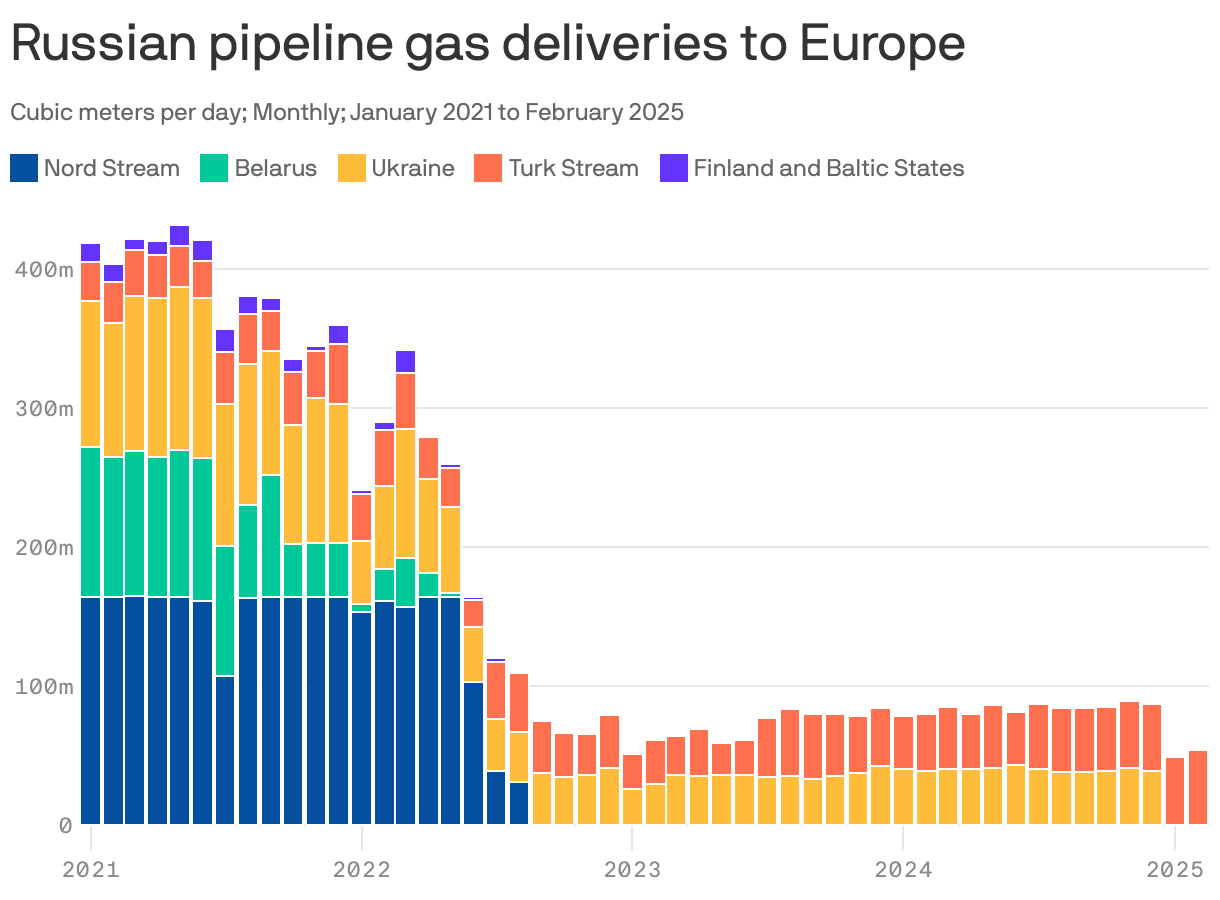
Despite lots of recent chatter, there are strong reasons not to expect a rebound of Russian pipelined gas to Europe, a new analysis argues.
Why it matters: Russia was long Europe's dominant supplier, and the breakup is the starkest example of the war on Ukraine reshaping global energy flows.
- But cease-fire discussions and high European gas prices have prompted discussion of revival.
- Most recently, Russian foreign minister Sergei Lavrov floated the idea this week in an interview with state media.
Yes, but: A near-term rebound is unlikely, writes Jack Sharples, a researcher with the Oxford Institute for Energy Studies. Some reasons include:
- Damage to the Nord Stream pipeline system in 2022 sabotage and Germany's refusal to sign off on Nord Stream 2. TurkStream is the only major pipeline still supplying Europe, and Sharples notes that it's at capacity.
- The more recent end of transit through Ukraine that "will not restart in the absence of a durable and lasting political settlement."
- Expiration of some long-term contracts with Gazprom and disputes over others, and a "wave" of LNG coming to market in 2025-2030.
The big picture: While Russian LNG shipments have risen, overall EU dependence on the Kremlin is a small fraction of prewar levels.
- Russia provided 14% of EU gas use last year, per the climate think tank Ember that's urging more use of renewables and storage.
Catch up quick: Top EU officials vow not to again become dependent on Russia, which once provided roughly half the bloc's gas.
- Higher LNG imports from the U.S. and elsewhere, substitute fuels and more have filled much of the gap, albeit precariously.
- But some European politicians and industries say avoiding Russia must be weighed against high prices sapping industrial competitiveness.
The bottom line: Who knows if pipeline volumes could again grow, but it looks quite unlikely that Europe will ever again be highly Kremlin-reliant.
- "For Gazprom, even if it does achieve a partial rebound, by the time it does so it will face a much more competitive European gas market than the one from which it withdrew in 2022-2024," Sharples writes.
2. ☂️ NOAA moves to fold Climate Prediction Center into larger entity
The National Oceanic and Atmospheric Administration is moving the Climate Prediction Center underneath a larger entity, known as the Weather Prediction Center, according to an email viewed by Axios.
Why it matters: The move was partly motivated by a desire to protect CPC, which because of its name is considered vulnerable to the Trump administration's budget ax, according to NOAA sources who spoke on condition of anonymity.
- Other federal agencies have ended funding for climate studies and taken climate change-related datasets offline based on President Trump's executive orders.
The intrigue: The email, sent yesterday morning, indicates that CPC will remain an independent center for a time during the merger period.
- Despite its name, CPC is responsible for monitoring and producing El Niño and La Niña outlooks, along with seasonal forecasts and other products.
- The work that CPC does is valuable to industry, the U.S. government and other countries because it can provide early warning of major shifts in weather patterns.
It doesn't monitor human-caused climate change or project the future climate beyond seasonal timescales.
- That work is left to other parts of NOAA, such as the National Centers for Environmental Information in Asheville, N.C.
- On that front, NOAA has taken steps to reduce the publicity around such work, pausing monthly global climate monitoring media calls and renaming monthly reports, for example.
NOAA didn't respond to a request for comment.
Zoom out: During the merger process, the director of the Weather Prediction Center, which issues short-to-medium range national forecasts, will also be the director of CPC, the email states.
3. 🍰 Bonus policy notes: EPA, DOJ, SEC
📧 EPA has opened an email line for companies seeking presidential exemptions from hazardous air pollution rules, calling it part of plans to "Power the Great American Comeback."
- How it works: The Clean Air Act allows exemptions when tech to meet standards isn't available or it's in U.S. security interests.
- Yes, but: Environmentalists say the request for emails shows Trump 2.0 officials will rubber-stamp requests to pollute.
👮 The Justice Department said it's creating a task force to "advocate for the elimination of anticompetitive state and federal laws and regulations" — including ones that undermine energy reliability and affordability.
⚖️ The SEC's GOP majority made it official, voting 2-1 to abandon its legal defense of Biden-era corporate climate disclosure rules. Go deeper.
4. Arctic winter sea ice sets a record low
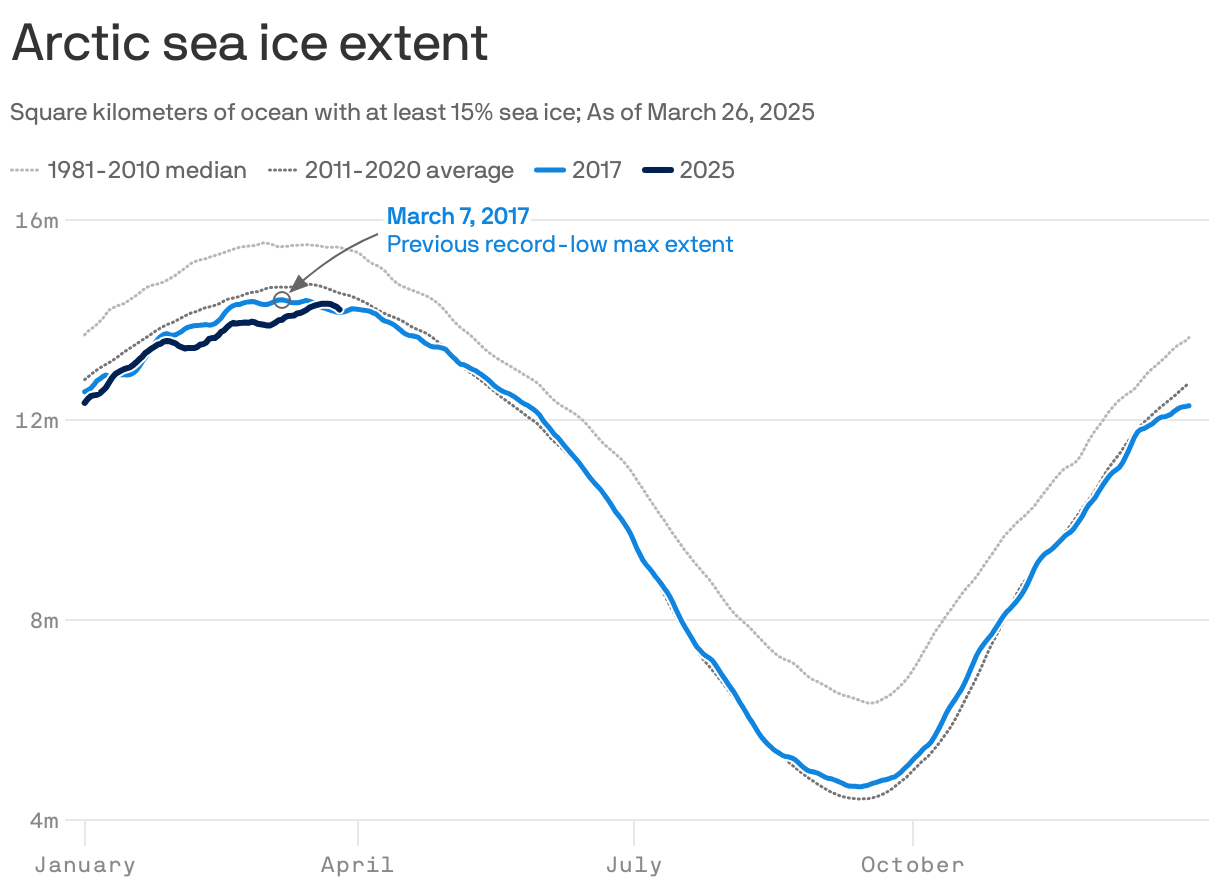
Arctic sea ice likely hit its lowest peak winter extent on record in the satellite era, according to the National Snow and Ice Data Center in Boulder, Colo.
Why it matters: The low winter extent sets the ice cover up for a potentially record-breaking summer melt. It is also a sign of human-caused, rapid Arctic climate change.
Zoom in: According to the NSIDC, the annual sea ice maximum occurred on March 22, and at 5.53 million square miles, came in 31,000 square miles below the previous record set in 2017.
- This is roughly equivalent to missing a chunk of sea ice the size of Maine.
- Much of the Arctic had below-average sea ice extent this winter season.
- The Gulf of St. Lawrence remained virtually ice-free, and temperatures across the Arctic were about 2°F to 4°F above average during the season.
The Arctic has been warming at about three times the rate of the global average.
Zoom out: The melting sea ice and warming has been opening up the Arctic to more shipping and military competition between Russia, the U.S. and China.
- Vice President J.D. Vance is slated to visit Pittufik Space Base in northwestern Greenland today, as the Trump administration makes its expansionist ambitions in the region clear.
What we're watching: Whether the low winter ice peak leads to a record low summer minimum.
5. 🪫 Battery energy storage safe despite fires, report says

Big fires at battery energy storage systems have drawn headlines and stirred controversy, but a new American Clean Power Association-commissioned report says the technology shouldn't be seen as unsafe.
Why it matters: The battery energy storage market has been growing rapidly and is expected to more than double in size by 2030.
Driving the news: The report released today — prepared for ACP by the Fire & Risk Alliance engineering consulting firm — examined 35 large-scale battery storage fires between 2012 and 2024.
- Many "involved early-generation systems that predate modern safety standards," the report said.
- It also said fears of widespread contamination have been unsubstantiated, with airborne emissions being "short-lived and localized" and that risks of water contamination "are minimal."
Along with the historical assessment, ACP released a national blueprint for battery storage safety.
- It makes recommendations for cities and states to regulate storage, enforce safety standards and ensure collaboration.
Zoom in: The report mentions the January blaze at the 300-MW first phase of Vistra's Moss Landing energy storage facility near Santa Cruz, Calif.
- That incident has led to lawsuits and spurred some communities to enact moratoriums on utility-scale energy storage development.
- The report said the environmental impact of that blaze "is being monitored closely."
6. 💵 A $23 billion new fund and more finance notes
🆕 Investing heavyweight EQT today announced the $23 billion close of its Infrastructure VI fund.
- Why it matters: Focus areas include energy generation and distribution, decarbonization, and electrification of industries and transport, it said. Dow Jones has more.
✅ Shell, TotalEnergies and Equinor will together invest $715 million to expand their joint Northern Lights CO2 transport and storage service.
- Why it matters: Northern Lights managing director Tim Heijn called it "the next step in building a commercially viable CCS market in Europe."
- State of play: The project provides infrastructure to third parties for moving CO2 and storage off Norway's coast. The first phase is slated to begin operations this year.
- What's next: Yesterday's phase 2 announcement follows a deal with Stockholm Exergi to store up to 900,000 metric tons annually. The JV says phase 2 will ultimately have at least 5 million metric tons of annual capacity.
7. ✈️ Number of the day: 0.3%
That's sustainable aviation fuels' share of global jet fuel production in 2024, per a Boston Consulting Group report using airline industry data.
What we're watching: The analysis offers supply- and demand-side strategies to help push SAFs into the marketplace. Check it out.
📧 Did a friend, colleague or an AI chatbot send you this newsletter? Welcome, please sign up.
🙏 Thanks to Chris Speckhard and Chuck McCutcheon for edits to today's edition, along with the brilliant Axios Visuals team.


/2025/03/27/1743106855139.gif?w=3840)